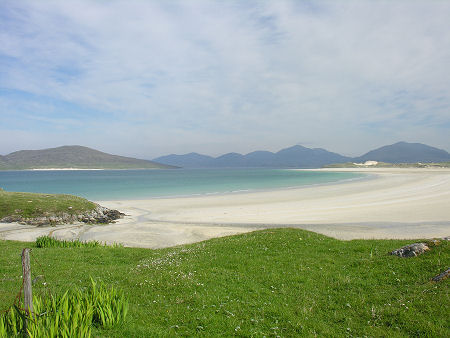
 Luskentyre Beach, Harris |
Scotland is a nation of over five million people occupying the northern third of the island of Great Britain, which lies off the north-west coast of mainland Europe. Anyone planning a visit has a number of choices: road, rail, sea and air, though which is likely to be best for you depends very much on where you are coming from.
Scotland is easily reached from England. The border between the two runs for 96km or 60ml north-east from the head of the Solway Firth a little north of Carlisle, to the North Sea north of Berwick-upon-Tweed. The border is wholly open and free from any formalities: you just cross it at will, like you would cross a county boundary in England.
If you are driving to Scotland from England, you have two main options, and a couple of minor ones. The first main option is to go up the east coast using the A1 from Newcastle to Edinburgh. This isn't the shortest route, but it can be the simplest, and the most relaxing, if you are heading for eastern Scotland. The second main option is to go up the west coast, passing Carlisle on the M6 before crossing the Scottish border onto the M74, which then heads north-west to Glasgow. This is the most direct route to western and much of central Scotland.
The two less commonly used alternatives are for those with more time on their hands, and for those who don't want to completely miss all that southern Scotland has to offer. On the eastern side, one alternative is to turn off the A1 south of Newcastle, at Darlington, onto the A68, and proceed relatively directly but relatively slowly north-west to Edinburgh. On the west side an option is to turn off the M6 just north of Carlisle, and head directly but, again, at a fairly leisurely pace, north up the length of the A7 to Edinburgh. Our tables of Distances by Road, both within Scotland and between selected English and Scottish cities, can be seen here.
You don't have to be a driver to reach Scotland by road. Various operators, especially Scottish Citylink and National Express, run coach services linking a number of English cities with their Scottish counterparts. These are often quite cheap compared with the equivalent train fares.
As far as railway services are concerned, there are two main options. The East Coast Main Line, which approaches the Scottish border from London via Peterborough, Doncaster, York, Newcastle and Berwick goes on to Edinburgh, with some trains carrying on to Glasgow, Inverness or Aberdeen. This line is also used by cross-country trains starting in south-west England and coming up through Birmingham and York. The second option is the West Coast Main Line, which passed through Birmingham, Crewe and Preston en route to the Scottish Border from London, before continuing to Glasgow. Finally, there are sleeper services from London to six Scottish destinations.
The remaining option if you are travelling from England is to fly to Scotland and this is obviously also an option for travellers coming from further afield, as Scotland's airports have direct connections with over 100 international destinations, right across Europe and as far afield as the Middle East, North Africa, the United States and Canada.
Glasgow Airport, a little to the west of Glasgow, offers a number of long haul international flights, as well as services to Ireland and many European destinations. Edinburgh Airport, just to the west of Edinburgh, is now Scotland's busiest airport, offering a wide range of European flights plus a few to the USA. Aberdeen Airport can be reached from many European destinations. Meanwhile, Glasgow Prestwick airport, on the coast just north of Ayr, is the main Scottish destination for a number of low-cost airlines. Finally, Inverness Airport offers direct links with Dublin and Amsterdam, and with a number of English airports.
Scotland can also be reached by ferry, though not nearly as easily as used to be the case. The ferry service linking Rosyth in Fife and Zeebrugge ceased operation at the end of 2010. Meanwhile, DFDS runs a daily service linking Newcastle and Amsterdam. The service they used to run linking Newcastle and Norway no longer operates. Daily links with mainland Europe are also provided by P&O North Sea Ferries between Hull in East Yorkshire and both Rotterdam and Zeebrugge. There are, of course, many more ferry links between southern England and mainland Europe. Until 2007 Smyril Line ferries linked Lerwick in Shetland with Denmark, Norway, Iceland and the Faroe Islands, and they also used to provide a service from Scrabster near Thurso. They no longer do so.
The ferry links between Scotland and Northern Ireland are provided by P&O European Ferries and Stena, who both sail to Northern Ireland from Cairnryan. A catermaran service to Troon ended in 2016. For a time a direct ferry link operated between Ballycastle in Northern Ireland and Campbeltown in Kintyre, but it no longer does so.