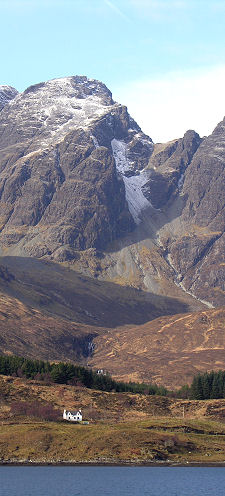
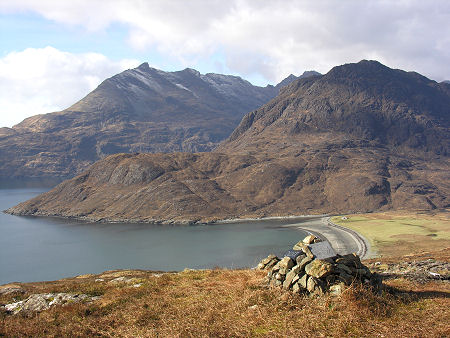
 The Ridge of the Black Cuiliin on Skye |
The Munros are distinct Scottish mountains over 3,000ft (914.4m) in height. They are named after Sir Hugh Munro a Scottish laird, politician, diplomat and a founding member of the Scottish Mountaineering Club. In September 1891 he published his "Tables giving all the Scottish mountains exceeding 3,000 feet in height", more usually known simply as "Munro's Tables".
Odd though it seems, until 1891, there had been considerable disagreement about the number of mountains over 3,000ft in Scotland. One well respected guide for the Victorian traveller listed just 31, while the 3rd Edition of Robert Hall's "The Highland Sportsman and Tourist" published in 1884 and making use of mapping information newly published by the Ordnance Survey, listed 236.
The tables published by Munro in 1891 were partly the result of the more accurate Ordnance Survey mapping already used by Hall, and partly the result of his own observations made during climbs of many of the mountains. The first edition of Munro's Tables listed 538 tops over 3,000ft, of which 283 were considered by him to be separate mountains, and soon became known as "Munros". Rather unhelpfully, Munro did not set out a clear definition of how a top qualified to be considered a separate mountain, and later efforts to work back from his conclusions to his reasoning suggest that he never tried to apply an objective definition, instead apparently deciding that if it looked and felt like a separate mountain, then it was. It may well be that this was because Munro did not care greatly about the difference: his own interest was primarily in climbing all 538 tops, including the Munros. He fell fractionally short, climbing 535 of them by the time of his death in 1919.
But while it may not have mattered greatly to Munro, this lack of clarity has been the cause of intense - almost theological - debate ever since. Munro himself was working on a revision of his tables at the time of his death in 1919 which would have changed the numbers of Munros and tops, and since his death the tables have been revised on a number of occasions by the Scottish Mountaineering Club. The most recent change took place in 1997, when more accurate altitude measurements and a shifting consensus of the distinction between what was properly a Munro and what was properly a top were applied. The result was an increase in the number of Munros from 277 to 284, and the 1997 Edition of the tables also listed a further 227 tops over 3,000ft, making 511 tops in all.
For a while it seemed likely that advances in measurement techniques might also lead to the promotion to Munro status of two mountains previously thought to be fractionally under 3,000ft in height. But in June 2007 it was announced that Foinaven in Sutherland fell short of the magic 3,000ft by 12ft, and in September 2007 it emerged that the second possibility, Beinn Dearg in Torridon, failed to qualify by an even narrower margin, when it turned out to be 2,997.58ft high.
In 2009 several mountains known to be close to the 3,000ft figure were resurveyed. On 10 September 2009 it was announced that Sgùrr nan Ceannaichean, south of Glen Carron, had a height of 2,997ft (913.43m) and no longer qualified for Munro status. In a 2011 survey, Beinn a' Chlaidheimh was found to be 2,998ft 8in (914 m) high. In the 2012 revision of the tables these two mountains were removed and the result was to give 282 Munros and 227 further subsidiary tops, making 509 tops in all.
We've already seen that Sir Hugh Munro didn't quite succeed in climbing all 538 of his tops, and neither was he the first to climb all the Munros, as the three tops he was missing when he died included two Munros. The honour of being the first to climb all the Munros fell to the Reverend Archibald E. Robertson when he reached the summit of his 283rd and final Munro, Meall Dearg in Glen Coe, on 28 September 1901. Well, it was probably his 283rd, because later analysis of his diaries have led some to question whether he ever climbed Ben Wyvis, having been forced to turn back from it during one of his early climbs. As a perfectionist (and a church minister) it seems almost certain that he did, even if the record of the event has not survived. Either way, Robertson has gone down in history as the first person to successfully complete a full round of the Munros.
Or should that be "compleat"? The Scottish Mountaineering Club have traditionally referred to rounds of Munros being "compleated" and those who have climbed all the Munros as "compleatists". Some feel that this deliberate anachronism is a little pretentious: but on the other hand, we are dealing here with a feat that is exclusively measured in anachronistic units (climbing mountains measured in feet rather than metres), so why not?
The Reverend Robertson remained the only person to have compleated a round of Munros for 22 years, when he was joined on the list of compleatists in 1923 by the Reverend A.R.G. Burn. They were joined in 1927 by J.A. Parker, in 1930 by J.R. Corbett (the man who gave his name to Corbetts), and in 1933 by J. Dow. By the outbreak of war in 1939, a total of nine people had compleated the Munros. By 1960 this total had risen to 40. And in late 2007, the list of compleatists stood on the verge of its 4,000th member.
Another word about terminology here may be helpful. Many refer to the Reverend Robertson as "the first Munroist", and define a Munroist as someone who has compleated a full round of Munros. Others, however, describe those in the process of collecting Munros as "Munroists": something which has come to the fore in the titles of books like "The Munroist's Log" and "The Munroist's Companion". On the whole it seems better to avoid this ambiguity altogether by referring to those who have compleated a round as compleatists, and those in the process of doing so as Munro-baggers.
And, finally, what about all those people already on the SMC list of compleatists when the number of Munros was increased from 277 to 284 in 1997? Not to worry: what matters is the list contained in the current edition of Munro's Tables at the time you climb your final Munro. Those no longer able to climb the "missing" 8 when the list was changed in 1997 are still regarded as having compleated the Munros (the additional number is 8, not 7, because one mountain previously considered to be a Munro was demoted in the 1997 tables). Though, arguably, the change did give people already on the list the chance to compleat for a second time simply by climbing the eight new Munros: and of course the changes in 2012 further complicate matters!