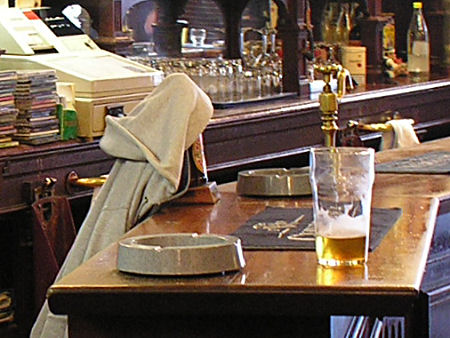
 Consigned to History: Ashtrays in a Scottish Pub |
Since 26 March 2006, smoking in all enclosed public spaces in Scotland has been prohibited. The legislation was intended to be wide in its coverage, and includes all enclosed spaces except private homes, and except specially designated smoking rooms which some accommodation providers have chosen to make available. The prohibition on smoking in Scotland also includes all forms of public transport, and any vehicle used for work unless it is a private car. Under a separate piece of legislation it became illegal in Scotland (and in England an Wales) for anyone under 18 to purchase tobacco or cigarettes from 1 October 2007 (the age had previously been 16). Since late 2016 it has been illegal to smoke in a car in which chidren aged under 18 are travelling.
For the purposes of the 2006 legislation, an "enclosed space" is one which is roofed and which is less than 50% open when you add together the areas of the front, back and sides of the space. By this measure most bus shelters are considered to be "enclosed public spaces", and as a result most carry the "no smoking" signs that are now on show wherever you go in Scotland. Anyone smoking in an enclosed public space can be fined, and the operator of premises on which smoking takes place can also face a fine.
In the run-up to the introduction of the smoking ban, there was a lot of discussion in Scotland about how effective it would be, and whether its impact would be positive or negative. In practice it proved almost 100% effective from day one. This seems to have been less because of the formal penalties laid down by the law, and more because most Scots, including virtually all of the non-smoking majority and, more surprisingly, many of the smoking minority, felt the ban to be a good thing and have actively supported it.
Since the ban was introduced there have been a number of studies into its impact. These suggest that the health of Scots as a whole has already improved to a measurable degree, with an especially positive effect on bar workers. One study showed that the presence in the blood of primary school children of by-products of nicotine, present because of passive smoking, had reduced by 39% since the smoking ban. On the other hand, there have also been claims that some traditional pubs reliant primarily on beer sales have seen their takings fall: but this has to be balanced by studies that report a considerably higher proportion of people who say they have visited pubs more often rather than less often since the ban.
From a visitor's point of view the ban means, if you are a smoker, being very careful about where you light up. And it also means checking to see whether designated smoking rooms are available when booking accommodation: you need to remember that accommodation providers are not required to provide designated smoking rooms, and smoking in a bedroom not especially designate is illegal. But for the non-smoking majority the smoking ban means you can go into pubs and restaurants without emerging stinking of other people's cigarette smoke and feeling the immediate need to wash all your clothes and your hair. Overall, the ban has made Scotland a considerably better place, both for visitors and residents alike.
There is one area in which the legislation in Scotland could and should be improved. Many inns and hotels allow smoking immediately outside the premises, or have external seating for drinking or dining at which smoking is permitted. A serious adverse effect of this is that it is too often impossible to open upper floor guest room windows in inns and hotels without having to suffer the smoke produced by the smokers below.