 The Stone's Enclosure in Perth Museum |
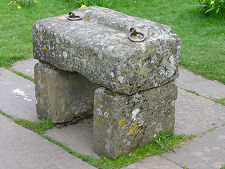
The Stone of Scone, also known as the Stone of Destiny, is seen as of huge significance to Scotland's nationhood. It was the seat on which generations of Kings of Scotland, and Kings of Dalriada before them, were crowned.
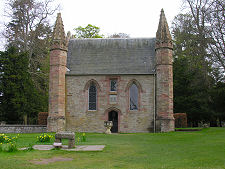
Until 1296 it was housed at Scone Abbey, where the coronations of Kings of Scotland took place: the last being of John Balliol. But Edward I of England stripped Scotland of all emblems of nationhood in 1296, and took the Stone of Destiny to a new home in Westminster Abbey. For the next 700 years it was to be housed in a specially-built coronation chair, on which Kings and Queens of England, then of Britain, were crowned.
The legend of the Stone of Destiny goes back to the foundation myth of Scotland. In about 1400BC, an Egyptian Pharaoh had a daughter called Scota, who married Goídel Glas. They were exiled from Egypt and eventuallty settled in north-west Spain. Their descendents later conquered Ireland and became the Scotii, who also in time came to rule Scotland.
When the descendents of Scota arrived in Scotland, the story continues, they brought with them a block of sandstone weighing 152kg. This had been used as a pillow by Jacob when he had the dream reported in Genesis about Jacob's Ladder. The Stone of Destiny, as it became known, was first located at Dunadd during the time of Dalriada, before being moved to Scone by King Kenneth I.
Until Christmas Day, 1950, the Stone of Destiny remained where it had been placed by Edward I, in Westminster Abbey. Four students from Glasgow University broke into Westminster Abbey in the early hours of the morning and removed the stone, accidentally breaking it in two as they did so. The stone was subsequently repaired by a Glasgow stonemason before being hidden in a tractor repair shed a Firemore, north of Inverasdale in Wester Ross.
But it was becoming clear that public opinion in Scotland was not as overwhelmingly in favour of the removal of the Stone of Destiny as the students had hoped. So on 11 April 1951 the Stone of Destiny was left, covered in a Saltire, at the altar in the ruins of Arbroath Abbey. It was returned to a repaired Coronation Chair in good time for the Coronation of Queen Elizabeth II in 1953.
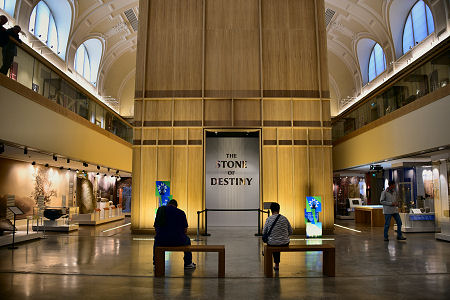
On 15 November 1996, as a result of an initiative by the UK Prime Minister John Major, the Stone of Destiny returned to Scotland once more, this time under military escort as it crossed the River Tweed at Coldstream. It took up residence initially alongside the Honours of Scotland in Edinburgh Castle, and more recently has found a permanent home in Perth Museum. It will return temporarily to Westminster Abbey when needed for coronations, most recently for that of Charles III.
Rumours persist about the Stone of Destiny. Some say that monks at Scone Abbey switched the stone and that what Edward I took to England was not the real Stone of Destiny. Others claim that those who removed the stone on Christmas Day 1950 then switched it, and that what was returned on April 1951 was not the original: which was instead hidden in a peat bank in Wester Ross. As with everything else to do with the Stone of Destiny, the importance of the symbolism surrounding it far outweighs the block of sandstone itself, all 152kg of it.