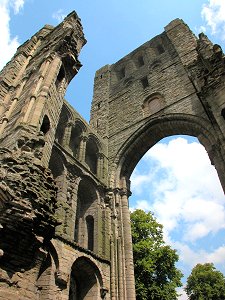
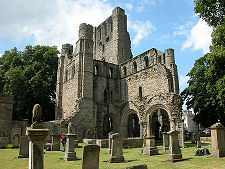
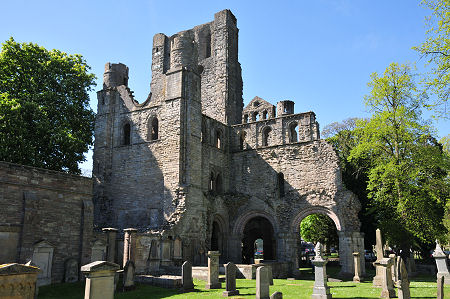
 Kelso Abbey from the South-East |
Kelso Abbey was the grandest of the Border Abbeys founded during the reign of King David I. But being so close to the troubled border with England it saw many armies pass by over the centuries. And the repeated attentions of the Earl of Hertford and Henry VIII's army during the "rough wooing" of the 1540s (see our Historical Timeline) ensured that very little of this once magnificent building survives.
David I founded a Tironensian (or reformed Benedictine) Abbey at Selkirk in 1113 while his father Malcolm III was still on the throne. In 1128 the community moved to Kelso and began work on the abbey whose remains are visible today.
Judging from the different styles on view in the remains, the Abbey Church took over 75 years to build. The best source of information about the finished abbey comes from a description of it in the Vatican archives written in 1517. (Continues below image...)
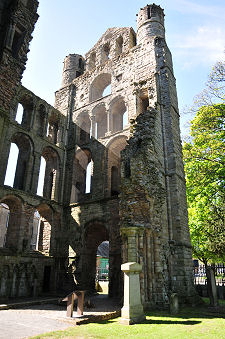
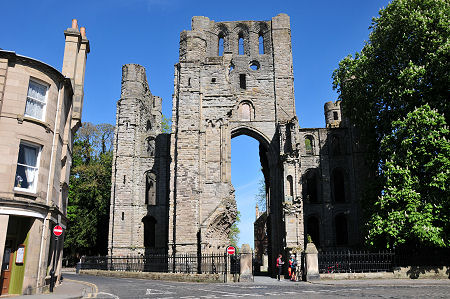 The Abbey Remains from the West |
The church followed the standard pattern of a main structure aligned east-west. The western half formed the nave, used for worship by the townspeople. This was divided from the choir which formed the eastern half, used by the monks.
The "usual" pattern would be to have a crossing where nave and choir met, with transepts either side and a tower above. What made Kelso very different was that the choir and nave each had a set of north and south transepts, and each had a tower over its crossing. The end result would have been a fairly symmetrical Abbey Church with two towers and four transepts, unique in Scotland. Nearby would have been the Abbey's normal ranges of domestic buildings arranged around a cloister.
Kelso Abbey suffered badly in the wars of independence between Scotland and England at the start of the 1300s, but the damage was later repaired. Kelso and the abbey were attacked again in 1523, and there were further attacks by the Duke of Hertford in 1542, 1544 and 1545. During the last of these the English tried with considerable success to destroy the abbey completely. The coming of the Reformation in 1560 meant there was no prospect of it recovering.
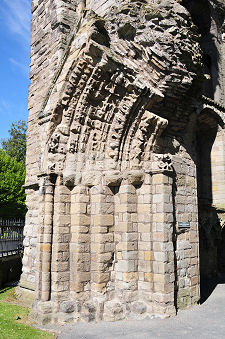
Parts of the structure were restored to become the parish church from 1649 to 1771, but in 1805 most of the ruins were cleared away, leaving just the parts of the west tower and its transepts which you see today. Nearby is a more recent addition, a Memorial Cloister erected to the memory of the 8th Duke of Roxburghe in 1933. This echoes the probable architecture of the cloisters of the original Abbey built 800 years earlier.
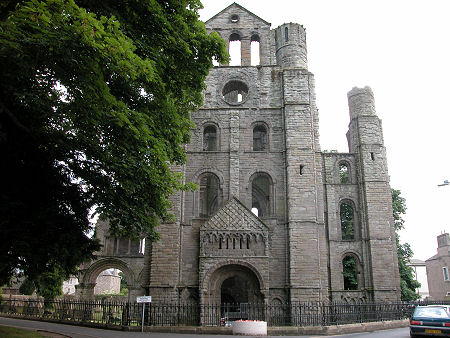 The Abbey from the North |
|
|
|
Visitor Informationwww.historicenvironment.scotHES: Abbey Web Page View Location on Map Grid Ref: NT 728 338 What3Words Location: ///bleaker.trap.dices |
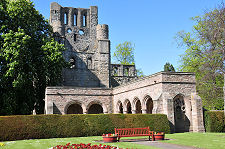 Abbey and Cloister |
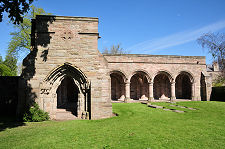 Memorial Cloister |
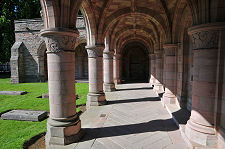 Inside the Cloister |
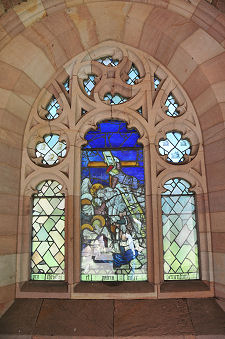 Cloister Window |
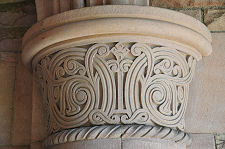 Column Carving |
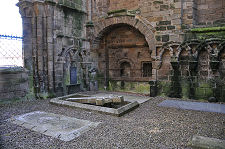
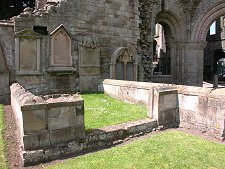 Graves in Chapel |