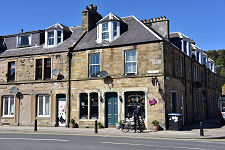
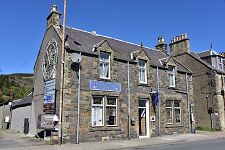
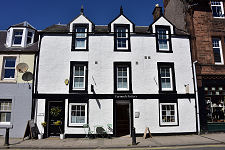
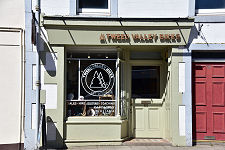
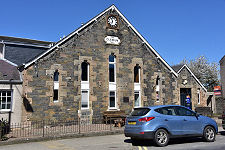
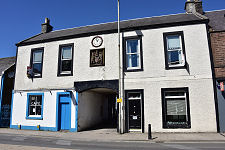
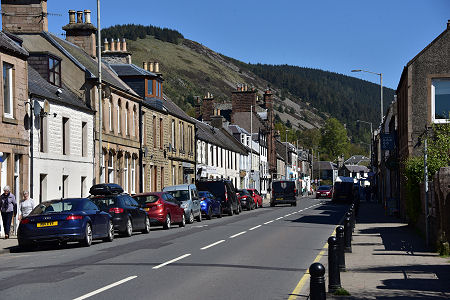
 Innerleithen High Street, Looking North-East |
Innerleithen lies close the north bank of the River Tweed some six miles east of Peebles and ten miles west of Galashiels. It grew initially along the line of the Leithen Water which flows through the town from the Moorfoot Hills to the north before meeting the Tweed nearby. Today it is the eighth largest settlement in the Scottish Borders.
In the 1700s the relatively few people living in Innerleithen made their living by sheep farming or weaving. Everything change in the late 1780s. Alexander Brodie, a native of nearby Traquair, returned to Innerleithen after running a successful blacksmithing business in London. He built Brodie's Mill, a woollen mill that still stands in Damside.
Brodie's aim was primarily to provide work for local people displaced from other work by agricultural improvements, and for 40 years his mill made little money. It did show that textile milling was a practical proposition in Innerleithen, however, and Brodie can be said to have brought the Industrial Revolution to the town. (Continues below images...)
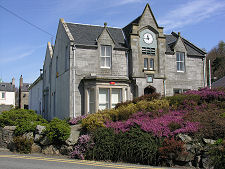
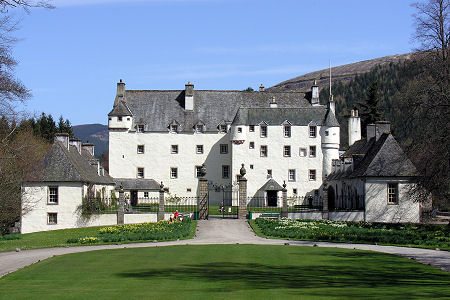 Traquair House |
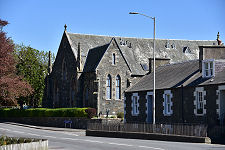
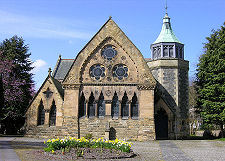
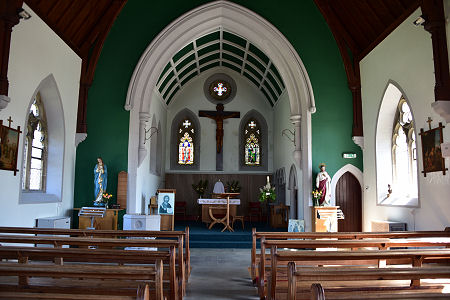 St James's Roman Catholic Church |
Other mills followed and by the end of the 1800s Innerleithen was a thriving mill town, with the industry probably reaching its peak output in the decade to 1910. Since then Innerleithen has shared the story of falling demand and rising competition common to many textile towns in the UK, and in the Scottish Borders in particular. Three of the town's textile mills were demolished during the second half of the 1900s, to be replaced by new housing. The last remaining in operation, clinging to a toehold in the rather precarious cashmere market, closed in 2013.
There was another reason for the growth of Innerleithen during the 1700s and 1800s. Sulphurous springs known as St Ronan's Wells arose on the north side of the town and acquired a reputation for healing those who sampled the water. When Robert Burns visited Innerleithen in May 1787 he described it as a "famous spa". Even better followed in 1827, when Sir Walter Scott published his only contemporary novel, St Ronan’s Well, set in a fictional Borders spa town that many associated with Innerleithen. The resort quickly became popular with affluent members of Edinburgh society who came to enjoy the clean air and, of course, to take the waters.
To entertain the influx of visitors, James Hogg, the Ettrick Shepherd, together with other prominent literary and sporting figures such as Christopher North and Henry Glassford Bell, founded the St. Ronan’s Border Club. One result was the inaugural meeting of St Ronan’s Border Games, held in September 1827.
Innerleithen's success, both as a mill town and as a spa town, increased significantly with the arrival of the railway in 1866. The spa was expanded, with a bottling plant being added in 1890. Today, St Ronan's Wells still exist, though the visitor centre was closed when we last visited.
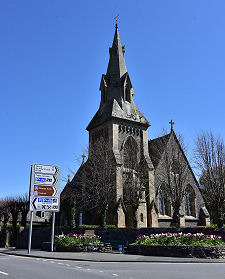
Innerleithen's other main claim to fame remains well worth visiting: a mile to the south lies the superb Traquair House, the oldest continuously inhabited house in Scotland. Also of interest is the presence on Innerleithen's High Street of the oldest working commercial letterpress printers in the UK. Robert Smail’s Printing Works dates back to 1866 and is operated as a visitor attraction by the National Trust for Scotland. The town is also home to several churches, most obviously St James's RC Church at the south-west end of the High Street.
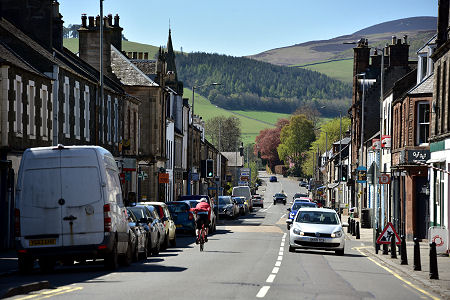 Innerleithen High Street, Looking South-West |
|
|
|
Visitor InformationView Location on MapWhat3Words Location: ///pipe.reactions.refrained |
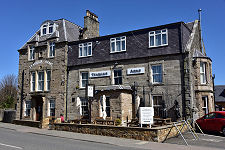 The Traquair Arms |
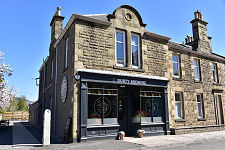 Durty Brewing |
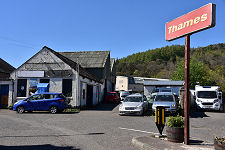 Garage |
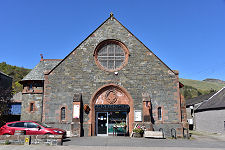 Post Office |
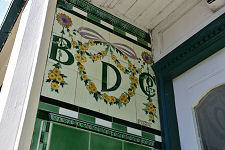 Former Buttercup Dairy Shop |
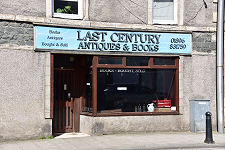 Last Century Antiques & Books |
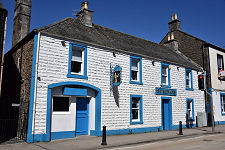 St Ronans |
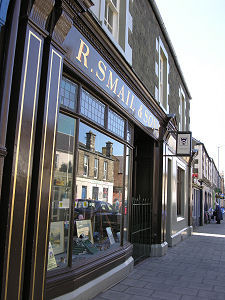 Robert Smail’s Printing Works |
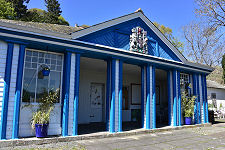 St Ronan's Wells |
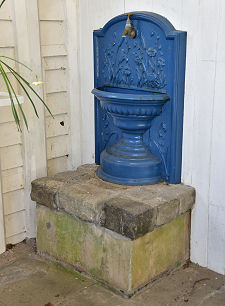 One of the Wells |