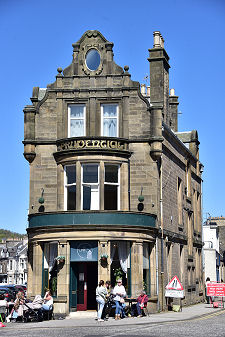
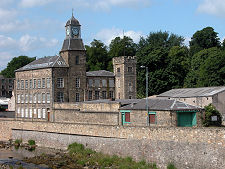
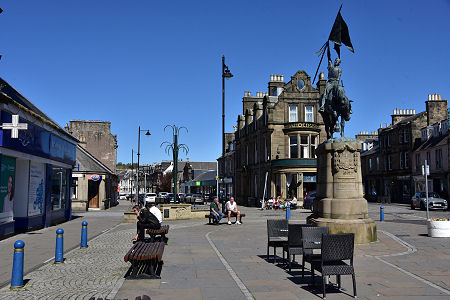
 Oliver Place and The Horse |
Hawick is the largest town in the Scottish Borders and the most urban-feeling of them. One visitor to the town in the 1820s described it as a sort of "Glasgow in miniature", a comparison that today would probably not be appreciated by either. It lies on the River Teviot where it is joined by the Slitrig Water, and the power its rivers provided was central to the growth of the town.
Hawick dates back to a settlement founded by the Angles in the 600s. In the 1100s the Lovells, a Norman family, built a large motte here as the base for their wooden castle. The town later suffered significantly in the cross border wars between England and Scotland in the 1300s, 1400s and 1500s.
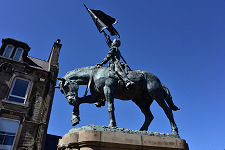
On 9 September 1513, most of the town's men of fighting age were killed at the Battle of Flodden. The following year, the town was threatened by a raiding party of English troops. They were fought off by the boys, or "callants" of the town, who captured the English flag in the process. This event is commemorated by a statue of a horse and rider at the north-east end of the High Street: and by the annual "Common Riding", in which several hundred riders gather to ride around the boundaries of the burgh. This takes place in early June each year. (Continues below images...)
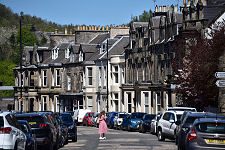
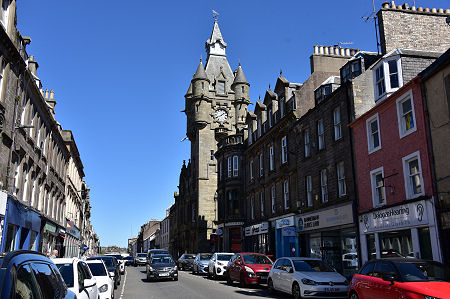 Hawick High Street |
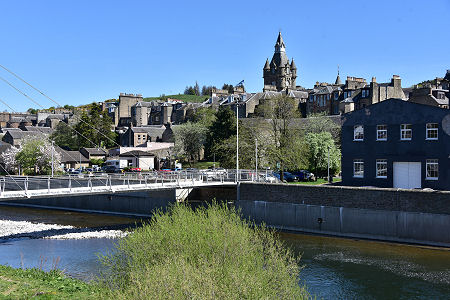 Hawick Seen Across the River Tweed |
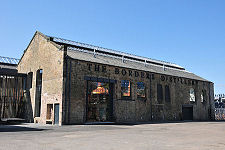
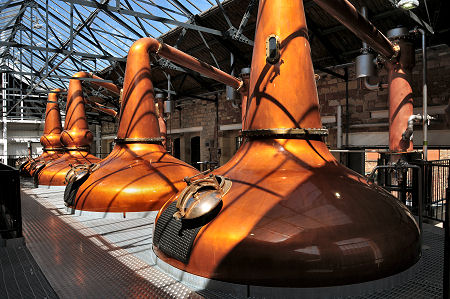 The Distillation Hall at the Borders Distillery |
Hawick's story for the last few hundred years has revolved around textiles. This started with hand knitting of hose (socks) in the 1600s: spun wool and linen was also produced at an early date. In the 1700s hand power was largely replaced by water power and a complex arrangement of sluices and lades was constructed to provide the town's 50 textile mills with enough water to keep them working.
By 1800, up to 3,000 people were employed in Hawick producing hosiery, carpets and other linen and woollen goods. During the second half of the 1800s, steam power began to replace water power and the size and number of mills grew. Amongst those to set up in Hawick during this period were John and Robert Pringle, whose brand Pringle of Scotland is now recognised across the globe: as is that of Lyle & Scott, who appeared on the Hawick scene in 1874. The scale of the industry in Hawick was huge. By 1870 well over a million pounds weight of wool was being turned each year into a range of goods including underwear and socks. Despite the wider decline in the fortunes of the textile industry in the Scottish Borders, it remains an important employer in Hawick.
Supporting the growth of the textile indcustry were improvements made to the road network in the 1700s, and the coming of the railway in the 1800s. The line from Edinburgh reached Hawick in 1849, and in 1862 the link was completed to Carlisle. The railway also helped the development of the second strand of Hawick's economy: its trade in livestock. By 1920 well over a quarter of a million sheep and cattle were sold each year at Hawick's market before being moved on by rail.
Hawick lost its railway in 1969, and the more recently rebuilt Borders Railway only reached as far south as Tweedbank, near Galashiels. Others found more innovative ways of organising their travel to Hawick. In 1785 an Italian called Vincenzo Lunardi made the trip from Glasgow in 2½ hours by hot air balloon.
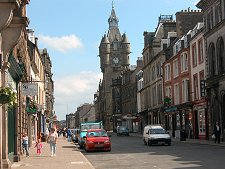
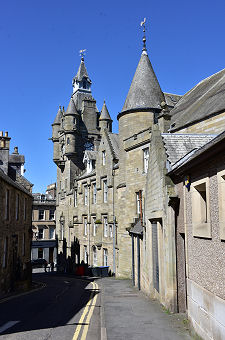
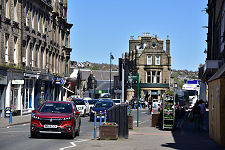
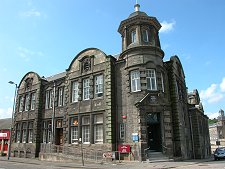
These days, most visitors come to Hawick while travelling along the A7 from Carlisle to Edinburgh, or to take advantage of the deals in the remaining textile factory shops in the town. Given its industrial background, it is easy to approach Hawick with low expectations. The reality turns out to be a very pleasant surprise. What you find is an interesting and attractive town with an imposing High Street, a spectacular Town Hall, and a collection of paths and wynds that more than repay exploration.
In 2018, Hawick also became home to the Borders Distillery, the first (legal) whisky distillery to operate in the Scottish Borders since 1837. According to press reports, the project cost £10m. The result is a superb asset to the area, built with a sense of care, of quality, and of attention to detail that is great to see. It also has the most visiually impressive still room - or distillation hall - that we have ever had the pleasure of visiting and photographing.
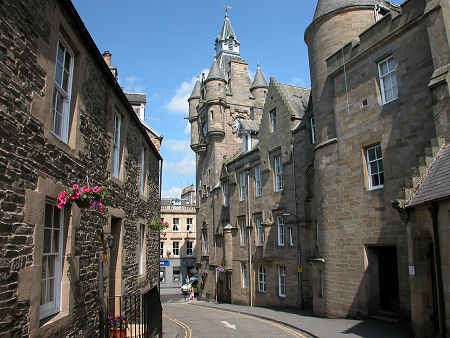 Looking Down Cross Wynd to Hawick Town Hall |
|
|
|
Visitor InformationView Location on MapWhat3Words Location: ///idealist.chest.skillet |
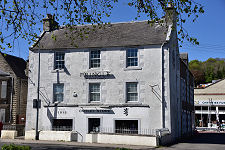 Pringle of Scotland Outlet Store |
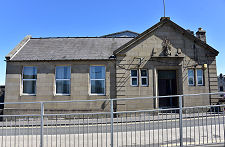 Hawick Burns Club |
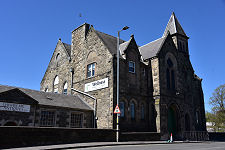 Orrock Hall |
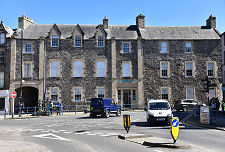 Borders Textile Tower House |
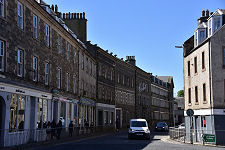 Tower Dykeside |
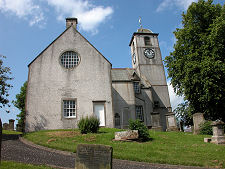 St Mary's Church |
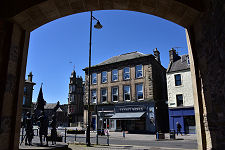 South-West End of High Street |
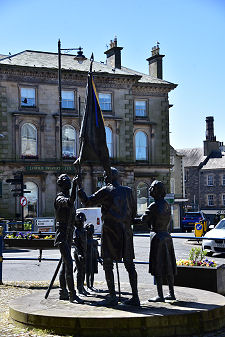 Common Riding Statue |
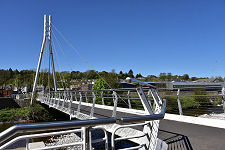 James Thomson Bridgee |
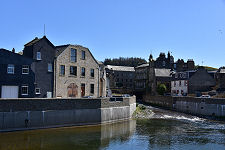 Confluence of the Slitrig Water and the River Tweed |
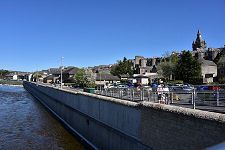 East Side of the River Tweed |
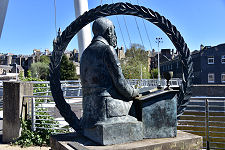 James Thomson Statue & Bridge |
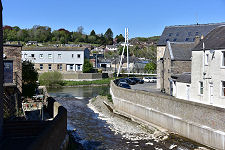 The Slitrig Water |