 St Fittick's Church, and the More Modern Neighbours |
The ruin of St Fittick's Church stands in an unexpected location, in a field just off the minor road linking Nigg Bay with the south shore of Aberdeen Harbour, and running along the eastern side of the settlement of Torry. It is possible to pull off the road onto a verge obviously frequently used for parking up lorries using the docks in Aberdeen, and a gate gives access to the field.
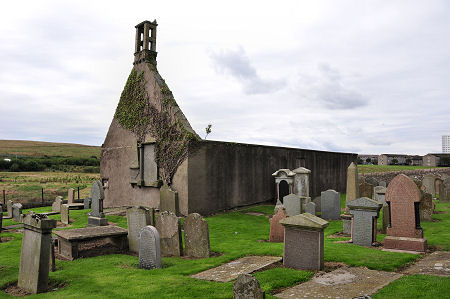
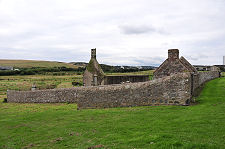
St Fittick's is surrounded by its churchyard, which in turn is surrounded by a substantial stone wall (except on the south side where there is a fence). Access to the churchyard is via a gate in its north-west corner. From here you can look across fields to the edge of Torry, and wonder how different this landscape must have looked when, according to legend, a religious foundation was established here by St Fittick in the mid 600s.
The story is that St Fittick was an Irish monk who was thrown overboard by superstitious sailors when a storm blew up off the coast here. He came ashore at Nigg Bay and established his church to give thanks for his salvation. There's an alternative view that "St Fittick" is actually the result of a confusion between the stories of two other saints, St Fiacre and St Fotin: but we are unlikely ever to know for sure.
Legend became history in the late 1100s (1199 according to some sources), when a chapel was built on the site still occupied by the ruin today, under the auspices of Arbroath Abbey. This chapel was consecrated by the Bishop of St Andrews, Bishop David de Bernham, in 1242, and seems to have gone on to serve the local community until, and for over a century after, the Reformation.
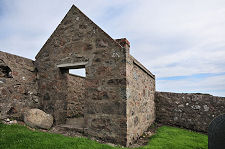
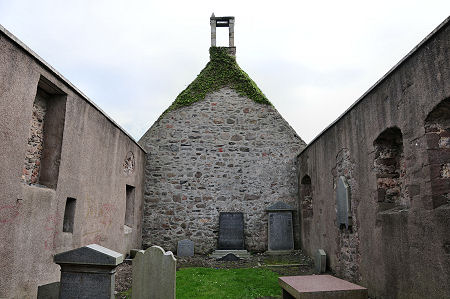
Much of the structure whose remains you can see today seems to date back to the late 1600s and early 1700s, and the bellcote carries the date of 1704. It is thought likely that some masonry from the building erected in the late 1100s may still exist within the later walls, but again it is difficult to know for sure. By the late 1700s, the church would have formed part of a group of buildings with a manse to the east, and outbuildings. The only other structure on the site today is the shell of a watchhouse in the north-east corner of the churchyard, built here, probably in the early 1800s, as protection against bodysnatchers. They were a real threat until the passing of the 1832 Anatomy Act which allowed a legitimate supply of cadavers for medical education and research.
By 1832 the church was already disused, however. The growth of Torry at the beginning of the 1800s meant that a larger and more conveniently located church was needed, and St Fittick's was replaced by Nigg Kirk in 1829. Other churches followed as the population continued to grow, and the name of St Fittick was brought back into use with the building of Torry St Fittick's Church in 1898.
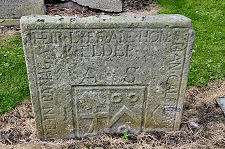
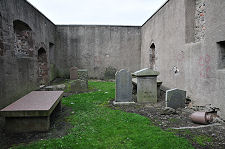
For today's visitor, St Fittick's Church is a fascinating, if not perhaps very attractive, place. The four standing walls have been "consolidated" to the point where the main material on show is concrete (with the exception of the inner face of the east wall. Rather more original are some of the fine collection of early gravestones in the churchyard, with a number dating back to the 1700s and 1600s. Especially interesting are those carrying "mememto mori" or symbols reminding viewers of the inevitability of death.
 The Stone Circle Seen from the West |
|
|
|
Visitor InformationView Location on MapGrid Ref: NJ 963 049 What3Words Location: ///over.levels.cans |
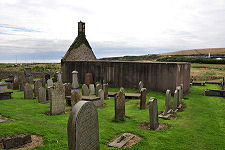 The Church from the North-West |
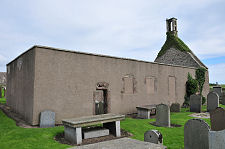 And From the South-West |
 Church and Churchyard |
 Interior, Looking West |