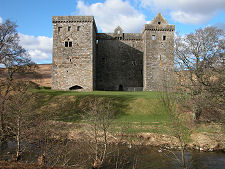
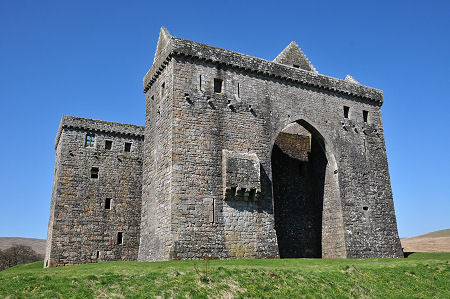
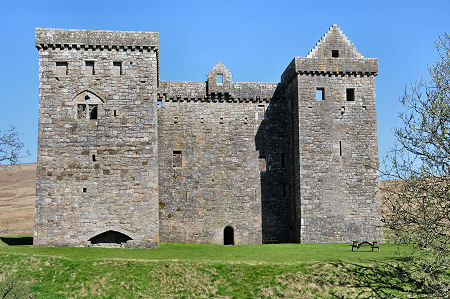
 Hermitage Castle from the South-East |
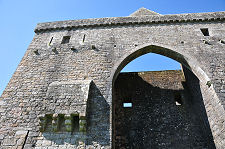
Hermitage Castle is a forbidding and oppressive place. It stands just five miles from the border with England and guards Liddesdale, so for centuries had considerable strategic importance. Seen from the east or west the architecture seems utterly brutal: sheer walls relieved only by blind arches that from some angles can be very reminiscent of Edvard Munch's painting "The Scream". Radio Scotland once broadcast a feature in which Hermitage Castle was described as the embodiment of the phrase "sod off" in stone. It's a difficult description to better.
The castle's unusual architecture is partly responsible for Hermitage Castle's remarkable atmosphere. So is the ballad writer Dr John Leyden, a friend of Sir Walter Scott. He elaborated on Hermitage's pretty unpleasant history, producing tales of myth and magic that have become confused with reality over the years since.
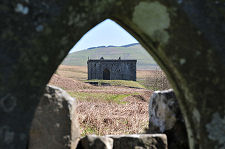
The setting also does the castle few favours. Its riverside location high in the valley of the Hermitage Water ought to be enchanting. But the bleak and open moorland that surrounds Hermitage Castle on its other three sides can seem oppressive.
The origins of Hermitage Castle date back to around 1240, when Nicholas de Soules, butler to the king, settled in the area. He probably initially built a hunting lodge a few hundred yards west of the site of the castle you see today, near the ruins of the Chapel of Hermitage. By 1320, the area was held by William de Soules, a man so widely disliked that there are two quite separate stories told about his demise. In one of them he plotted against Robert the Bruce and was imprisoned in Dumbarton Castle, with Hermitage being forfeited to the Crown. In another more fanciful story, based on a ballad written in the 1700s (which referred to him by the family name "de Soulis"), William de Soules was boiled alive in molten lead by locals after inflicting a reign of terror on the neighbourhood. (Continues below image...)
 Hermitage Castle from the South |
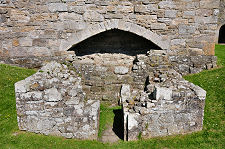
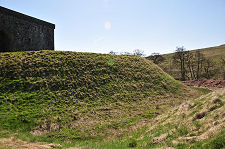
The first castle at Hermitage was probably built in around 1330. Being so close to the border with England, Hermitage Castle changed hands a number of times over the years. The wooden castle probably comprised a strongly-defended motte and a larger bailey. Nothing remains above ground of this first castle, but it is thought that some of its earthworks are still visible today, including ditches that were probably flooded using water re-routed from streams flowing from the high ground to the north.
In 1338 the castle was captured by Sir William Douglas. He was an ambitious man who responded to the appointment by King David II of Alexander Ramsay as Sheriff of Teviotdale by imprisoning Ramsay in Hermitage Castle and starving him to death. In response, David II took the line of least resistance and appointed Sir William to the newly vacant post.
The first stone castle was built at Hermitage in about 1360, for the Cumbrian nobleman Lord Dacre, who had inherited lands in the area by marriage. His castle took the form of a fortified manor house, with two north-south aligned ranges separated by a narrow cobbled courtyard. The courtyard area and the walls facing onto it have survived within the structure you see today, and it is clear that Lord Dacre's castle was extremely well-built, though it may never have been completed.
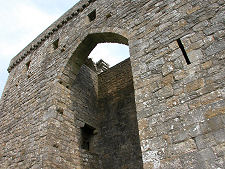
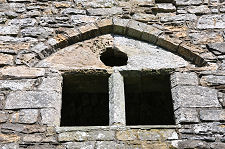
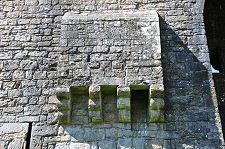
By 1371 Hermitage Castle was in the possession of William, 1st Earl of Douglas. He rebuilt Dacre's castle as a single large keep, retaining parts of the structure, but raising the height considerably and building over the courtyard. It was William's illegitimate son, George, 1st Earl of Angus, who, from 1390, added four great stone towers to the corners of the castle, producing what you see today. The blind arches were added to allow wooden fighting platforms to run the length of the outside of the tops of the walls. The result was definitely a castle built for war rather than for show. With very few windows below the wall tops, and the gaps there obscured by the fighting platforms, the interior of Hermitage Castle must have been an incredibly dark and gloomy place.
In 1492 James IV's doubts about the loyalty of the 5th Earl of Angus led him to instruct that Hermitage Castle be exchanged for the less strategically sensitive Bothwell Castle, until then held by the 1st Earl of Bothwell.
The only hint of romance in Hermitage Castle's story came in October 1566, when it was held by James Hepburn, 4th Earl of Bothwell. He was injured in a fight with border reivers. When news of this came to the ears of Mary Queen of Scots, visiting Jedburgh, 25 miles away, she dropped everything and rode with a small retinue to be by his side.
Still married at the time to Lord Darnley she could not be seen to stay at Hermitage with Bothwell, so after two hours she returned the 25 miles to Jedburgh. En route her horse stumbled into a marsh and Mary contracted a fever from which she nearly died.
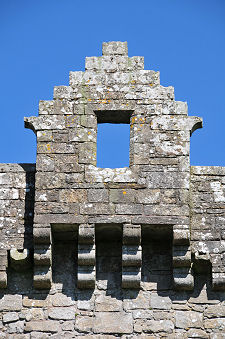
Hermitage Castle fell into disuse in the early 1600s. Its fame as a gloomy and romantic ruin spread through the 1800s: Sir Walter Scott had himself painted with Hermitage in the background. This interest led the then owner, the 5th Duke of Buccleuch, to undertake extensive repairs which helped so much of the exterior wall to survive until the castle was placed in state care in 1930. It isn't clear how faithful the restoration actually was to the original, and the end result does have oddities, such as the gable end rising over the wall head above the eastern blind arch. This seems to have been for decorative purposes only, as there could never have been a structure here requiring the gable end you see today.
Catch Hermitage Castle on a beautifully sunny day and it can seem relatively benign. But if you do find yourself alone here on a gloomy day, with the wind whistling through the few openings in the walls, it's easy to understand why many visitors have reported unusual apparitions and happenings. You only have to look at this fascinating and intimidating castle to know it comes with real character that can at times seem a very long way from benign.
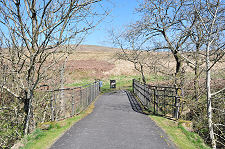
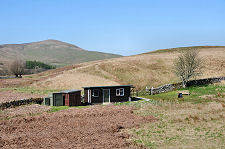
While you are visiting Hermitage Castle, make sure you don't overlook the Chapel of Hermitage, whose ruins can be found a couple of hundred yards west of the end of the bridge from the roadside parking area.
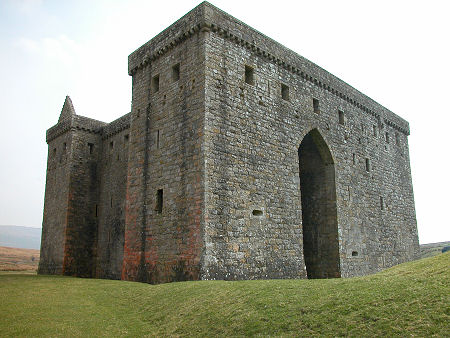 Hermitage Castle Seen from the North-West |
|
|
|
Visitor Informationwww.historicenvironment.scotHES: Castle Web Page View Location on Map Post Code: TD9 0LU Grid Ref: NY 496 961 What3Words Location: ///kipper.caves.atlas |
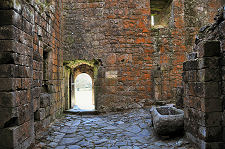 Doorway and Old Courtyard |
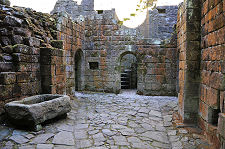 Old Courtyard from Doorway |
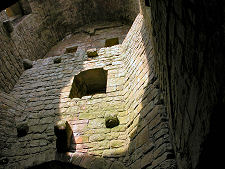 Original Vaulting in SW Tower |
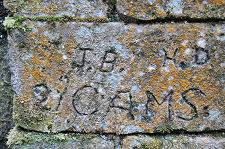 Old Graffiti |
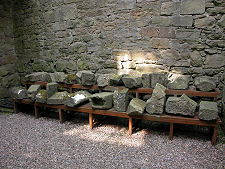 Display of Carved Stones |
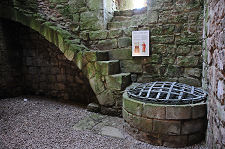 One of the Wells |
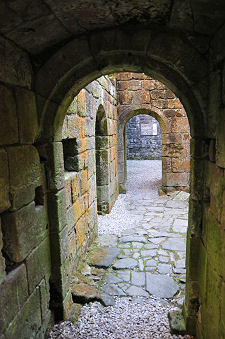 Doorways |
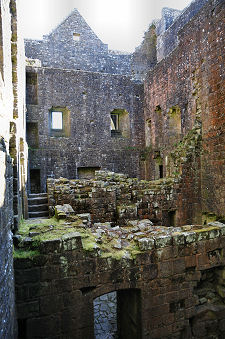 Interior, Looking East |
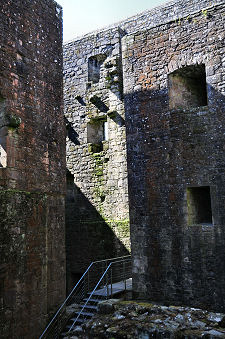 Interior, Looking South-West |