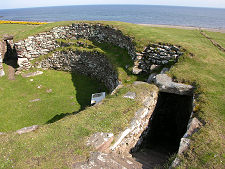
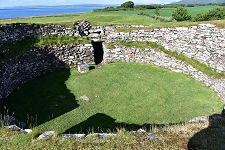
 Carn Liath from the Top of Its Wall |
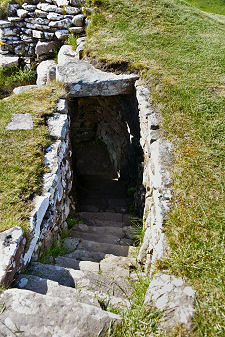
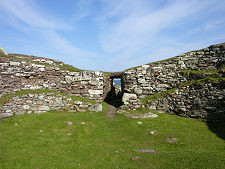
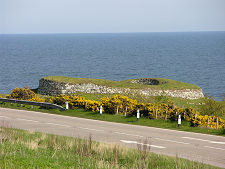
Between Golspie and Brora is Carn Liath, the Grey Cairn. This broch occupies a terrace overlooking the shore, has walls that are still 12ft high in places, and comes complete with a well preserved entrance passage and lintelled doorway.
The broch lies immediately on the seaward side of the A9 about a mile east of Dunrobin Castle, i.e. a mile further from Golspie on this almost south-facing stretch of coast. There is signposted parking on the inland side of the A9 just to the west of Carn Liath.
Anyone intending to visit needs to know that having parked your car you should make your way to the broch by means of a path that starts at the western end of the old road you have parked on: the end away from the broch.
The path is well signposted. It leads down to a relatively safe place to cross the busy A9, and then along a track to the broch from the far side of the crossing point. Don't try to cross the A9 nearer the broch. (Continues below image...)
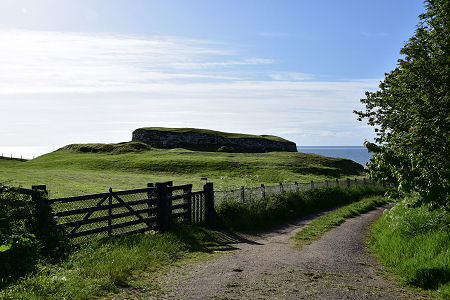 Seen from the Approach Track |
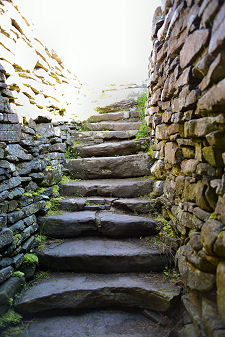
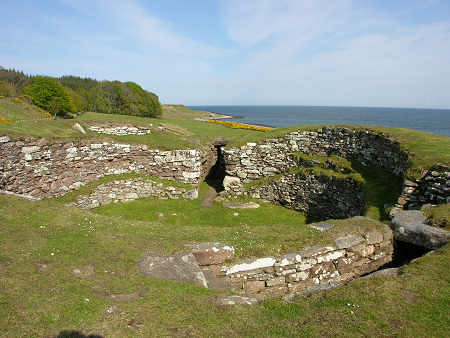
The remains of the broch are still impressive. The interior is deeper than the exterior, which remains partially banked. In the entrance passage is a cavity that was possibly used to guard the broch. And on the opposite side of the broch from the entrance is a set of steps within the wall.
Carn Liath was first excavated in the 1800s by the Duke of Sutherland. As the name implies it was thought at the time to be some sort of burial mound or cairn. But as it was cleared away the broch you see today emerged from the build-up of earth.
The broch was probably built in the last century BC or first century AD. Opinions differ about the purpose of brochs, and range from resource-hungry status symbols to temporary defensive structures for extended families and their livestock. Around 500 were built in Scotland, including good examples at Broch of Gurness in Orkney, Dun Carloway in the Western Isles and Mousa Broch and Clickimin Broch in Shetland.
The original clearance of the site unearthed a range of pottery pieces and stone and bone implements, plus a silver ornament and an iron knife blade. More recent excavations in 1986 found a bronze age burial on the site, complete with grave goods.
The remains of the broch are surrounded by signs of a small settlement. Opinions differ about whether this would have been in use at the same time as the broch itself, like a castle with its surrounding village: or whether it was constructed by the broch-dwellers when they no longer needed the original structure. Excavations have indicated that the surrounding houses might have been in use as late as AD 400.
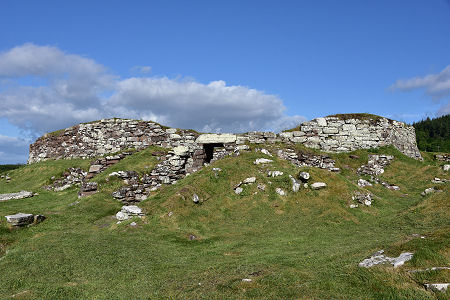 The Broch from the Seaward Side |
|
|
|
Visitor Informationwww.historicenvironment.scotHES: Site Web Page View Location on Map Grid Ref: NC 870 013 What3Words Location: ///idea.scorecard.bulk |
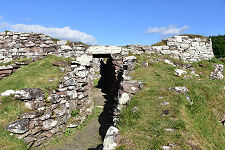 Entrance from the Outside |
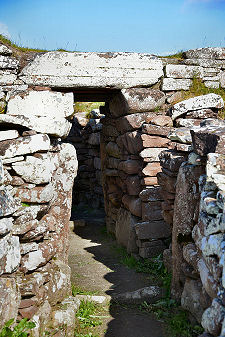 Approaching the Entrance |
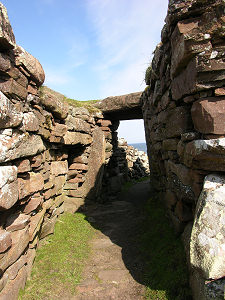 Entrance from the Inside |
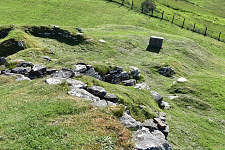 Outer Buildings |
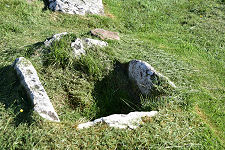 Kist Burial |
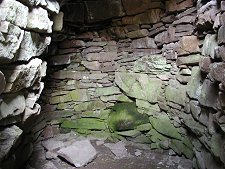 Entranceway Cavity |