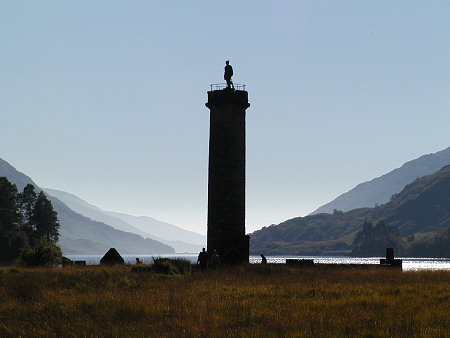
 The Monument with Loch Shiel Beyond |
On Monday 19 August 1745 a small rowing boat landed at the north end of Loch Shiel. It was early afternoon. Prince Charles Edward Stuart, "Bonnie Prince Charlie" came ashore and met his escort of 50 MacDonalds before retiring to a nearby barn to await the response to letters he had sent to possible supporters all over the Highlands.
Another 150 MacDonalds were quickly on the scene, but for some time it seemed that Bonnie Prince Charlie was going to have to challenge for his father's right to the thrones of Scotland and England with just 200 men. Then pipes were heard approaching from the north. It was around 1,000 men of the Clan Cameron coming from Achnacarry and Loch Arkaig. Three hundred Macdonnells arrived later, having been delayed by a successful skirmish with Government troops near today's Spean Bridge.
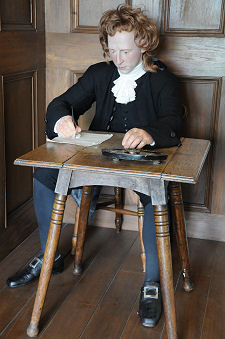
Judging that he had enough support to mount his rebellion, Charles Edward Stuart climbed the hill behind today's NTS visitor Centre and raised his standard. A brief ceremony, translated into Gaelic for the benefit of the Jacobite clansmen, followed, and the Prince then ordered that brandy be distributed.
And so the '45 was born. It was to end in bloody failure at Culloden on 16 April 1746, less than eight months later. In its aftermath the Highland way of life that had existed for hundreds of years was swept away by brutality, suppression and self interest.
But in the meantime, Charles had come very close indeed to taking the crowns he sought. His army reached Derby on 6 December 1745, before retreating after a closely argued meeting in the upstairs room of a Derby pub. Meantime, the Hanoverian court was packing its belongings onto ships in the Thames. Had Charles advanced George II would probably have fled, leaving Charles' father as James VIII of Scotland and III of England.
Some say that if this had happened the English and French would have avoided a further 70 years of conflict; the English would not have had to raise taxes in the colonies to pay for the French wars; the Americans would not have had cause to fight a war for their independence; and the French revolution might not have happened. The world would be a very different place.
On the other hand if the Jacobites had advanced from Derby they might have been cut to pieces by government troops four months earlier than they actually were, and at somewhere like Northampton rather than at Culloden. Who can say for sure?
But given Bonnie Prince Charlie's real interest lay in London, he spent more time than he intended in western Scotland. Before raising his standard at Glenfinnan, Charlie had initially landed on Eriskay in the Western Isles. He then landed on the mainland in Loch nan Uamh, near Lochailort some miles west of Glenfinnan, before making his way here by a roundabout route.
The irony is that after Culloden he passed this way again, several times, while evading the Government troops searching for him. It says much for the loyalty of his supporters that no one collected the vast reward of £30,000 placed on his head. And on 20 September 1746 he left Scotland for the last time when he was picked up by a French frigate on the shores of Loch nan Uamh, close to where he had landed just over a year earlier. Today The Prince's Cairn marks the spot from where he departed. See our Historical Timeline.
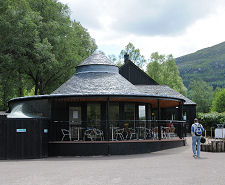
By 1815 the Jacobite threat had receded sufficiently into history to allow the erection at Glenfinnan of a monument to mark the raising of the standard, paid for by the wealthy descendant of a Jacobite. This is a stone tower surmounted by a statue of a kilted highlander (not the prince himself as is often thought). The monument was made possible by the construction in 1812 by Thomas Telford of the road from Fort William to Arisaig, which passed Glenfinnan as its successor does today. The Glenfinnan Monument came into the care of the National Trust for Scotland in 1938, and they have maintained it ever since. They have also built a visitor centre, details above right, next to the main road.
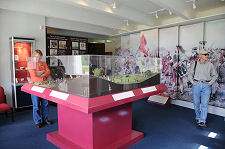
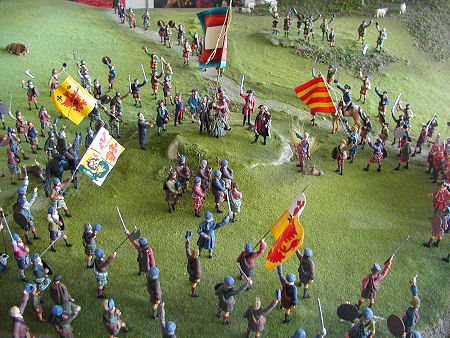 The Raising of the Standard: Model in Visitor Centre |
|
|
|
Visitor Informationwww.nts.org.ukNTS: Glenfinnan Web Page View Location on Map Glenfinnan, PH37 4LT. Grid Ref: NM 906 805 What3Words Location: ///yard.fraction.microfilm |
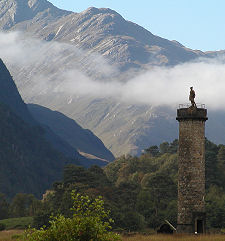 Mountain Landscape |
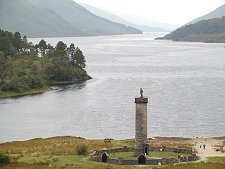 Seen from the Viewpoint |
 Red Deer Near Monument |
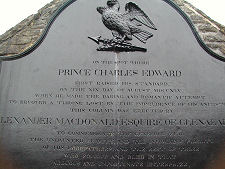 Commemorative Plaque |