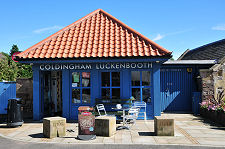
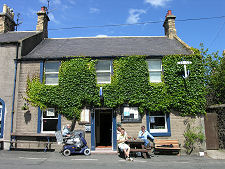
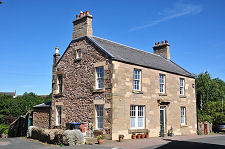
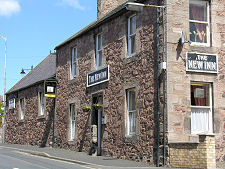
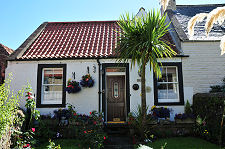
 Coldingham High Street |
Coldingham lies just under a mile inland from the North Sea coast of Scotland, and just under ten miles from the English Border. It sits astride the A1107, which provides a more scenic alternative to the A1 for visitors driving up through the Borders via Eyemouth.
This picture postcard village has an unusually ancient history, and one that is unusually closely tied with England. This even extends to its very English-sounding name. Some have suggested that this comes from the Old English for "village of the people of Colud", presumably a reference to an early laird.
An alternative view, that Coldingham was actually referred to on Ptolemy's Roman map of Britain as Colania, has found a following, but overlooks the distance that settlement is marked as being from the sea. Alternative views that Colania became Lanark or Crawford seem more likely. (Continues below image...)
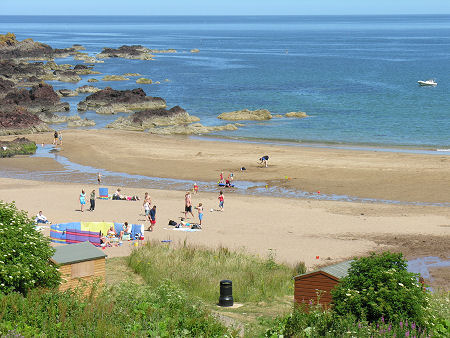 The Beach at Coldingham Bay |
What is beyond doubt is that Coldingham was established at a very early date. A monastery was founded two miles to the north in 635, open to both monks and nuns by a Northumbrian Princess called Aebbe. She later became a saint, St Aebbe. In 683 fire largely destroyed the monastery. At the time some held this to be divine retribution for what was, perhaps euphemistically, called "disorderly behaviour" among the monks and nuns. Whatever the truth of this, the monastery may have been rebuilt on the same site before being destroyed by Vikings in 870.
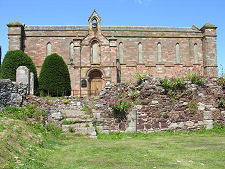
Coldingham's story closely reflected that of the monastery here, and the priory that followed it, on a different site in what is now the village of Coldingham, from 1098. The village grew alongside the priory from the 1100s until the Reformation in 1560. This was despite attacks by invading English armies in 1216, 1537 and 1547, and despite a fire raised at the priory by its own prior, William Drax, in 1430. This was, allegedly, an attempt by him to conceal his theft of a large amount of money being carried by a messenger from the Scottish King to the English King.
Even the Reformation in 1560 and the Union of the Crowns of Scotland in 1603 did not end the priory's role as an attractor of trouble for the village. In 1650, troops opposing Cromwell were positioned in the priory to block his advance into Scotland. After a two day siege by Cromwell's artillery the village and its priory were badly in need of rebuilding. One result is the local saying that there isn't an old building in the village that doesn't contain stone removed from the ruins of the priory.
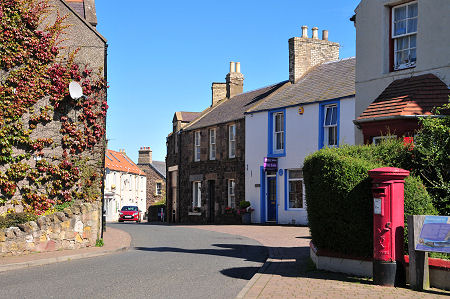
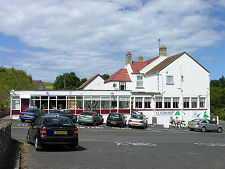
Coldingham is well worth spending a little time in. The remains of the priory are especially worth visiting, and if you do nothing more, make sure you stroll along the lovely High Street, and pop into the "Coldingham Luckenbooth", an attractive cafe/shop/information point/post office near the entrance to the priory. We didn't notice at the time, but a photograph taken on our most recent visit in 2016 showed that the mercat cross we'd photographed standing beside the main road through the village in 2006 had disappeared, leaving only its base. It's unclear why this happened, and whether the cross is likely to be restored to the village at any point in the future.
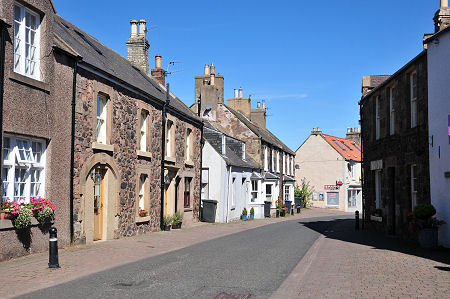 Another View of the High Street |
|
|
|
Visitor InformationView Location on MapWhat3Words Location: ///collapsed.oven.owls |
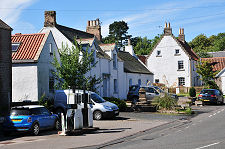 Main Road Through Village |
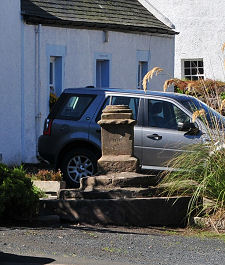 Mercat Cross Base in 2016 |
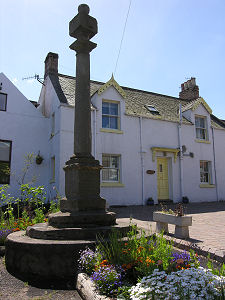 Mercat Cross in 2006 |
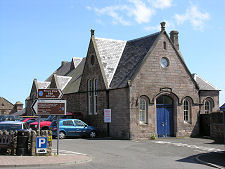 Public Hall |
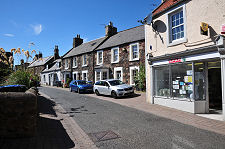 Spar Shop and High Street |
 St Vedas B&B |