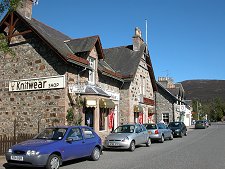
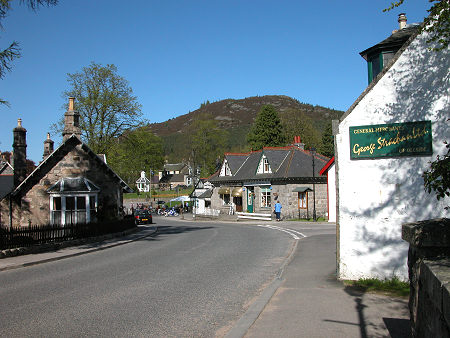
 Invercauld Road with Creag Choinnich in the Background |
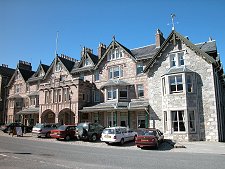
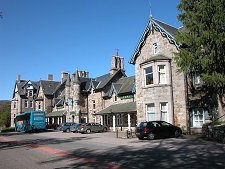
At 1,100 feet above sea level, Braemar holds the record for Britain's lowest recorded temperature, of -27.2 degrees C, on 10 January 1982. But this is not this attractive village's only claim to fame. A popular highland resort, Braemar enjoys a scenic location at the meeting point of three passes in Upper Deeside where the Clunie Water flowing north from the Cairnwell joins the upper River Dee. The village gained favour with Queen Victoria and still enjoys royal patronage today.
Braemar is probably best known for its highland games, the annual Braemar Gathering which takes place on the first Saturday in September. The games date back over 900 years, to the time when an annual contest between local clans was watched by King Malcolm III. The tradition of royal involvement was resumed by Queen Victoria after her purchase of the nearby Balmoral Estate, and successive generations of royals have maintained that tradition ever since.
Braemar's long history means that Braemar Castle, which stands half a mile to the north-east, was the second to be built in the village. The first was the Royal Castle of Kindrochit in Mar, or just Kindrochit Castle.
This was built on what is now the east bank of the Clunie Water in the centre of Braemar by Malcolm III during his reign from 1057 to 1093. Its remains are easy to miss: just some forlorn stone walls and grassy mounds close to the village's main car park with only a small sign to show that this was a Royal Castle for upwards of five hundred years.
Malcolm Canmore's castle was significantly strengthened by Sir Malcolm Drummond, Earl of Mar, under orders from Robert III in the years after 1390. The result was a large oblong keep (the fifth largest in Scotland) standing within the older castle on an island in the Clunie Water. Sir Malcolm Drummond was murdered before the tower was complete, probably by Alexander Stewart, Robert III's nephew.
Alexander Stewart then went on to capture Kildrummy Castle in Strathdon and with it Drummond's widow, the Countess of Mar, before forcing her to marry him and so becoming Earl of Mar himself. Such were the joys of Scottish local politics in the years around 1400.
The more recent Braemar Castle was built in 1628 by the Earl of Mar. It was burned in 1689 but rebuilt in 1748 when it was leased to the government as a military barracks. Much of what now stands, including the star shaped outer wall, dates back to that time. Today it is run by the local community as a visitor attraction.
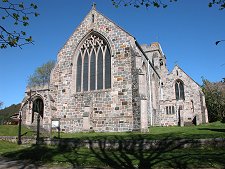
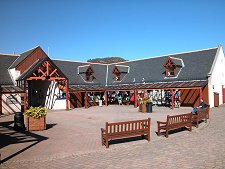
The centre of Braemar is a bustling place and a popular halt for bus tours. There is a variety of shops and, in the centre, the Highland Heritage Centre with displays on Braemar's royal connections and the Highland Gathering. This is housed in a building which is also home to the Tourist Information Centre. Behind the Heritage Centre is Braemar Parish Church, with its distinctive spire: just one of four churches in the village, three of which are still active.
Braemar is also popular with outdoor enthusiasts and is situated in some excellent climbing country. An easy ascent of Braemar's own mountain, Morrone, takes in spectacular views. Further afield is the more challenging Lochnagar, whose north peak, the White Mount, is said to have been the inspiration for a children's story written by Prince Charles.
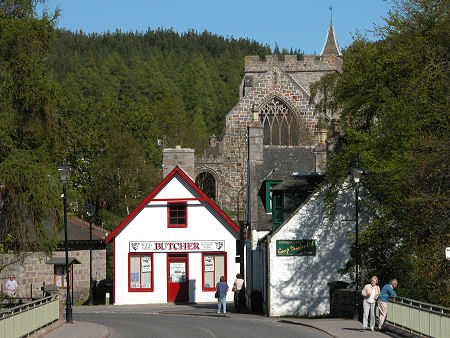 Looking East Across the Bridge Over the Clunie Water |
|
|
|
Visitor InformationView Location on MapWhat3Words Location: ///firmer.clasps.sonic |
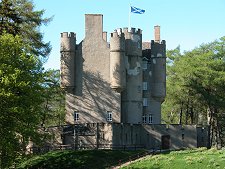 Braemar Castle |
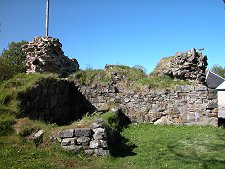 Remains of Kindrochit Castle |
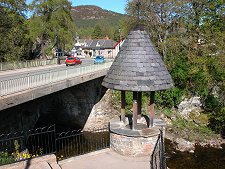 Bridge over the Clunie Water |
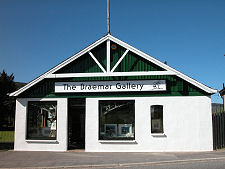 The Braemar Gallery |