|
||
 St Andrews |
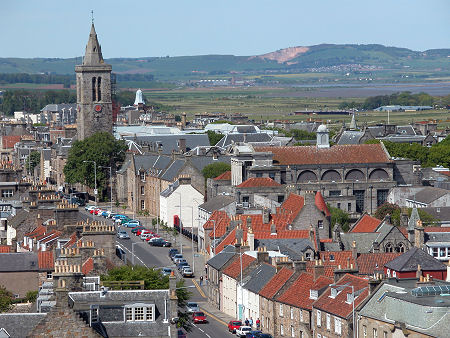
The University of St Andrews lies in the town of St Andrews on the east coast of Fife. It is oldest university in Scotland, and the third oldest in the UK (and in the English-speaking world), after the Universities of Oxford and Cambridge. A relatively small university whose 11,000 students nonetheless have quite a presence in a town of just 17,000 people, places at St Andrews are highly prized. There are usually around 12 applicants for each available place, and the university has not needed to take part in the clearing system for some years.
All this has tended to lend the university a slightly elitist reputation, something it is tackling with an active programme of widening access. St Andrews has one of the lowest drop out rates in the UK among undergraduates, and nearly 80% graduates obtain a First Class or an Upper Second Class Honours degree. Academically, the University of St Andrews is highly regarded.
The University is divided on traditional lines into four academic faculties: arts; divinity, medicine and science. Many of the university building are spread around the medieval heart of the town, as are the many halls of residence. Around half of all students at St Andrews stay in halls of residence, and places are guaranteed for first year students.
History
The University of St Andrews owes its origin to a society formed in 1410 by a group of eminent ecclesiastics who wished to establish a seat of learning here and attract a core of learned teachers to it. The actual foundation of the university took place three years later when in 1413, Pope Benedict XIII issued a series of bulls establishing the society as a university. The first college, St John's, was founded within a decade, and St Salvator's College followed in 1450, St Leonard's College in 1511 and St Mary's College in 1537. Some of the college buildings constructed at that time remain in use today, including St Salvator's Chapel, St Leonards College chapel, and St Mary's College quadrangle.
St Andrews had been chose as the site of Scotland's first university because it was an extremely important ecclesiastical centre in pre-Reformation Scotland. Much of the teaching was religious in nature and many of the teachers were clerics as well as academics. Despite this, the university survived the Reformation of 1560, perhaps because the concept of a secular university had been established in Scotland by the founding of the Universities of Glasgow and Aberdeen.
During the 1600s Students at St Andrews adopted the distinctive red gown that remains a feature of undergraduate life today. Later in the same century the university considered, and rejected, a relocation to Perth. In 1747, St Salvator's and St Leonard's merged to form the United College of St Salvator and St Leonard, now simply known as the United College. The university continued through much of the 1800s with a declining number of students, perhaps as few as 150 during the 1870s. Perhaps as a result, in 1897 St Andrews joined forces with University College, Dundee. This association came to an end in 1967 when University College became an independent University of Dundee.
Notable People Associated with The University of St Andrews
|
