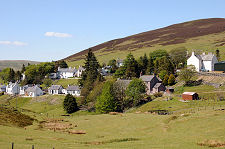
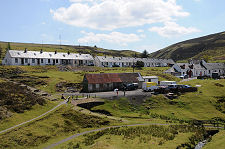
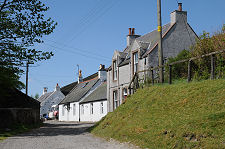
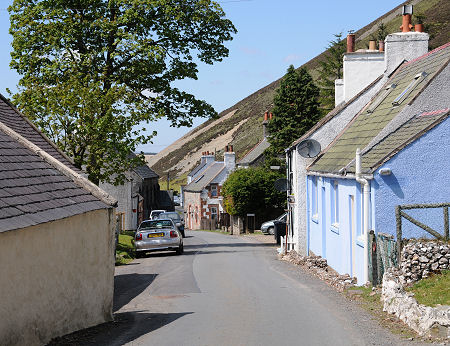
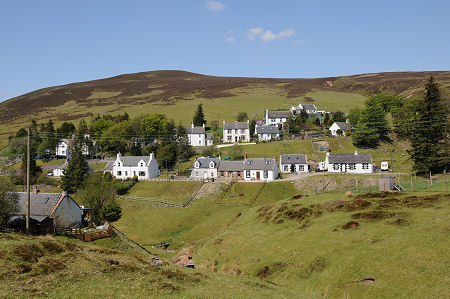
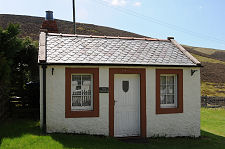
 Church Street in Wanlockhead |
High in the Lowther Hills to the west of the A74(M) is Wanlockhead, Scotland's highest village at 467m or 1,531ft. It owes its existence to the lead, gold and other minerals found under the surrounding countryside.
These mineral deposits were probably first exploited by the Romans and from the 1200s they were being worked again by groups of miners who gathered here each summer. The first permanent settlement appeared in about 1680, when the Duke of Buccleuch built a lead smelting plant and workers' cottages that could be occupied all year round.
Lead was for many centuries the mainstay of the village's economy, but it was not the only mineral found here. What became known as "God's Treasure House" also produced zinc, copper, silver and gold. Some of the world's purest gold, at 22.8 carats, was found locally and used in the Regalia of the Scottish Crown.
Although a heavily industrialised and highly industrious village, Wanlockhead's miners also looked to their own cultural welfare. In 1756 the village followed the example of nearby Leadhills and opened a subscription library. The village curling club was formed in 1777 and there were also bowling and quoiting clubs, a drama group and a silver band.
From 1900 Wanlockhead was served by a branch railway from Elvanfoot via Leadhills, the highest adhesion (i.e. normally driven) railway in the country, but by then lead mining had already passed its peak. The railway closed in 1938 following the closure of most of the area's lead mines. The Leadhills & Wanlockhead Railway is a 2ft narrow gauge railway built along part of the old trackbed which currently terminates half a mile from Wanlockhead.
Today's Wanlockhead depends primarily on tourism. The Southern Upland Way long distance footpath passes through the village, but the main attraction for the tourist revolves around the village's industrial past. Wanlockhead is now best known as the home of the Museum of Lead Mining. This excellent visitor attraction allows a real insight into the process of lead mining and into the lives of the miners and their families who came to this remote spot.
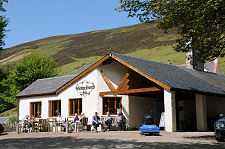
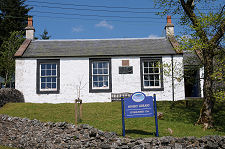
From its base in the visitor centre in the old village smithy, visitors to the museum follow a trail through the village that includes a guided tour of the Lochnell Lead Mine; the Miners' Library; miners' cottages; and industrial relics such as the Wanlockhead Beam Engine. You can also visit the museum's gold panning area and have a go yourself: though actually finding gold is not a guaranteed part of the experience!
The village itself occupies the meeting point of three valleys. One descends south then west towards Nithsdale, while the other descends in a north-westerly direction past relics of lead mining before the road runs out. The third heads north-east and climbs briefly to the watershed at the boundary between Dumfries & Galloway (in which you find Wanlockhead) and South Lanarkshire. It then descends through neighbouring Leadhills.
The village grew primarily to provide homes for miners, and as the mines were scattered around the valleys, the clusters and rows of cottages that served them are likewise surprisingly dispersed. The result is a very open village, surrounded by hills and with a great deal of undeveloped greenery within it, especially along the bottom of the valley of the Wanlock Water. Today you can only really begin to get a feel for the various elements by driving around the village, stopping en route to see it from different vantage points offered by the topography.
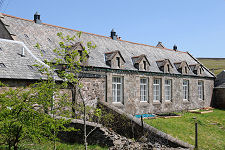
A good route for motorists, assuming an approach from the direction of Leadhills, is to continue along the main road until you have almost passed the village on your right, then taking a right turn, and descending to the Museum of Lead Mining. From here you can appreciate much of the village, and especially its scatter. An excursion along Church Street from the museum takes you through what is arguably the most picturesque part of the village and past the disused church. You then pass the Wanlockhead Beam Engine and other evidence of the lead mining industry.
Returning to the core of the village, it is worth taking the road along the north-east side of the valley of the Wanlock Water. Look out near the junction for the entrance to car park of the Wanlockhead Inn, Scotland's highest pub. You then climb past the Miners' Library and the Wanlockhead Community Centre in the old school building. This road brings you out on the B797 from Leadhills, at a point just to the east of Wanlockhead itself.
 The East End of the Village |
|
|
|
Visitor InformationView Location on MapWhat3Words Location: ///drums.stick.satellite |
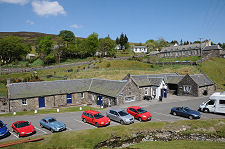 Museum of Lead Mining |
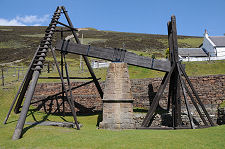 Wanlockhead Beam Engine |
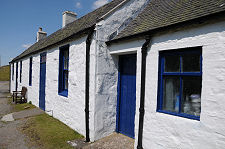 Miners' Cottages |
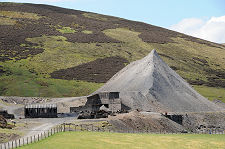 Disused Lead Mine |
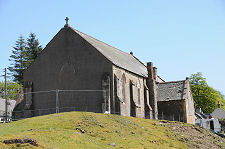 Disused Church |
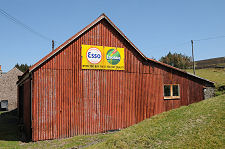 Old Garage |
 "The Manor" |