 Perth and The River Tay |
Until the early 1980s most journeys through eastern Scotland would sooner or later have brought you to Perth. Since then the city has been bypassed to the south and west by the M90 and A9; and to the north by a new bridge over the River Tay. As a result very little through traffic needs to enter Perth, though it remains an extremely busy city. And a city it is: Perth became Scotland's seventh city in 2012.
Perth's origins lay in the fort the Romans built at Bertha in about AD83 to act as a supply base for their occasional occupation of north-eastern Scotland (see our Historical Timeline). This was located at the highest point on the River Tay their ships could reach, at its confluence with the River Almond two miles north of the current centre of the city. A thousand years of silting meant the highest navigable point had moved downstream by 1125, when King David I set up a new town, again on the west bank of the River Tay. This formed the basis of modern Perth and was set out in the grid plan still so evident within the compact city centre today.
At about the same time the first bridge was built across the River Tay, linking Perth with what later became called Bridgend, and with the ancient capital of Scotland at Scone, two miles upstream on the east bank of the Tay.
Perth's history has been intimately tied to its river ever since. As, until recent times, the lowest crossing point of the Tay, it assumed a strategic significance that was not missed by passing armies over the following centuries. In the Wars of Independence the town was heavily fortified and held by the English. Robert the Bruce captured it in January 1313 after his troops swam across the town moat and climbed the walls. Its later visitors included armies owing allegiance to the Covenanters, the Jacobites and Oliver Cromwell. (Continues below images...)
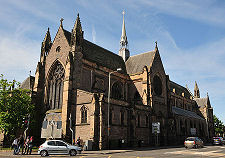
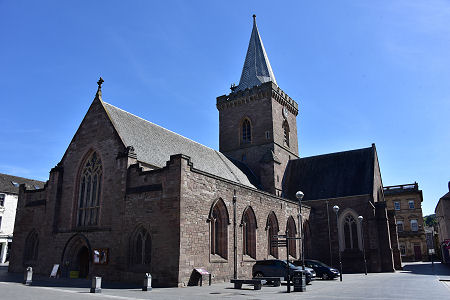 St John's Kirk of Perth |
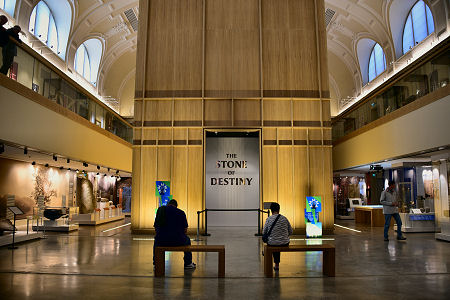 Inside Perth Museum |
If the River Tay assured Perth's growth and its wealth, it also formed an ever present threat to its low-lying location. This was demonstrated forcibly in 1209 when a flood destroyed the bridge across the river. It also badly damaged the earth motte near today's High Street on which the castle had been built in 1160. As a result the castle had to be pulled down.
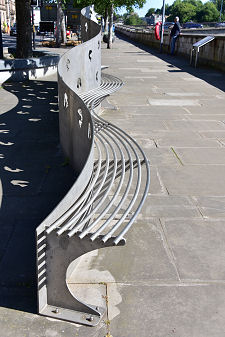
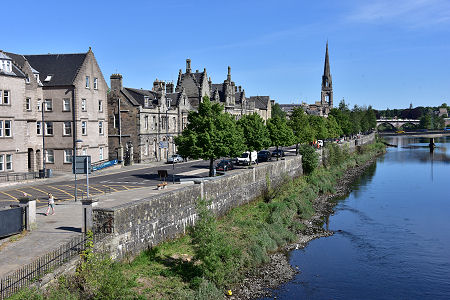
Flooding by the River Tay has characterised the story of Perth right up to modern times. As recently as 1993 large parts of the city were inundated. This led to the construction over several years of large scale flood defences that were completed late in 2001, leaving Perth with a remodelled and very attractive riverside, and returning to the residents full access to the parks of North and South Inch.
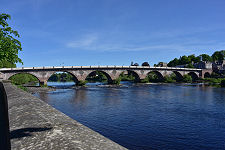
Problems with its bridges have formed another recurring theme through much of Perth's history. The bridge that was swept away in 1209 was swiftly replaced. Another bridge was built in about 1590. This was badly damaged in more floods in 1621 and finally destroyed, again by the river, in 1648. For the following 130 years Perth made do with a ferry link across the Tay. In 1771 a new stone bridge, Perth Bridge, was built. This survives, though the Victoria Bridge, built in 1900 to provide a second crossing, was replaced by the Queen's Bridge in 1960.
As a settlement, Perth has expanded steadily westwards in recent years towards its bypass. But the city centre still occupies the area it did in medieval times, constrained as it is by the river and by the twin public parks of the North and South Inch.
North Inch achieved a certain infamy as the site of the Battle of the Inch, organised by Robert III in 1396. In an effort to end a long standing feud between the Kay and Chattan Clans, and in an effort to suppress wider trouble in the Highlands, the King arranged a fight to the death between 30 men of each clan. This took place in front of spectators, including the Royal Court, who watched from specially built stands.
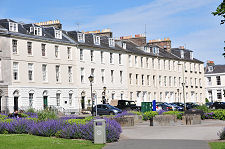
The battle started with each man firing three bolts from his crossbow and the survivors then closed with daggers and axes. After a bloody afternoon, eleven of the Clan Chattan were still on their feet when the last survivor of the Kay contingent escaped by swimming across the Tay. The battle took place on the part of North Inch now overlooked by Rose Terrace.
Proximity to Scotland's ancient seat of power at Scone led some to hope that Perth could become Scotland's capital. During the reign of King James I the court spent much of its time at the Abbey of Blackfriars in the city. However the King was murdered here on 21 February 1437 by nobles he had antagonised. When his six-year-old son was crowned as James II, it was to be in Edinburgh rather than at Scone, as this was deemed by his mother to be safer. Perth's hopes of capital status died with James I.
Perth's more recent history, at least until the coming of the motorways in the early 1980s, has been dominated by the railways. The third surviving bridge across the Tay was built in 1849 and carries the railway via Moncrieff Island towards Dundee. Unusually, the railway builders respected the existing pattern of development of the city and the railway station was located at the south-western corner of the old city grid. From here, various railway companies developed lines to most significant destinations in Scotland, including northwards via Dunkeld to Inverness.
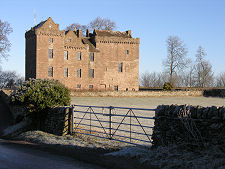
Visitor attractions in Perth include St John's Kirk of Perth, dating back to medieval times; St Ninian's Cathedral; the Black Watch Museum and nearby 51st Highland Division Memorial; Perth Museum, now the permanent home of the Stone of Destiny or Stone of Scone; Perth Art Gallery; Greyfriars Burial Ground, home to one of the finest collections of early gravestones anywhere in Scotland; and Branklyn Garden, cared for by the National Trust for Scotland. Just to the north of Perth is Scone Palace, while a little to its west is Huntingtower Castle. Overlooking the South Inch and close to the railway station is The Parklands Hotel.
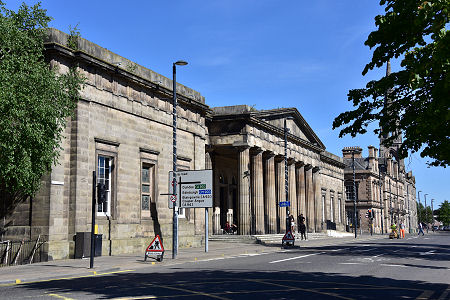 Tay Street and Sheriff Court |
|
|
|
Visitor InformationView Location on MapWhat3Words Location: ///dome.skirt.bravo |
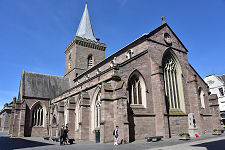 St John's Kirk
of Perth St John's Kirk
of Perth |
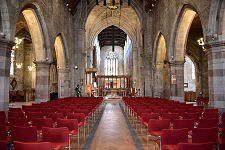 Inside St John's Inside St John's |
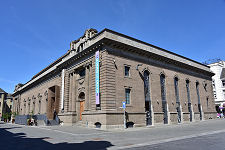 Perth Museum Perth Museum |
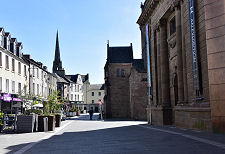 St John's Place St John's Place |
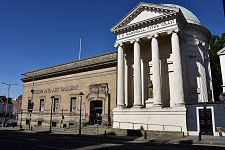 Perth Art Gallery Perth Art Gallery |
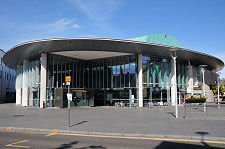 Perth Concert
Hall Perth Concert
Hall |
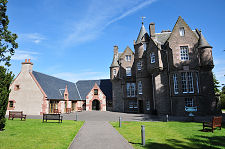 The Black Watch
Museum The Black Watch
Museum |
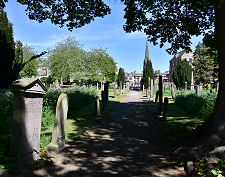 Greyfriars Burial Ground Greyfriars Burial Ground |
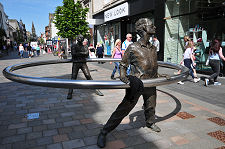 High Street High Street |
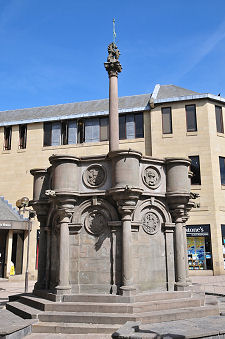 The Mercat Cross |
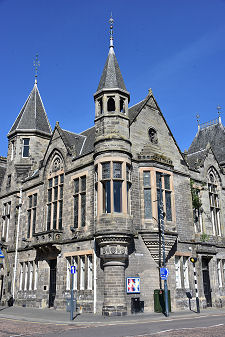 Municipal Buildings Municipal Buildings |
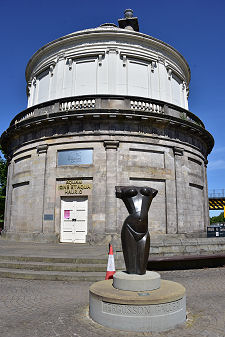 The Closed Fergusson Gallery The Closed Fergusson Gallery |