 Black Watch Castle & Museum at Balhousie Castle |
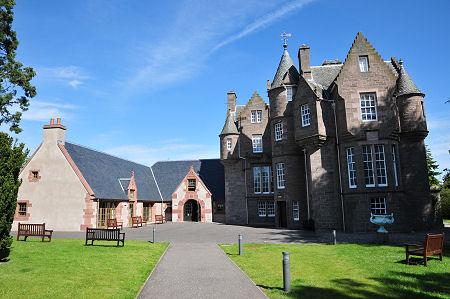
The Black Watch Museum is housed in Balhousie Castle, on the north side of Perth overlooking the North Inch. Within it is told the story of Scotland's oldest Highland Regiment and of the soldiers who served in it. The Museum is well signposted from the centre of Perth and is within easy walking distance of it. Parking is available at the museum.
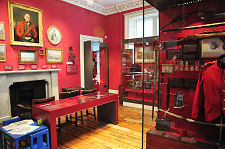
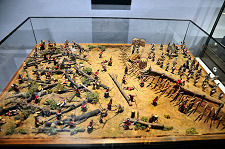
The Museum's collections are divided between thirteen galleries, most of which are organised chronologically. After an introduction, the visitor moves on to a gallery devoted to "The Early Years", before visiting rooms covering "The French Wars" and "Empire". The First World War displays are especially poignant, and the visitor then moves through to galleries covering the Second World War and the post-war era, a reminder that conflict did not stop in 1945. Among the final four galleries are "A Day in the Life", looking at the life of a modern member of the Black Watch, and a space for temporary exhibitions.
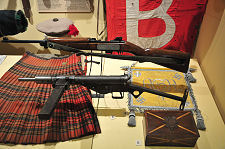
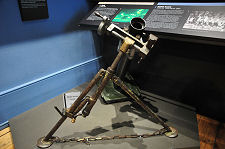
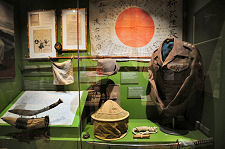
The range of objects on view is remarkable. The gallery devoted to the First World War, for example, includes a gas helmet, a object that looks so primitive it seems almost comical: until you remember that men's lives depended on it working as intended when they were under attack by poison gas. There are also medals awarded to members of the regiment on display, plus weapons, personal objects, maps, pictures and sculptures. This is a place that reminds visitors very directly that between 1914 and 1918 some 50,000 officers and men served in the Black Watch Regiment. 8,000 of them were killed and a further 20,000 were wounded.
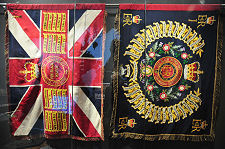
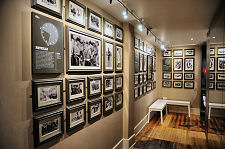
The realities of soldiering are reflected again and again at the Museum, whether in the Remembrance gallery, or in the Iraq Memorial to Black Watch soldiers killed more recently serving in Iraq, which stands in the grounds. Perhaps the most sobering object of all is the display of the Regiment's Honours, showing just how often it has been involved in battle, and in how many different places: including Al Basrah and Iraq in 2003 and their earlier echoes, Mesopotamia in 1915-7 and Baghdad in 1917.
Many of the objects on view in the museum have been donated, often from unlikely sources. One room contains a beautiful stained glass window depicting a Seaforth Highlander standing guard over two Black Watch soldiers in the Crimea. The window came to the museum after many years in a public house in Edinburgh's Rose Street. Equally fascinating is the story of "The Silent Highlander", a near life-size figure who stands guard at the doorway leading through to the galleries. He spent the first hundred years of his life standing outside a tobacconists opposite Knightsbridge Barracks in London: except when he was borrowed to oversee functions in the Officers' Mess at the barracks. His more recent life in Balhousie Castle probably seems very tranquil in comparison.
Balhousie Castle has its origins in a stone castle built here in the 1100s. This was developed into an "L" plan tower house in 1631 by George Hay, 1st Earl of Kinnoull, whose father had been granted the estate here by Charles I in 1625. The building you see today largely dates back to a major redevelopment that took place in 1862-4 under the direction of the architect, David Smart, for Thomas Robert Hay-Drummond, 11th Earl of Kinnoull. The Hay family leased the castle out to a succession of occupants until 1912, when they moved back in. From 1926 the castle served as a convent for nuns from the Society of St Peter associated with the nearby St Ninian's Cathedral. The army took over in 1940 and has remained ever since. The castle has been home to the Regimental Museum of the Black Watch since the 1960s.
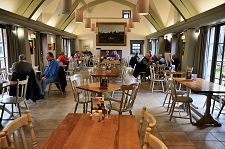
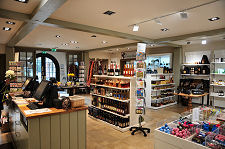
More recently a major refurbishment has taken place which saw the tasteful addition of a large annex on the western side of the castle. This is home to the visitor reception, the shop, and an excellent cafe. During the refurbishment the museum itself was also transformed, and brought up to the very best modern standards of lighting, display and design.
The Black Watch was raised from loyal clans to police the Highlands in the aftermath of the 1715 Jacobite Uprising. They were given the name of Black Watch to reflect both their role and the dark colours of their tartan. In 1739 King George II authorised the formation of the Black Watch into a regular army Regiment of the Line.
The Regiment first saw action in 1745 at the Battle of Fontenoy in what is now Belgium. By 1777, it was known as the 42nd (Royal Highland) Regiment of Foot and was in action in the Americas at the Battle of Ticonderoga. In 1786 the Second Battalion split off to form the 73rd Regiment of Foot, serving in India and Ceylon while the 43rd served in the West Indies. In 1795 the 42nd Regiment adopted the distinctive "red hackle" attached to its headgear.
During the Napoleonic Wars the 42nd and 73rd Regiments of foot fought in Egypt, Spain and Portugal before coming together for the final victory at the Battle of Waterloo. Later in the 1800s the 42nd Regiment fought in the Crimean War before being sent to India. Meanwhile the 73rd was serving in South Africa. In 1881 the two regiments reunited as the 1st and 2nd Battalions of the Black Watch Regiment, soon afterwards seeing action in Egypt and Sudan. At the turn of the century, both Battalions were in action in the Boer War.
World War One saw the Black Watch increased in size from two Battalions to seven, and it saw action in various parts of Belgium, France, Mesopotamia (now Iraq), Palestine and the Balkans. The outbreak of World War Two found the Second Battalion of the Black Watch in Palestine, and it soon saw action in Somaliland and on Crete. The rest of the Regiment fought in France before taking part in the evacuation from Dunkirk. The Black Watch then saw action in North Africa and later in Sicily. While the Second Battalion took part in the Italian campaign, the rest of the Regiment landed on the beaches of Normandy in the D-Day landings, before taking part in a series of engagements across occupied Europe and across the Rhine into Germany. Meanwhile, the Second Battalion was sent to India where it took part in operations deep in the Burmese jungle.
The period since the Second World War has not been a peaceful one for the Black Watch. Its soldiers were the last to leave the newly independent Pakistan in 1948, and the last to leave Hong Kong in 1997. The Regiment fought in the Korean War in 1952 and was then stationed in Kenya during the Mau Mau uprising. It moved to Cyprus in 1958, and returned as part of a UN peacekeeping force in 1966. From 1970 the Regiment was involved in the troubles in Northern Ireland, and in the 1990s it took part in peacekeeping operations in the Balkans. In 2003 the Black Watch took part in the attack on Basrah in southern Iraq, and it has since served in a peacekeeping role in Iraq on a number of occasions.
On 28 March 2006, the Black Watch Regiment became the 3rd Battalion, Royal Regiment of Scotland as part of a controversial amalgamation of all of Scotland's infantry regiments. The 3rd Battalion remains known as "The Black Watch", and its members still wear the red hackle on their headgear. For a wider picture see our feature on Military Scotland.
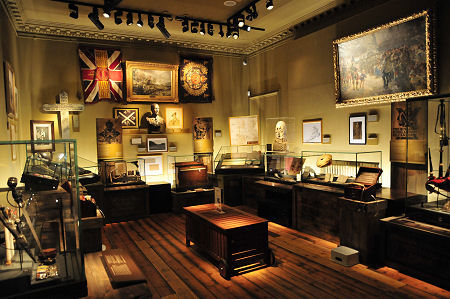 The Black Watch in World War One |
|
|
|
Visitor InformationView Location on Map5 Star Museum. Balhousie Castle, Perth PH1 5HR. Grid Ref: NO 114 244 theblackwatch.co.uk Opening Hours Admission Accessibility What3Words Location: ///focus.person.mixer |
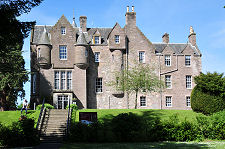 Balhousie Castle from the East |
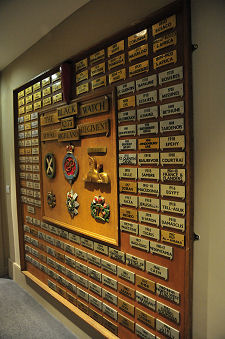 Battle
Honours of the Black Watch Battle
Honours of the Black Watch |
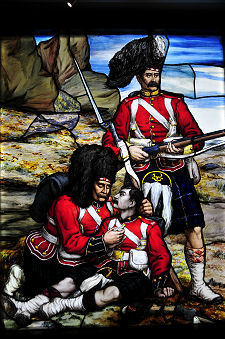 Stained Glass
Window Stained Glass
Window |
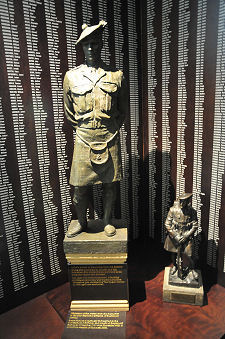 Remembrance Remembrance |
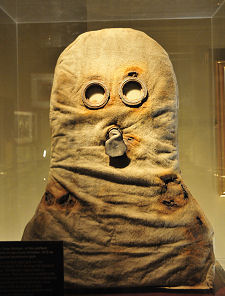 World War One Gas
Helmet World War One Gas
Helmet |
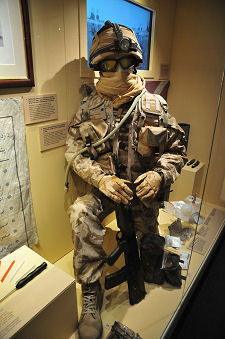 Black Watch in Afghanistan |