 Perth Museum & Art Gallery |
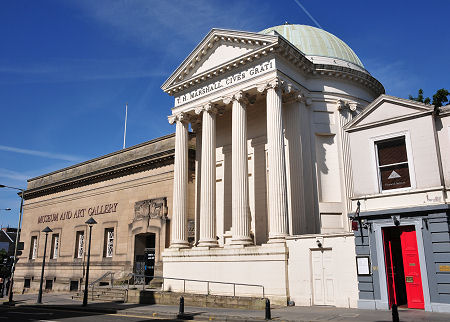
Perth Museum and Art Gallery is one of the oldest museums in the UK and has a collection of nearly 500,000 objects. It is housed in an imposing building near the north-east corner of the central area of Perth, and admission is free. A visit should be viewed as an essential part of getting to grips with the story of Perth and its people.
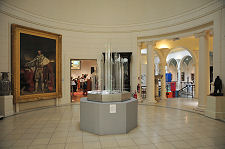
Beyond the doors of Perth Museum and Art Gallery is the main reception area, set beneath a beautiful glass dome. Here you can also find the museum shop and a small lounge area.
Before progressing through to the main galleries beyond, spare a moment for the spectacular Pictish Cross slab which stands unassumingly off to one side. This is the stone known as "St Madoes 1" and originally stood beside the Church at St Madoes, on the north side of the Tay five miles east of Perth. It stands 1.75m high by 0.91m wide and the front face carries a cross surrounded by animals. The rear carries carvings of three symbols and three mounted warriors, but it is difficult to see these in any detail because of the stone's current location, which means its rear face has to be viewed in a mirror.
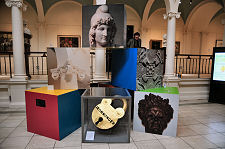
Access to the Library and the Upper Round Gallery is from the main reception, but the gateway to most of the galleries is the circular central lobby beyond the reception area, home to a some fine artworks, both old and very modern.
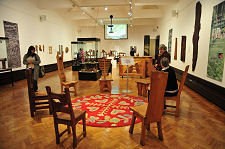
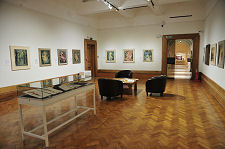
Heading left from the central lobby brings you into Art Gallery 1. It is worth remembering that this is an art gallery as well as a museum, and all three art galleries carry exhibitions that change every few months.
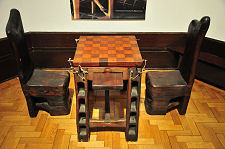
At the time of our visit in early 2015, Art Gallery 1 was home to a superb exhibition of the work of wood artist Tim Stead, who sadly died in 2000. Based on the Scottish Borders, he produced furniture for many prestigious clients, and more free-form artworks. A neighbouring gallery was home to an exhibition of works from Scottish artists responding to the themes in Tim Stead's work. Meanwhile, Gallery 3 carried an exhibition devoted to paintings of the renowned Scottish artist, John Duncan Fergusson.
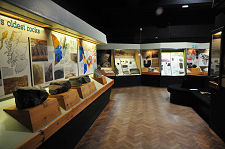
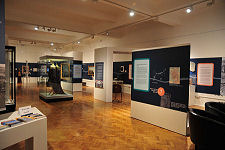
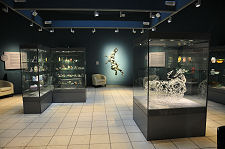
The museum revolves around two core areas. "Wild and Wonderful Perthshire" allows visitors to follow a trail past exhibits about Perthshire's flora, fauna and geology. Thoroughly modern in approach this combines exhibits, information and hands-on sections designed to appeal to everyone. This emerges into what feels like the museum's largest area, devoted to the story of Perth and Perthshire. It covers the whole history of human activity in the area and allows you to chart man's progress from an age of stone tools to the world we live in today. Among the exhibits are two further Pictish symbol stones, one of which, the Inchyra Stone, carries rare examples of Ogham script. At the time of our visit another exhibition, "Dazzle", looked at the story of glassmaking in Perthshire.
The origins of Perth Museum and Art Gallery date back to the formation of the Antiquarian Society of Perth in 1784, which two years later was renamed as the Literary and Antiquarian Society of Perth. In 1824 the Society gained a permanent home for its collections when the Marshall Monument was completed as a memorial to Thomas Hay Marshall of Glenalmond, a former Lord Provost of Perth. This became one of the oldest purpose-built museum buildings in the United Kingdom. In 1881 the Perthshire Natural History Museum was built on Tay Street to provide a home for the collections of the Perthshire Society of Natural Science.
In 1926 a large bequest of funds and paintings was made by Perthshire resident Robert Brough. Together with another bequest by R Hay Robinson this allowed the council to plan a major extension to the Marshall Monument. An architectural competition was launched, with the winning design coming from a Perth-based firm, Smart Stewart Mitchell. Building began in 1932, and the new building allowed the collections of the Literary and Antiquarian Society of Perth and the Perthshire Society of Natural Science to be brought together for the first time.
The new building was formally opened on 10 August 1935 by the Duke and Duchess of York, later to become King George VI and Queen Elizabeth.
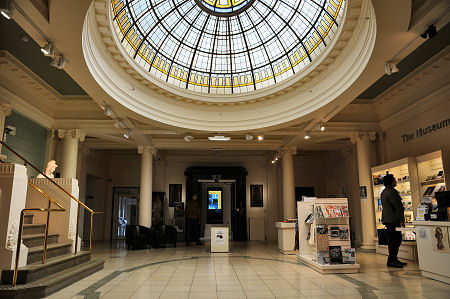 Reception and Shop, Perth Museum & Art Gallery |
|
|
|
Visitor InformationView Location on MapSTB 3 Star Museum. George Street, Perth, PH1 5LB. Tel: 01738 632488. museum@pkc.gov.uk Grid Ref: NO 119 238 Perth Museum & Art Gallery What3Words Location: ///judge.behind.such |
 Ironmonger's
Advertising Sign Ironmonger's
Advertising Sign |
 The Story
of Perth and Perthshire The Story
of Perth and Perthshire |
 Dazzle:
Glassmaking in Perthshire Dazzle:
Glassmaking in Perthshire |
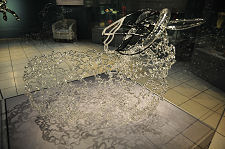 Perthshire Sheep in
Glass Perthshire Sheep in
Glass |
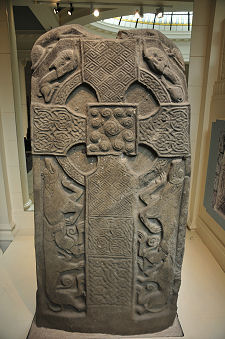 St Madoes Pictish Cross Slab |