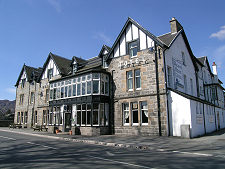
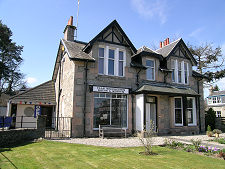
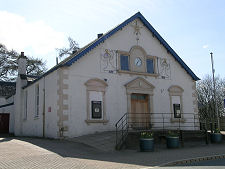
 Newtonmore Main Street |
Banchor Farm, which today stands at the west end of Newtonmore, dates back to 1645. But in those days it stood alone. Newtonmore, which translates as big new town, only began to grow after 1750. The real spurt of growth came in the early 1800s as a result of the clearances. Families cleared from their crofts on estates in the central Highlands to make room for sheep grazing, settled where they had more room to grow crops than was possible in built-up Kingussie.
More formality arrived when a Parliamentary road was built through Newtonmore by Thomas Telford in 1817 to link Kingussie to Fort William. A new bridge had been built over the River Spey just south of Newtonmore in 1808, and the main Inverness to Perth road was also then routed through the village rather than via the ford and ferry between Kingussie and Ruthven Barracks.
The main route north continued to pass this way until the A9 bypass was built a little to the east in the late 1970s. As a result, most people now pass the village by without really noticing they are doing so: unlike neighbouring Kingussie, Newtonmore is not obvious from the new road. The excellent cafe at Ralia, at the junction of the B9150 and the A9 south of Newtonmore, is about as close as many people now come. This is a shame, because Newtonmore has a lot to offer visitors to the area, or to those simply passing through.
Newtonmore also took advantage of the arrival of the Inverness and Perth Junction Railway (which later became part of the Highland Railway) in 1863. This brought visitors in ever greater numbers and led to the development of some of the hotels that feature so prominently in the village today. Today the railway station is simply a rather sparse platform reached by a side road a few hundred yards south of the village. But more importantly it is still served by trains, putting it ahead of many highland stations built during the railway boom of the 1800s.
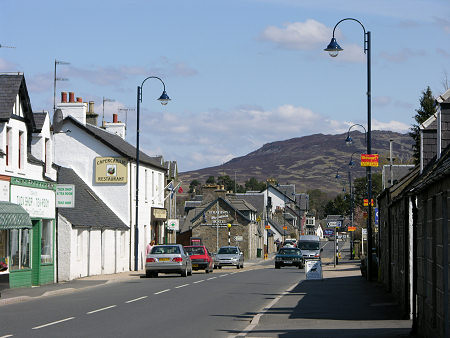
The village today is still focused tightly around the main A86 road, and comes complete with a range of attractive grey stone or white harled shops, restaurants and other services. These include the better part of a dozen hotels, as well as guest houses, B&Bs and hostels.
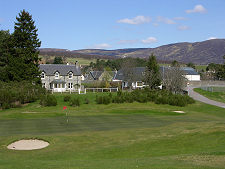
Just to the north of the main street is St Bride's Church, an unusual low lying design built in 1900, and complete with an attractive little bell tower. To the south, the village is bounded by the 18 hole Newtonmore Golf Club. This attractive parkland course lies both sides of the railway line.
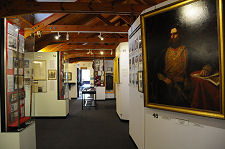
Towards the western end of the village, overlooking the junction between the road to Fort William. and the road back to the A9, is the excellent Clan Macpherson Museum: a place of pilgrimage for members of the clan, and extremely interesting for the rest of us.
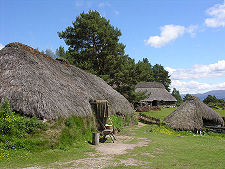
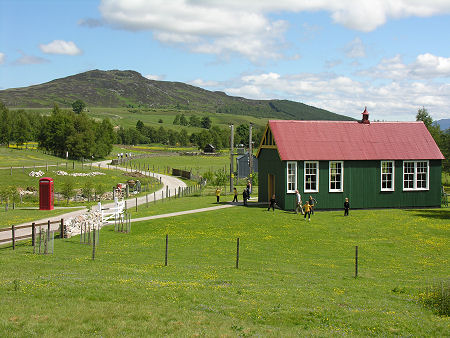
North east of Newtonmore, the road towards nearby Kingussie leads past the Highland Folk Museum. This offers an outstanding day out and includes a range of attractions in an outdoor setting, plus many buildings relocated from elsewhere in the Highlands.
 Highland Folk Museum |
|
|
|
Visitor InformationView Location on MapWhat3Words Location: ///forces.note.retailing |
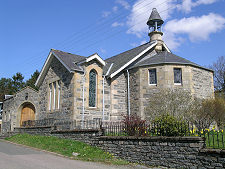 St Bride's Parish Church |
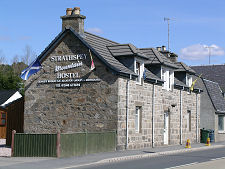 Strathspey Mountain Hostel |
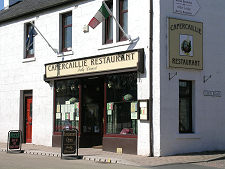 Capercaillie Restaurant |
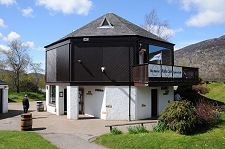 Ralia Cafe, on the A9 |