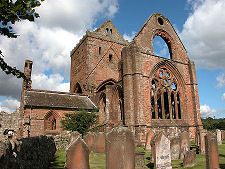
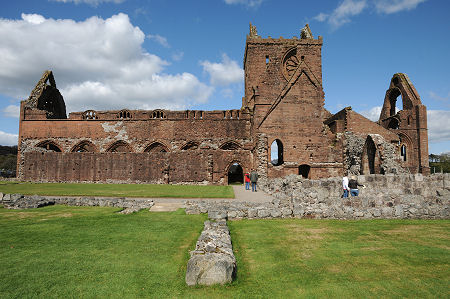
 Sweetheart Abbey from the South |
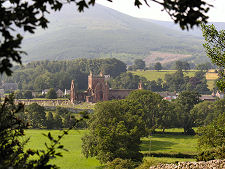
The substantial remains of Sweetheart Abbey can be found on the eastern edge of the village of New Abbey, five miles south of Dumfries. To its south-west lie hills climbing to the summit of Criffel while to its east lies the estuary of the Rive Nith.
The story of the founding of Sweetheart Abbey is held to be a testament to the enduring power of love. On 10 April 1273 Lady Devorgilla signed a charter establishing a new Cistercian abbey here in memory of her husband, John Balliol, who had died in 1268. Thanks to the Reformation her later endowment of a college at Oxford University in his name turned out to be a more enduring memorial.
Lady Devorgilla's love for her departed husband extended to carrying his embalmed heart around with her in an ivory box with enamelled silver trimmings. After her death in 1290 she was buried in the sanctuary of the abbey church she had founded, and on her instructions the casket containing her husband's heart was buried beside her.
The guide book tells us that in tribute to her love for her husband, the monks in the abbey she had founded chose thereafter to call it Dulce Cor or Sweetheart Abbey. The enduring power of love, certainly: but to squeamish modern sensibilities this is a love story with a distinctly gruesome edge.
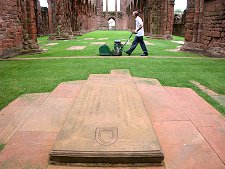
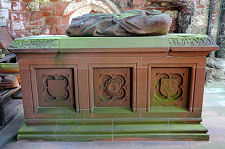
Today a monument marks the original location of Lady Devorgilla's tomb, in front of where the altar would have stood. A much larger monument was erected here in the 1500s, but was destroyed after the Reformation. The surviving pieces, including part of an effigy of Lady Devorgilla were incorporated into a restored tomb-like structure in 1932 which can be seen in the south transept.
While the abbey became known as Sweetheart, the village that grew to serve it stuck with the original and more straightforward name of New Abbey. This was intended primarily to distinguish it from the not so distant Dundrennan, home of Sweetheart Abbey's mother house, Dundrennan Abbey.
For the next quarter of a millennium monks lived, worshipped and died at Sweetheart. Edward I of Englandstayed here in 1300 but Sweetheart didn't suffer the same fate of many Scottish abbeys further east at the hands of passing English armies. In the late 1300s it came under the protection of Archibald the Grim, Lord of Galloway and builder of Threave Castle.
The end of Sweetheart Abbey as an active religious community followed the Reformation of 1560, though the impact here was more gradual than almost anywhere else in Scotland. By this time Sweetheart was under the protection of Lord Maxwell, a Catholic. With his help the last Abbot, Gilbert Broun continued to reside at Sweetheart and to practice the unreformed religion in defiance of the new order.
In 1603 Abbot Gilbert was imprisoned in Blackness Castle for his obstinacy, but on release he returned to Sweetheart. In 1608 his belongings were publicly burned in Dumfries and the Abbot was exiled to France, where he died four years later.
Many of the domestic buildings associated with Sweetheart Abbey were then slowly dismantled to provide stone for buildings in the village. In a remarkably early act of conservation, local subscribers clubbed together in 1779 to preserve the shell of the abbey church and what was left of the remainder "as an ornament to that part of the country".
Their successors passed the abbey into State care in 1928 and it is now looked after by Historic Environment Scotland. In 1974 a plaque was unveiled commemorating Sir William Paterson, founder of the Bank of England and architect of the Darien Scheme, who was buried at Sweetheart Abbey in 1719.
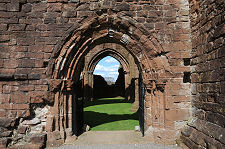
Today's visitor approaches from the large car park to the north-west of the abbey and progresses to the entrance near what would have been the western side of the cloister. The site is closely hemmed in on its northern and eastern sides by a large graveyard, and it is possible to appreciate these little viewed aspects of the abbey from different parts of the graveyard without entering the actual abbey itself.
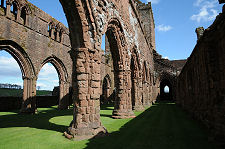
Once you do enter, your first port of call is the visitor reception, on the south side of the site, and you are then free to explore. Your first impression of Sweetheart Abbey is of just how overwhelmingly red it is, an impression that grows stronger if the sun is out. A large part of the shell of the abbey church is still standing, but little remains of the domestic buildings that would once have stood to its south, beyond wall lines on the ground.
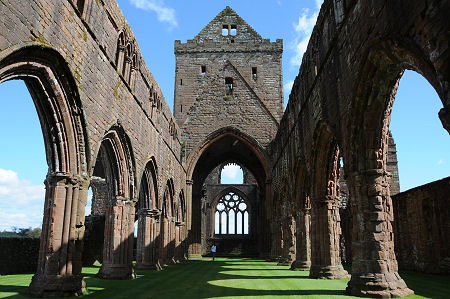 Inside the Nave of Sweetheart Abbey |
|
|
|
Visitor Informationwww.historicenvironment.scotHES: Abbey Web Page View Location on Map Post Code: DG2 8BU Grid Ref: NX 965 662 What3Words Location: ///fuse.trickle.airbrush |
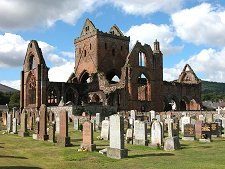 The Abbey Seen from the North |
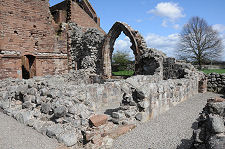 The Warming Room |
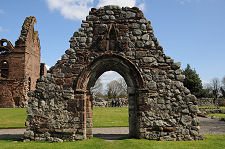 West Cloister Range Doorway |
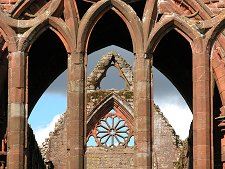
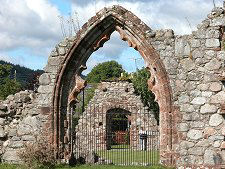 More Arches |
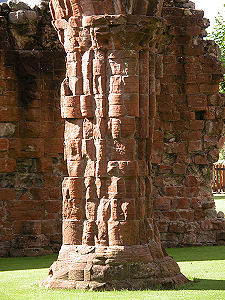 An Eroded Column |