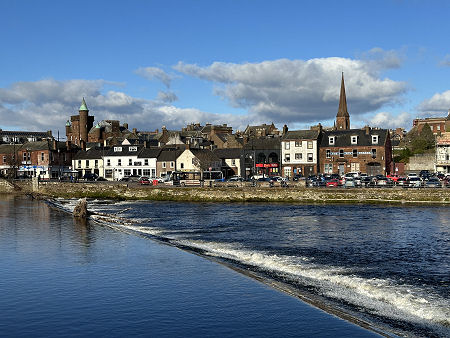
 Dumfries Seen Across the River Nith |
Known, like its football club, as "Queen of the South", Dumfries is an ancient town with a long and turbulent history. Today it is by far the biggest town in south-west Scotland; the administrative centre for Dumfries and Galloway; and the focus of a large rural hinterland.
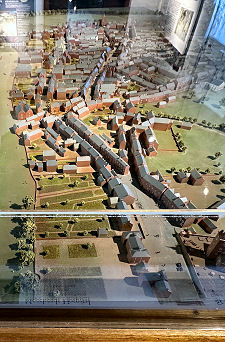
Dumfries was founded as a Royal Burgh in 1186 on the east side of the lowest crossing point of the River Nith. The land beyond the Nith, known as Galloway, only securely became part of Scotland during Alexander II's reign in 1234. As a result Dumfries was very much a frontier town during its early years as a Royal Burgh. Partly as a result of this it grew rapidly both as a market town and as a port.
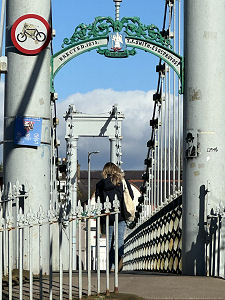
The first stone bridge over the Nith, Devorgilla Bridge, (or Old Bridge) named after Devorgilla, the mother of King John Balliol, was built here in 1432, possibly on the site of a wooden bridge built by Devorgilla in the 1260s.
It was rebuilt after flooding in 1620 and was shortened at its eastern end in about 1800. It is still used by pedestrians and is one of Scotland's oldest standing bridges. Most traffic over the Nith was diverted to the New Bridge or Buccleuch Bridge when it was completed in 1794. Since 1925 Dumfries also has a second road bridge, St Michael's Bridge, over the Nith, and there is also the rather fine Nith Suspension Bridge for pedestrians erected in 1875. Given the propensity of the River Nith for frequent and sometimes violent flooding, the main surprise is that the bridges that cross it at Dumfries have survived so well. (Continues below image...)
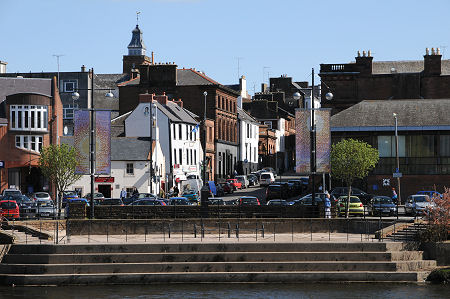 A Closer View of Dumfries Over the River Nith |
It was not from Galloway but from England that most of Dumfries' problems came during its first 500 years. English armies variously sacked, plundered or occupied the town in 1300, 1448, 1536, 1542, 1547, 1570: and it suffered again during the strife of the 1640s. Not all of Dumfries' bloody reputation was externally inflicted. Nine women were burned to death for witchcraft in the town in 1659, and two centuries later in 1868, Dumfries was the site of Scotland's last public hanging.
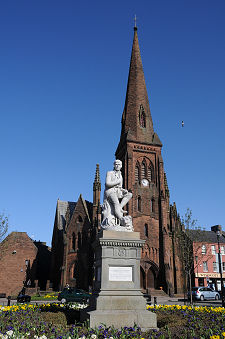
And to complete this account of the nastier side of Dumfries' history, it was in the Church of the Grey Friars that on 10 February 1306, Robert the Bruce murdered a rival for the Scottish crown, John III Comyn, "the Red Comyn". Robert the Bruce was excommunicated as a result, less for the murder than for its location, but nonetheless went on to become King of Scotland. Today's Greyfriars Church was built in 1868, overlooking the site of the murder on the opposite side of Castle Street, which is marked by a plaque on a wall between a travel agents and a discount shop.
Greyfriars Church also overlooks the attractive location of a symbol of a happier inheritance from the past: a statue of Robert Burns, sculpted in Italy in 1882. Burns spent the last years of his life in Dumfries, dying here in 1796. The statue is just one of a series of associations with Scotland's most famous poet to be found in the town. If you head south through the main shopping area you come to a tiny vennel leading to the Globe Inn, his favourite drinking place.
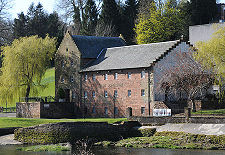
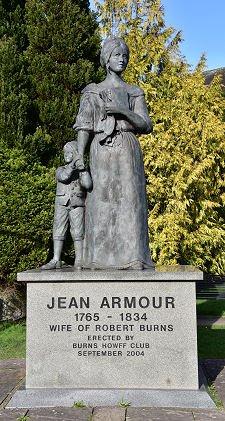
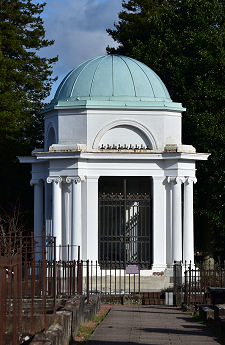
Visitors to Dumfries on the trail of Robert Burns can also find Robert Burns House at 24 Burns Street, south of the High Street, while his mausoleum can be found nearby in St Michael's Churchyard. To complete the list of places associated with Burns, on the west side of the River Nith is the Robert Burns Centre, housed in what was once the Dumfries Old Town Mill.
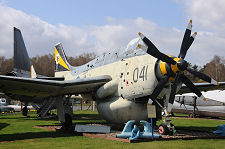
Dumfries also has three further museums. The excellent Dumfries Museum and Camera Obscura can be found atop a hill above the west bank of the River Nith and the Robert Burns Centre. This is built partly in a converted windmill. Meanwhile at the west end of Devorgilla Bridge is the Old Bridge House Museum, a series of remarkable collections of objects associated with aspects of life in Dumfries. And on the north-eastern edge of the town is the excellent Dumfries and Galloway Aviation Museum.
Anyone wanting to stay in Dumfries should consider the Cairndale Hotel, on the east side of the town centre, which we found to be excellent.
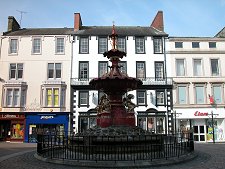
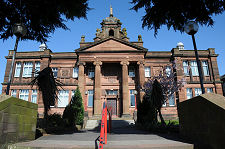
The town is home to many beautiful buildings, many constructed from the characteristic red stone. Perhaps the most spectacular is Mid Steeple, dating back to 1708 and once the town tolbooth and prison. This has undergone a major restoration in recent years, and the image on this page shows the works on the surrounding paving almost at an end. Other notable red buildings include Dumfries Academy, the Municipal Chambers and Dumfries and Galloway Council Offices. A more recent addition to the collection, because it was previously painted white, is "The Robert the Bruce", a pub conversion in a magnificent old church building overlooking the spot where the man it is named after killed his rival in 1306.
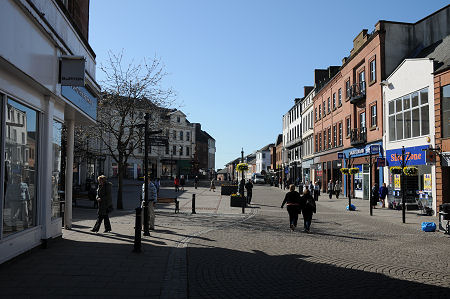 High Street |
|
|
|
Visitor InformationView Location on MapWhat3Words Location: ///spud.fines.bench |
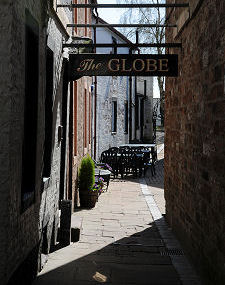 The Globe Inn |
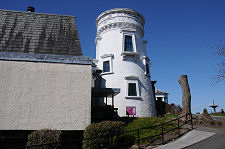 Museum and Camera Obscura |
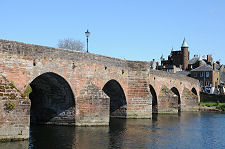 Devorgilla Bridge |
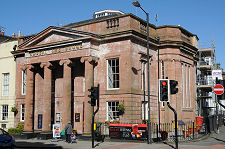 The Robert the Bruce |
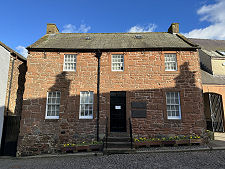 Robert Burns House |
 Jean Armour: Robert Burns' Wife |
 Robert Burns Mausoleum |