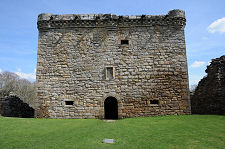
 Craignethan Castle from the West |
Craignethan Castle stands in a magnificent defensive location, high on a bluff created by land that drops steeply to the River Nethan on two sides and to the Craignethan Burn on the third. The steep sided valley formed by the River Nethan cuts into the uplands on the western side of the Clyde Valley some four miles north-west of Lanark. Craignethan Castle can be approached along a minor road that heads south-west from the A72 at Crossford, in the Clyde Valley, or along minor roads running north-east from Blackwood, a village that is now bypassed by the M74.
Whichever approach you use, you end up in the wonderfully named hamlet of Tillietudlem, and from here a single track access road curves around to approach Craignethan Castle from the west. Of the two roads to Tillietudlem, the one from Crossford is best because, if you keep a careful look out en route, it gives you some spectacular views of the castle from the valley below.
On arrival at the car park you begin to appreciate that while the castle's location afforded superb defences on three sides, it was compromised on the western side by significantly higher ground rising within easy cannon range. The natural assumption, therefore, is that the castle must have been built before artillery became a consideration. This is actually some way from the truth. Craignethan Castle was very much a product of the artillery age, and when originally built it could boast some of the strongest artillery defences anywhere: though sadly almost nothing now remains of the most important part of them.
Craignethan Castle was built by Sir James Hamilton of Finnart, the illegitimate son of the Earl of Arran. Work began in about 1530 and seems to have taken several years. Hamilton was a man with powerful enemies, and a claim in 1540 that he had been involved in a plot against his friend James V many years earlier, though probably untrue, led to his execution for treason. Craignethan passed to the Crown, before being acquired in 1542 by another James Hamilton, 2nd Earl of Arran, half brother of the original builder, who was also Regent of Scotland.
This Hamilton pursued his personal ambitions with mixed success before and during the personal reign of Mary Queen of Scots. After her abdication, Hamilton and his family led the forces supporting Mary's claim to the Scottish Crown. In January 1570, this led to their arranging the assassination in Linlithgow of the Earl of Moray, acting as Regent for the infant James VI. The Earl of Moray had briefly captured Craignethan Castle in 1568 after Mary's defeat at the Battle of Langside, but lost it to the Hamiltons again later the same year.
In July 1570 and again in 1571 the Hamiltons launched abortive military coups from their bases at Craignethan and Hamilton Castles. During the second of these the new Regent for James VI, Earl Lennox, was also killed (see our Historical Timeline). Hostilities paused in 1573, but in March 1578 James VI took personal control of the government at the age of 12. In May 1579 he moved against the Hamiltons and they were finally brought to account for their part in the deaths of James' two Regents in 1570 and 1571.
What is now known as Cadzow Castle fell quickly to James VI's forces. Hamilton Castle was besieged for four days, and Craignethan Castle was expected to put up even stiffer resistance. But it was abandoned without a fight, and in the 1580s the main defences were demolished. Craignethan ceased to function as a castle after an active life of just 50 years. The tower house remained in use as a family residence, but was replaced in 1665 with a more modest and modern house in the south-west corner of the outer courtyard by the castle's then owner, Andrew Hay.
Craignethan Castle assumed new significance in the 1800s when it was associated in popular imagination with "Tillietudlem Castle", which featured in Sir Walter Scott's novel "Old Mortality". Despite Scott's denial of the link, a nearby branch line railway station, built later in the 1800s, was named Tillietudlem Station. The railway line is long gone, but the name of the station lives on in the name subsequently given to the local hamlet. The growing popular interest in the castle led to repairs starting at the end of the 1800s, and in 1949 Craignethan was placed in the care of the State. Today it is looked after by Historic Environment Scotland.
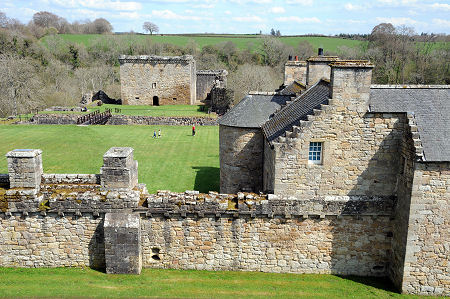
You approach Craignethan Castle on foot from the car park on the hillside to the west. As you see it laid out in front of you, your first impression is of the domestic buildings around the outer courtyard, and the tower house standing aloof at the far end of the castle beyond the defensive ditch.
The visitor reception is in a building on the inside of the wall near the main gateway, and this, with the 1665 house in the south-west corner of the castle and the doocot tower in the north-west corner of the outer courtyard, are the main points of interest in this part of the castle. It is thought that in the 1500s the centre of the outer courtyard was given over to decorative or kitchen gardens, and that there were ranges of accommodation built around its outer edges.
The outer courtyard is separated from the inner courtyard by a deep stone-lined ditch cut across the promontory on which the castle stands. The only access is by means of a modern bridge. This is probably as good a time as any to think about Craignethan Castle's lost artillery defences. The main element of these was a stone wall that rose sheer from the east side of the ditch and carried on up until it dwarfed the tower house to the east. In effect the tower house and the east end of the castle were protected by hiding them behind an absolutely huge barrier, so thick it could be relied upon to withstand the best artillery of the day, even when guns were placed in what is now the car park on high ground to the west. It is a great shame that this wall was removed in the 1580s as its sheer scale must have been extremely impressive.
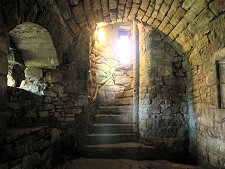
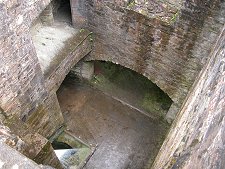
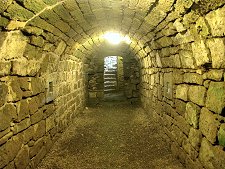
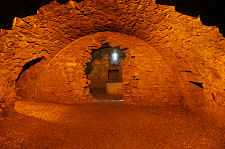
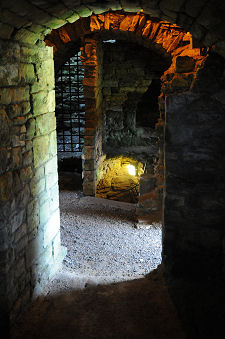
Much of the stone from the demolished wall was used to fill the ditch, and when this was cleared out in 1964 it revealed a further surprise, a caponier set across the floor of the ditch and designed to allow defenders inside it to shoot at any attackers who made it as far as the floor of the ditch. The caponier can be reached by means of a turnpike stair on the eastern side of the ditch. When it was excavated in 1964 it still contained animal bones believed to be the remains of the last meal of the defenders who deserted it without firing a shot in 1579.
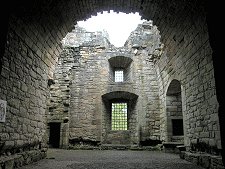
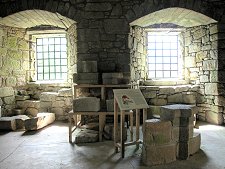
The main building on the eastern side of the ditch is the tower house. This provided accommodation for the laird and his family, and various levels of it can be explored today, from the basement kitchen to the roof. This end of the castle is also home to three further towers. Immediately to the north of the tower house is the gate tower, through which visitors would have to pass in order to enter the inner courtyard after crossing the ditch and passing along the outside of the north wall. The ruinous north-east tower housed additional accommodation and a kitchen, while the south-east tower, the best preserved of the original structures of the castle, seems to have provided yet more accommodation and a chapel.
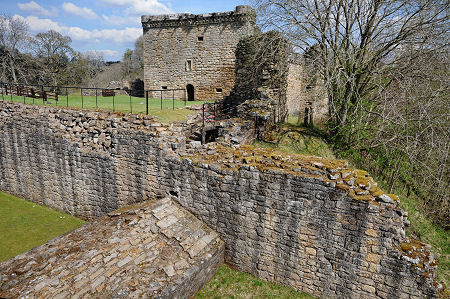 Tower House Seen Across the Ditch, with the Caponier in the Foreground |
|
|
|
Visitor InformationView Location on Map4 Star Castle. Tel: 01555 860364. Post Code: ML11 9PL Grid Ref: NS 815463 www.historicenvironment.scot HES: Castle Web Page Opening Hours Admission Accessibility What3Words Location: ///prompt.performed.dean |
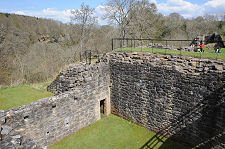 Traverse Wall Across End of Ditch |
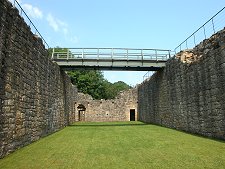 The Ditch from the Caponier |
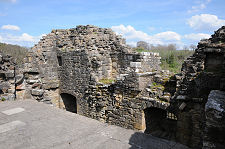 Attic Level in the Tower |
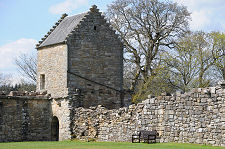 The Dovecot Tower |
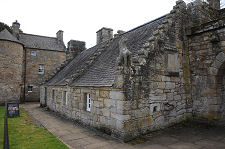 Visitor Reception |
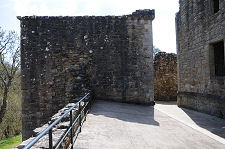 The South-East Tower |
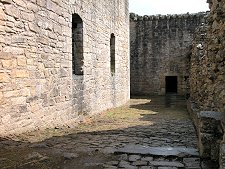 Cobbled Yard |
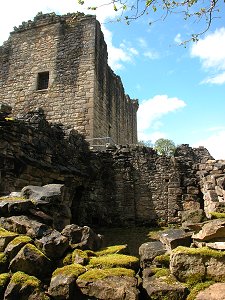 Tower House from the North-East |