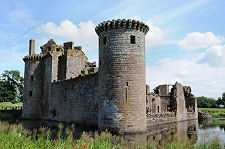
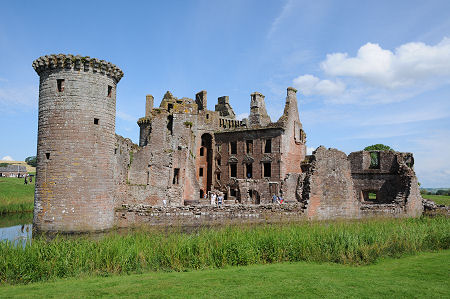
 Caerlaverock Castle from the South-West |
It takes a little effort to get to Caerlaverock Castle. It lies just off the B725 some seven miles south of Dumfries, close to where the River Nith flows into the Solway Firth. But this is a trip well worth making: Caerlaverock is one of the most attractive and interesting castles in Scotland.
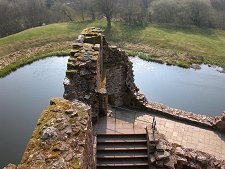
There are a number of things that help set Caerlaverock apart. The most striking is the way it is lapped by the waters of its broad inner moat. Coupled with its shape, an equilateral triangle with its apex at the huge northern gatehouse, the result is intriguing and instantly pleasing to the eye.
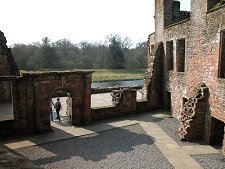
You should start your tour with a walk around the bank that runs along the outside of the inner moat. A second, outer, moat has been drained, but is still very obvious around much of the castle. The south-east tower and most of the south curtain wall were destroyed in 1640. This produces the effect of a life-size cutaway of the castle with most of the interior visible from the far side of the moat. Tackling it this way means that when you do enter the castle itself, you already have an excellent idea of its layout.
Also adding to the interest of a visit to Caerlaverock Castle are a number of extra attractions. Is one castle not enough for you? You can also find the foundations of another, earlier, castle visible at the end of a nature trail through the woods to the south. And in the visitor centre are a well stocked shop, a café and an exhibition about the castle. Plus enthusiastic and knowledgable custodians keen to help you make the most of your visit. (Continues below image...)
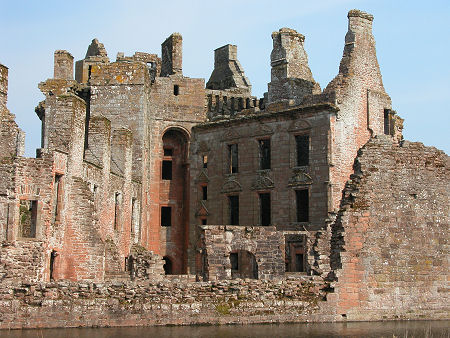 Cutaway View of the Castle Interior |
Finally, it is worth noting that Caerlaverock Castle stands on the northern edge of the Caerlaverock National Nature Reserve. This covers some 21 square miles or 55 square kilometres running in a strip along the shore of the Solway Firth. It consists of saltmarshes, mudflats and grazing land and is an internationally important site for waterfowl and wading birds.
As you arrive at the castle, the narrow road from the B725 passes through a stone arch thought to have been built in the late 1500s. This gives access to what was originally the castle's large outer ward. Parking is signposted, and from here you proceed to the visitor centre to begin your visit.
The story of Caerlaverock Castle begins with the granting of lands in the area to Sir John De Maccuswell (or Maxwell), Chamberlain of Scotland, in 1220. He set to work building a stone walled castle 200 metres south of the one you see today. It is still possible to see grassy mounds which define the layout of what he built. Maybe "Old Caerlaverock Castle" was simply too close to the Solway Firth to keep its occupants dry and comfortable, or perhaps the clay on which it was built, even with wooden piling for support, was unable to bear the weight of the structure.
Either way, at some point in the 1260s Sir John's brother and heir, Sir Aymer Maxwell, began building a replacement castle on a triangular outcrop of rock a little to the north of the old castle. What we now know as Caerlaverock Castle was completed in the 1270s and was occupied by Herbert Maxwell, son of Sir Aymer and nephew of Sir John.
In 1299 the garrison of Caerlaverock Castle attacked the English-held Lochmaben Castle. Retribution arrived the following year when Edward I of England invaded Galloway and successfully besieged Caerlaverock with 87 knights and 3000 men. The siege was supported by a collection of siege engines transported from all over southern Scotland and northern England.
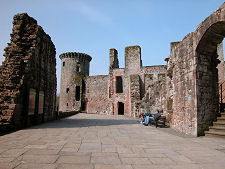
The English kept the castle until 1312. They then returned it to Sir Eustace Maxwell, Sir Herbert's grandson, who at the time was a supporter of King John Balliol. Sir Eustace later switched his support to Robert the Bruce, which led to an unsuccessful English siege of Caerlaverock Castle. The Maxwells then slighted the castle to prevent it being used by English forces. It had been repaired by 1337, and following a further switch of sides by Sir Eustace Maxwell, was besieged and captured by Scots in 1356. Most of the remains of the castle on view today date back to the rebuilding that took place through the remainder of the 1300s and most of the 1400s. The west and (largely destroyed) south ranges date back to this time, as does the formidable gatehouse.
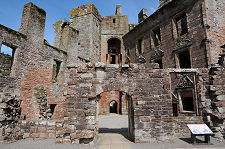
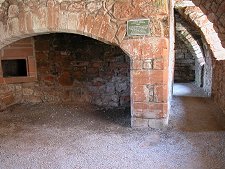
The castle saw more action in the 1500s, being captured by the English in 1544 and again attacked by them in 1570. However the union of the crowns in 1603 finally offered the promise of peace between England and Scotland after 400 years of sporadic warfare. In 1634 Robert Maxwell, the First Earl of Nithsdale, converted the castle into something more befitting the family's standing and the more peaceful times. He built the magnificent Nithsdale Lodging, the east range whose ornamental stonework still dominates the interior of the castle.
But the promise of peace was illusory, and wars between England and Scotland were swiftly replaced by wars of religion, doctrine and kingship. In 1640, just six years after the building of the Nithsdale Lodging, Caerlaverock was held by the Maxwells for King Charles I against a besieging army of Covenanters for thirteen weeks before surrendering (see our Historical Timeline). Damage caused by the Covenanters during and after the siege was never repaired and what you see today is pretty much what was left in the Summer of 1640. Caerlaverock Castle was placed in State care in 1946 and is now looked after by Historic Environment Scotland.
Read about Thomas D. Murphy's visit to Caerlaverock Castle in his 1908 book, British Highways and Byways From a Motor Car.
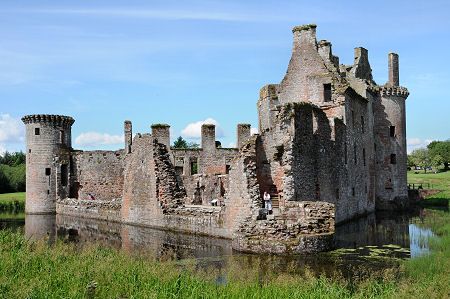 Caerlaverock Castle from the South-East |
|
|
|
Visitor Informationwww.historicenvironment.scotHES: Castle Web Page View Location on Map Post Code: DG1 4RU Grid Ref: NY 025 656 What3Words Location: ///basin.startles.charm |
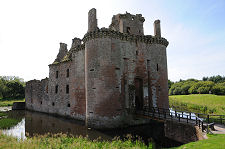 The Gatehouse |
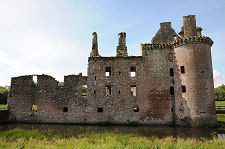 The South-East Range |
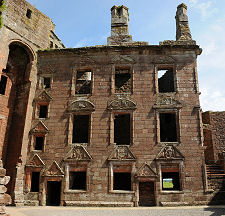 The Nithsdale Lodging |
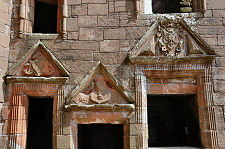 Nithsdale Lodging Stonework |
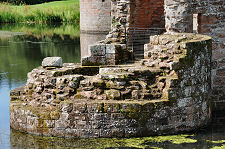 Base of the South-East Tower |
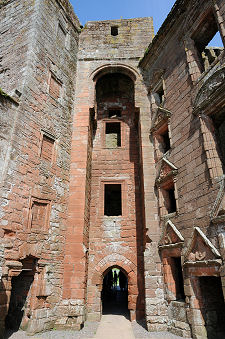 Castle Entrance |
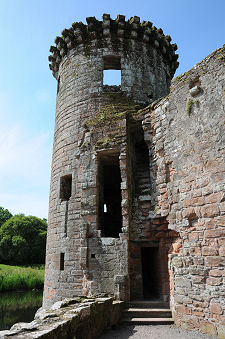 The West Tower |
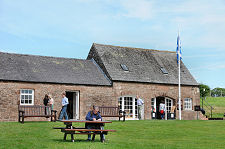 Visitor Centre |
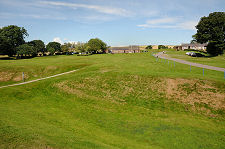 Outer Moat and Outer Ward |
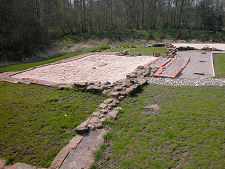 Remains of Old Caerlaverock Castle |