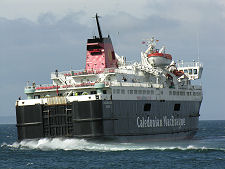
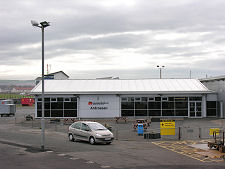
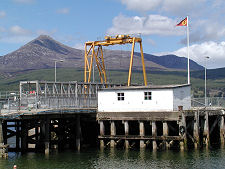
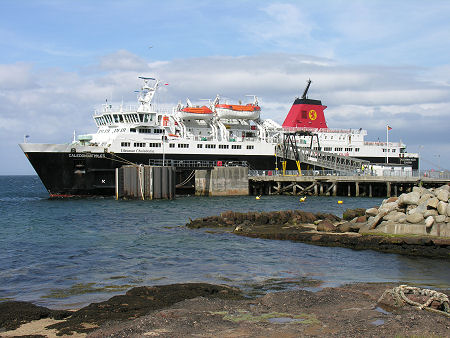
 MV Caledonian Isles at Brodick |
In the heyday of the Clyde steamers you could travel by sea to the Isle of Arran from any of a large number of Clyde, Ayrshire, Kintyre and Bute ports; and to destinations on Arran including Lochranza, Corrie, Brodick, Lamlash, Whiting Bay, Kildonan and Blackwaterfoot.
Times have changed and today the island has two ferry links. The first, and by far the best known, is the link between Ardrossan on the Ayrshire coast and Brodick on Arran. The main ship in service on this route is one of Caledonian MacBrayne's largest vessels, the MV Caledonian Isles. This can carry up to 120 cars and 1000 passengers, with cars driving straight through and using the stern door at Brodick and the bow door at Ardrossan. During the summer months, the normal service is supplemented by a number of return crossings each day by the smaller MV Saturn. For current timetable and fare information, and for bookings, visit CalMac's website.
The second ferry link to and from Arran is provided by the connection between Lochranza at the northern tip of the island, and Claonaig, on the Kintyre peninsula south of Tarbert. This can carry 18 cars and up to 150 passengers for the 30 minute journey across the Kilbrannan Sound. The presence of these two ferries means that Arran can be used as a stepping stone en route to or from Kintyre and Islay, and Caledonian MacBrayne offers a "Hopscotch" ticket that allows the two routes to be linked together.
These days if you think "ferry", you tend to think "car ferry". It wasn't always so. It was certainly not the case in 1839 when the Ardrossan Steamboat Company built a wooden paddle steamer called the Isle of Arran and offered a service between and the rather primitive piers then in existence at Lamlash and Brodick.
Other footnotes to history include the oddly named "Frith of Clyde Steam Packet Co Ltd". Presumably once the original slip of the quill had been made it proved too much trouble to correct it. This company's other claims to fame included running the steamer Ivanhoe on an alcohol-free basis during the 1880s, and a line in advertising that would raise a few eyebrows nowadays: "Passengers may rely on having a pleasant sail without the ordinary rabble common on board Clyde steamers during the Glasgow Fair."
Nonetheless the Ivanhoe provided a popular link between Helensburgh, Greenock, Wemyss Bay and various Arran ports, and succeeded in moving Arran upmarket as a destination for those who were particular about their travelling companions. A period of frantic competition followed, with the railway companies in a race to provide the fastest services. At its height in the early 1890s you could travel from St Enoch station in Glasgow to Arran by express train and connecting steamer in an hour and a half.
The 1900s brought a steady reduction of the range of services on offer, with the loss of links to Campbeltown and to Ayrshire ports other than Ardrossan. Meanwhile the steady increase in traffic on the Ardrossan to Brodick route led to a perpetual struggle to provide vessels with the capacity and the speed of loading and unloading to cope with demand.
A major step in this continuing battle was the arrival on the route in August 1993 of the Caledonian Isles, which had been built in Lowestoft. This replaced the older MV Isle of Arran, itself designed for the route and brought into service in 1984. With the arrival of the Caledonian Isles and its 50% larger car-carrying capacity, supply leapfrogged demand once more, and the supplementary summer sailings in recent years of the MV Saturn have ensured that capacity on the route remains ahead of demand. Built at Troon in 1977, the Saturn is a much smaller vessel than the Caledonian Isles, but is popular with those who sail on her.
Finally, as you drive effortlessly into the Caledonian Isles' large vehicle deck, spare a thought for your predecessors in the 1930s who had to drive over two precarious planks to board the first "car ferries", but only if the tide was right. Or those in the 1950s who could benefit from hoists and turntables, but on ships where loading and unloading took so long that delays accumulated on busy days and last sailings often finished hours late.
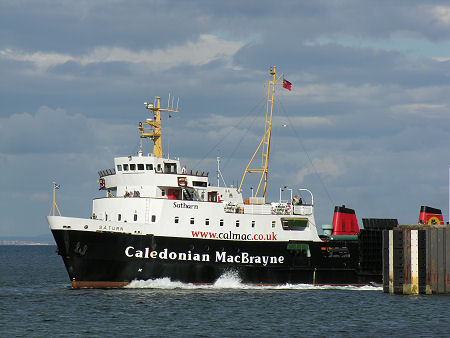 MV Saturn Leaving Brodick |
|
|
|
Visitor InformationView Location on MapFull details, including current timetables and prices can be found on CalMac's website. |
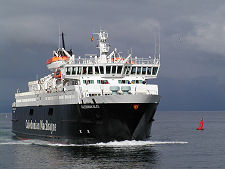 Caledonian Isles Nears Ardrossan |
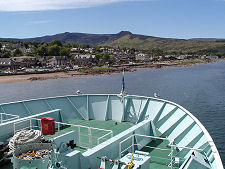 Brodick from the Caledonian Isles |
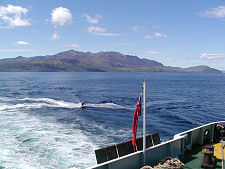 The North End of Arran |
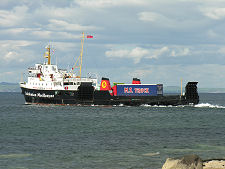 Saturn Leaving Brodick |
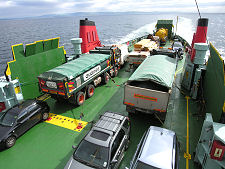 Saturn's Vehicle Deck Saturn's Vehicle Deck |