 Étienne MacDonald Note About Image Copyright |
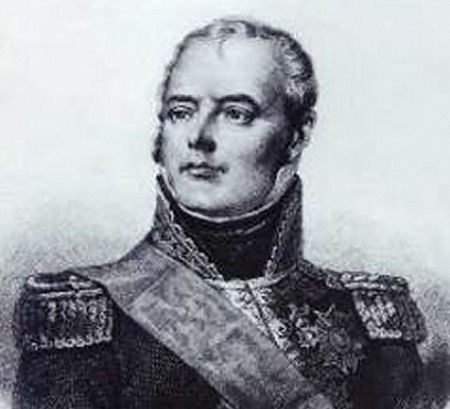
Étienne-Jacques-Joseph-Alexandre MacDonald, 1st Duc de Taranto, lived from 17 November 1765 to 7 September 1840. He was a Marshal of France during the Napoleonic Wars. The wider picture in Scotland at the time is set out in our Historical Timeline.
Étienne MacDonald was born in Sedan, France in 1765. His father was Neil MacDonald of Howbeg, South Uist, a staunch Jacobite living in exile following the suppression of the 1745 Uprising, and a close relative of Flora MacDonald, who had helped Prince Charles Edward Stuart evade capture by government troops after the uprising.
In 1785, MacDonald joined the French army fighting against the Prussians in the Netherlands. After the outbreak of Revolution in France he sided with the Revolutionary army, perhaps because the woman who became his first wife came from a strongly revolutionary family. He distinguishing himself in the Battle of Jemappes against the Austrians on 6 November 1792. The following year he was promoted to Colonel, later rising to General. In 1797 he was appointed Governor of Rome. He later added Naples to the French possessions in Italy, and successfully held up the Austrian and Russian Armies at the Battle of Trebia in Northern Italy in 1799. In 1800 he was appointed commander of the French Army in Switzerland.
In 1805 MacDonald fell out with Napoleon by appearing to support a potential rival, Jean Moreau, and he was relieved of his military command. But in 1809 Napoleon appointed him military adviser to Prince Eugène de Beauharnais, Viceroy of the Kingdom of Italy and commander of the French Army in Italy. On 5 & 6 July 1809 he led part of Napoleon's army in the French victory over the Austrians at the Battle of Wagram near Vienna. Napoleon immediately made him a Marshal of France and gave him the title of 1st Duc de Taranto.
MacDonald served in Spain in 1810, and in 1812 he commanded part of Napoleon's Grande Armée during the disastrous invasion of Russia. He remained loyal to Napoleon during the latter's subsequent defeat and abdication, though he then became a strong supporter of the restored Bourbon Dynasty, remaining with them during Napoleon's "100 days" that culminated at the Battle of Waterloo. The Bourbons later made MacDonald Chancellor of the Legion of Honour, and Major General of the Royal Bodyguard.
In 1823 MacDonald married a second time, to Mademoiselle de Bourgony. Their son, Alexander, succeeded to the title of Duc de Taranto on MacDonald's death in 1840.