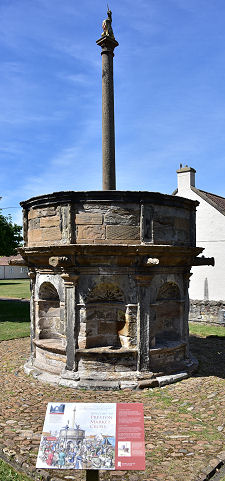
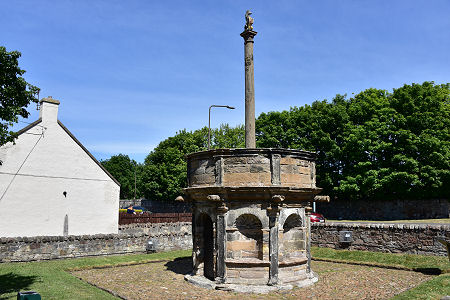
 Preston Cross from the South |
A fairly modern estate of bungalows a short distance from Prestonpans railway station and on the edge of modern Prestonpans is the slightly unexpected location for Preston Cross, the only surviving example of a mercat (or market) cross of its type on its original site in Scotland, and often said to be the finest mercat cross in the country.
It is reasonable to ask why such an important structure was built in what appears to be a very peripheral location. The answer lies in the fact that in the early 1600s the area around Preston Tower was the location of the town of Preston, a distinct settlement from Prestonpans, which stood on the coast. At that point, Preston was the more important of the two settlements, and in 1617 the Hamiltons of Preston, the local landowners and residents of Preston Tower, were granted a charter to hold a weekly market and an annual fair.
The annual "St Jerome's Fair" took place on the second Thursday of each October and, despite being held at a time when the weather might not have been expected to be at its best, would have been the social and mercantile highlight of the year for Preston and for much of the surrounding area. (Continues below image...)
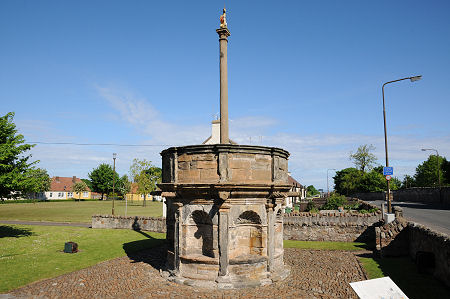 Preston Cross from the South-West |
A market town needed a mercat cross as the symbolic representation of the right to hold markets and fairs, and as a focal point for the events themselves and for town life more widely. The records relating to the building of Preston Cross were lost when Preston Tower was attacked and burned in 1650, but it seems likely that it was erected some time soon after 1617. Preston Cross was one of five mercat crosses built to a similar design in Scotland in the 1600s. Those built in Edinburgh, Perth and Dundee were later destroyed or replaced, while Aberdeen's mercat cross was moved to a different location in about 1840. This makes Preston Cross all the more special.
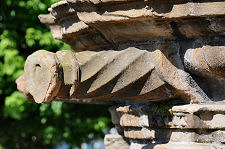
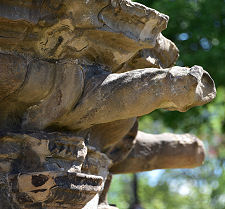
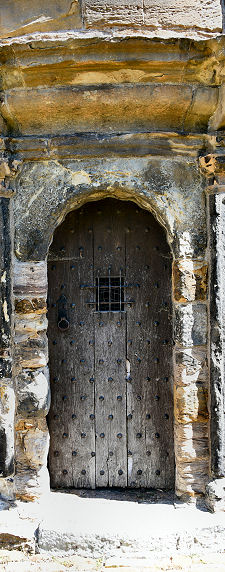
Preston Cross comprises a cylindrical structure measuring some 14ft in diameter and 12ft in height, with the central shaft and ceremonial unicorn rising to an overall height above the ground of just under 30ft. The base has two doorways. One, protected by an iron yett or grill, gives access to stone steps leading up to the platform on top of the base of the cross. From here proclamations would have been read out. On the other side of the structure is a wooden door giving access to a small circular room. This served as the town prison and replaced a cell that had previously been in use in Preston Tower.
In 1636 the right to hold the fair passed to "The Chapmen of the Lothians": a chapman was a travelling salesman. As late as 1851 it is recorded that "The Ancient and Royal Fraternity of Chapmen of the Three Lothians, Incorporated 1530" was issuing invitations to "our ancient cross of Salt Preston, where we will hold our court, and thereafter will proceed in state to witness the sports and pastimes of the villagers." By the late 1800s it is recorded that the area around the cross formed "a large market garden" and that The Chapmen of the Lothians had ceased to exist as an organisation. Preston Cross had, however, been recently restored at that time through public subscription, and this seems to have been the main factor in ensuring its survival into the modern era. It is now in the care of Historic Environment Scotland.
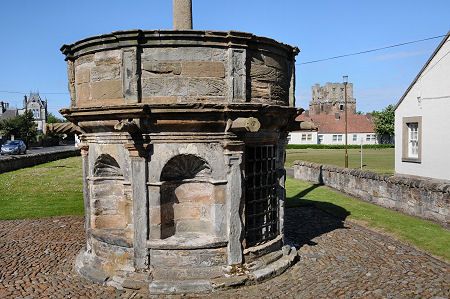 Base of the Cross, with Preston Tower in the Background |
|
|
|
Visitor Informationwww.historicenvironment.scotHES: Preston Cross Web Page View Location on Map Grid Ref: NT 392 741 What3Words Location: ///scam.tidal.shops |
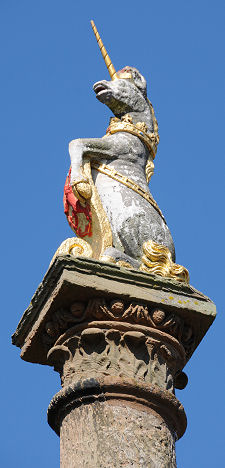 The Unicorn |
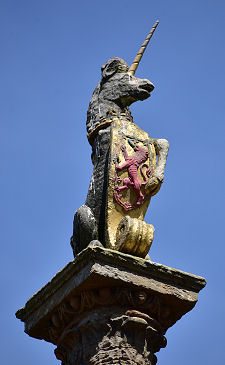 Another View of the Unicorn |
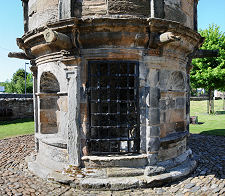 The Yett Protecting the Stairs |
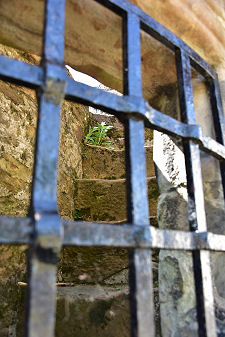 A Glimpse of the Stairs |