 St Andrews Old Kirk from What Was Once the West End of the Nave |
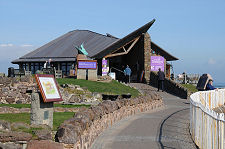
The two bays that form the shoreline of North Berwick are divided by a rocky promontory that is home to the town's harbour and to the Scottish Seabird Centre. With beaches either side, this is one of the most popular parts of the town for its many visitors, with the result that even out of season, it can be a busy area.
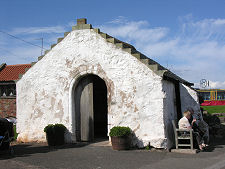
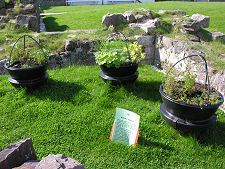
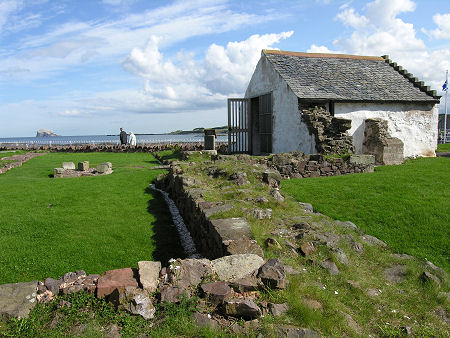
It would be interesting to know how many of the visitors who walk along the path from the East Bay to the Scottish Seabird Centre pay much attention to the small white-harled stone building which stands just inland from the path. Or to the lines of low stone walls that are laid out across the area of grass to its north. We suspect that most people barely notice them, even if they pause to sit and eat an ice cream on the bench next to the building. Which is a shame, because it adds to the drama of the location to realise that you are walking across the middle of a church whose entire east end was swept into the sea in a storm in 1656.
By the time nearly half of St Andrew's Old Kirk was claimed by the sea, there had been a church on this spot for around 1,000 years. The first church was probably made of wood and was probably constructed by monks from the Abbey at Lindisfarne some time in the 600s. The succession of "probablies" in that sentence reflect the fact that no trace of this early church has ever been found, probably because of later building on the same site.
This later building began with a simple rectangular stone church comprising a nave and a chancel some time in the mid 1100s. The church would have served the local community, and the steady stream of pilgrims passing through North Berwick to catch a ferry to Earlsferry in Fife en route to St Andrews. These pilgrims were to remain an important feature of the local economy until the Reformation in 1560 and the income they provided paid for a series of extensions to St Andrew's Old Kirk.
The first addition was a chapel on the north side of the church in the late 1200s. A tower followed in the early 1400s, and aisles either side of the nave in the late 1400s. The final addition, made after the Reformation, was a small porch projecting south from the end of the south aisle. It is ironic that this porch is the only part of the church to survive today. The 1656 a storm caused the complete collapse of nearly half of the church, with much of it simply disappearing as the sea advanced to a line now occupied by the modern sea defences. Some people at the time viewed this as divine retribution: the kirkyard had, allegedly, been a gathering place for witches in the 1590s.
What was left of the church was beyond saving, still less repair, and most of the rest of the church rapidly also disappeared as it was used as a quarry by the townspeople of North Berwick. The porch remained because various uses were found for it, including, from the 1850s, as a base for the Coastguard Rocket Patrol, who would attempt to launch lines out to ships grounded on coastal rocks. The site was abandoned and a replacement Parish Kirk, also dedicated to St Andrews, was built nearer the centre of the town. This was in turn replaced by a new church on yet another site in 1883.
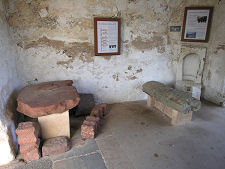
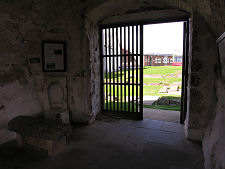
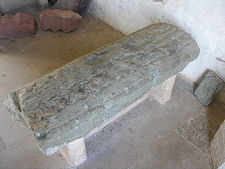
Inside the porch today is a display of some of the items unearthed during excavations in the 1950s and in 2000. These include part of a table gravestone, and part of a grave slab probably marking a knight's burial in the 1200s. These are the only grave markers that remain. The old kirkyard, later known as Anchor Green, is otherwise empty: with one exception. This is the fine Celtic cross that stands a little to the south of the porch. This was erected in memory of Catherine Watson who, on 27 July 1889 at the age of 19, saved a drowning boy in North Berwick's East Bay, but was herself drowned while doing so.
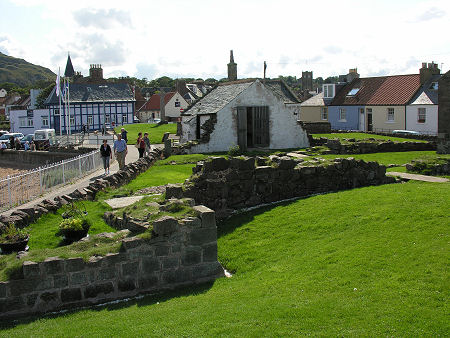 Looking South Across the Nave to the Porch |
|
|
|
Visitor InformationView Location on MapGrid Ref: NT 554 856 What3Words Location: ///kebabs.pave.blissful |
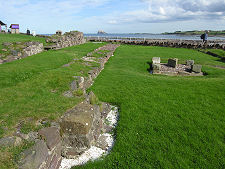 Looking East Along the Nave |
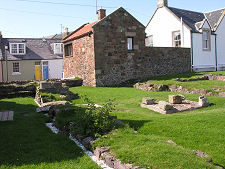 Looking North-West Across the Nave |
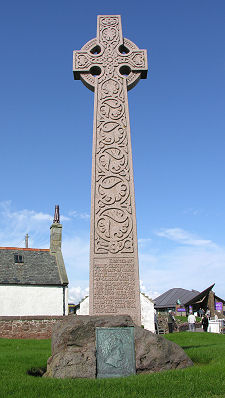 Cross Commemorating Catherine Watson |