 Knockando Parish Church |
Close to Cardhu Distillery and on a ridge looking south over the Spey Valley lies the beautiful Knockando Parish Church. You reach it by driving almost into Cardhu Distillery before following the road round to the left and, apparently, away from the settlement. A signpost at a crossroads a quarter of a mile further on points you to the left, and the church is a short distance from here. There is a car park just outside the churchyard gate.
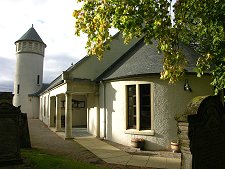
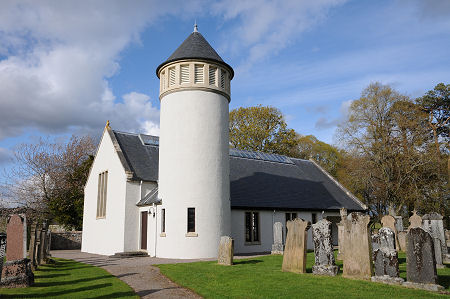
What you find is a church that is obviously of fairly recent construction. Knockando Parish Church was built in 1993 to replace a predecessor, which was destroyed by fire in November 1990. All that had been left was a charred shell. A major fundraising campaign was launched and the exceptionally beautiful church you see today was built at a cost of £400,000.
Knockando Parish Church was designed by the Law & Dunbar-Naismith Partnership to reflect the spirit of the earlier church: and the almost free standing circular corner tower is strongly reminiscent of its predecessor.
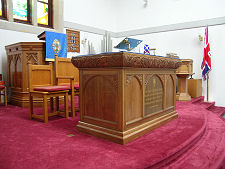
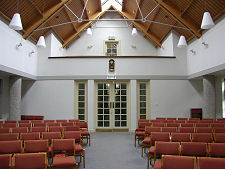
Internally the church has a wonderfully light and airy feel. This is helped greatly by the glazed ridge that runs along most of the length of its roof. The underlying shape is very traditional, as is the presence above the east end of the nave of a gallery. The columned porch built into the south-east corner harks back to even earlier antiquity, giving this part of the building an almost Roman feel.
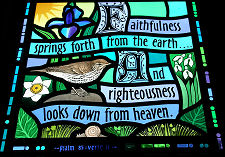
The columns are carried through into the interior, with more being used to separate the nave from narrow aisles to the north and south. This adds to the sense of space and light, while some beautiful modern stained glass contributes to the church's very welcoming atmosphere.
Today's church is only the latest of several to have stood on the site. The church that burned down in 1990 was built in 1757. It was later enlarged in 1832 and 1868 before being extensively rebuilt in 1906 at a cost of £2000. It was at this point that a round tower was added to the church, which is replicated so effectively in the building you see today.
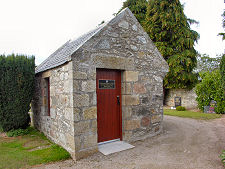
One feature unaffected by the fire was the watch house in the churchyard. This was presumably added in the early decades of the 1800s, when the scourge of bodysnatchers (or "resurrectionists") stealing fresh corpses for medical schools affected even the most remote corners of Scotland. This threat ended with the passing of the 1832 Anatomy Act, which allowed a legitimate supply of cadavers for medical education and research. The watch house has been converted into a free standing chapel.
Two further features are well worth looking out for in the churchyard of Knockando Parish Church. The first is the presence of three ancient carved stones set into the inner face of the churchyard wall near the gate. They are badly weathered, but it is still possible to see that two are Pictish symbol stones. The third is said to carry runes, but they are far from obvious. The stones were moved here in the 1850s from an old burial ground at nearby Pulvrenan.
It is also worth looking out for the remarkable collection of immortelles in the churchyard. Immortelles were stunningly beautiful but highly fragile memorials comprising china flowers, birds and other objects arranged in a circular form and covered by a glass dome. They were popular in the 1800s and the few which have survived have been protected by wire cages. If you find one with an unbroken glass dome today, it usually has so much condensation on its inside surface that the contents are difficult to see. We've never seen more than two anywhere else, but there are at least five at Knockando, though in various stages of completeness.
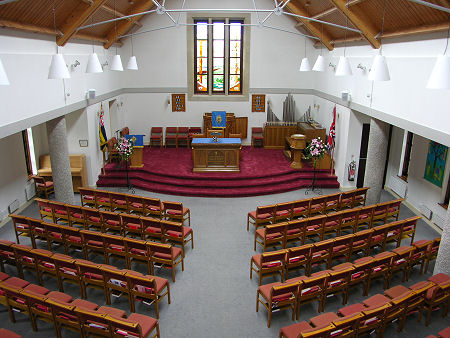 The Interior of the Church |
|
|
|
Visitor InformationChurch WebsiteView Location on Map Grid Ref: NJ 186 429 What3Words Location: ///perused.ready.sailing |
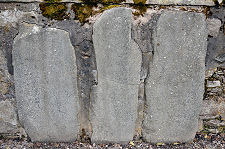 Stones Set in Churchyard
Wall Stones Set in Churchyard
Wall |
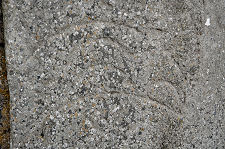 Traces of a Pictish
Symbol Traces of a Pictish
Symbol |
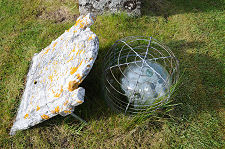 Complete Immortelle Complete Immortelle |
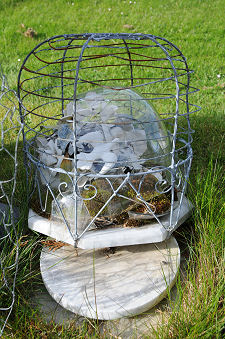 Damaged Immortelle |