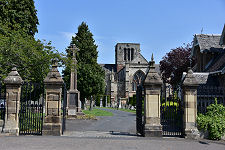
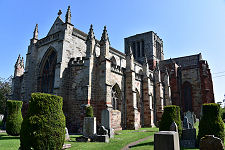
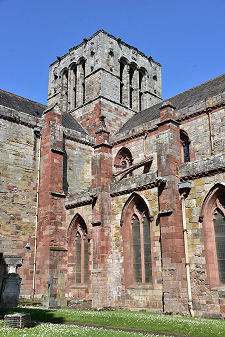
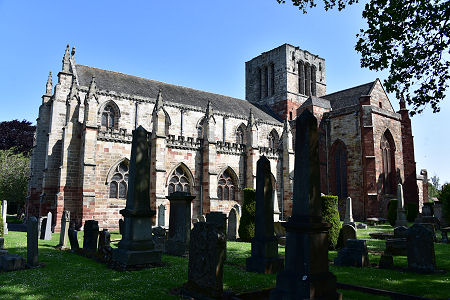
 St Mary's Church, Haddington, from the South |
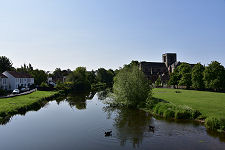
A short walk from the bustle of Haddington's High Street and Market Street is Scotland's longest parish church, St Mary's. In a beautiful setting on the banks of the River Tyne, St Mary's is a tranquil oasis with a turbulent history.
The casual visitor to St Mary's is likely to be struck first by the warmth of the welcome on offer, and then by the scale of a space larger than you'll find in many cathedrals. St Mary's is 62.8m long, or 0.7m longer than St Giles' Cathedral in Edinburgh.
But it takes a little while for the real wonder of St Mary's to sink in. Perhaps you'll notice the weathering on the statues in the south transept that make them look more like exterior stonework. Or, most obviously, it might simply be the information boards that lead you to realise that much of St Mary's was only restored to what you see today between 1971 and 1973.
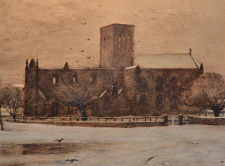
For most of St Mary's life the parish worshipped in the nave of the church. This was all that remained in a usable state after Haddington was used as the headquarters of an occupying English army in 1548. After the English had departed the nave was restored and in 1561 a wall was built to close off its east end. The tower, transepts and choir were left roofless and exposed to the elements for over 400 years: a historic ruin attached to, but cut off from, the active church in the nave. (Continues below images...)
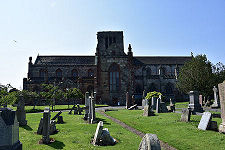
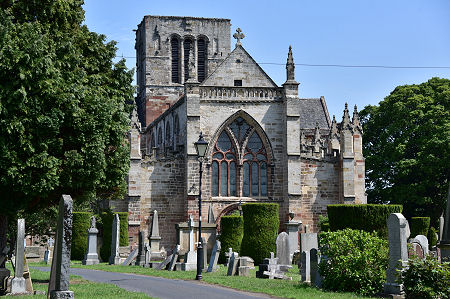 St Mary's Seen from the West |
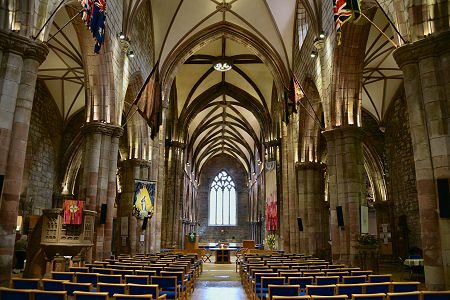 Inside St Mary's, Looking East |
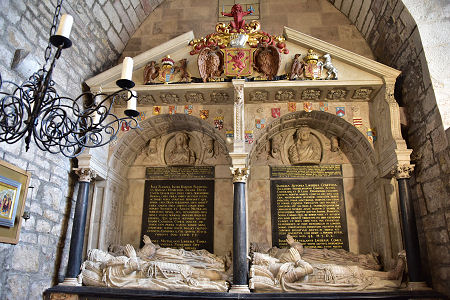 The Lauderdale Aisle |
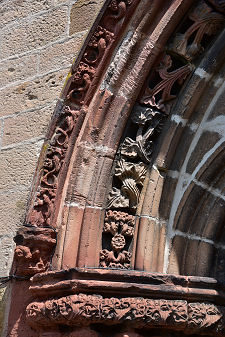
The restoration of St Mary's has been described as one of the most significant church restorations undertaken in the 20th Century. Perhaps most remarkable is the difficulty in "seeing the joins". Externally there is nothing to suggest the church hasn't always been as you see it today.
Internally, the clues offered by weathering of areas of stonework are subtle, and it takes the more modern furnishings of the choir to give it a distinctive atmosphere. Less obvious is the ceiling of the choir, apparently constructed in the same way as that of the nave, but actually made of fibreglass using 1970s boat-building technology.
An especially nice example of the approach taken during the restoration can be seen in the beautiful South Transept window that started life in St Michael's, Torquay, before being stored in crates in the Victoria and Albert Museum from the 1930s. Someone realised that this would be a perfect fit for the gap in St Mary's, and as can be seen from the image on this page, we all benefit as a result.
The choir is striking for its beautiful hand-made clear glass windows. These tie St Mary's to a strand of history dating back nearly eight centuries to 1242. That was the year in which the Grey Friars completed their friary church in Haddington. This church became known as The Lamp of Lothian because of the "elegance and clearness of light" in its choir. The Lamp of Lothian (and much else besides) was extinguished in February 1356 by Edward III of England during a brief military campaign so fierce it became known as "the Burnt Candlemas."
In 1380, work began on the building of St Mary's, a short distance away from the site of the friary church. St Mary's was completed in 1486 but was to last just 62 years until the attentions of another occupying English army left almost everything but the nave ruined in 1548.
Over the centuries, St Mary's has often been called The Lamp of Lothian through confusion with the predecessor friary church. The clear glazing inserted in the restored choir of St Mary's in the 1970s has brought the stories of the two churches together. The east end now has the "elegance and clearness of light" once attributed to the Grey Friars' friary church. It can now properly be called, as the title of its guidebook suggests, The Lamp of Lothian. There's a sense in which the 1970s restoration breathed life back into not just one, but two different churches destroyed centuries earlier.
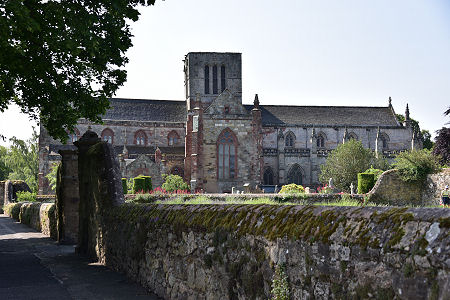 St Mary's from the North |
|
|
|
Visitor Informationwww.stmaryskirk.co.ukView Location on Map Grid Ref: NT 518 736 What3Words Location: ///pine.goals.cling |
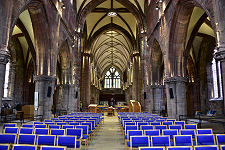 Looking West in the Restored Choir |
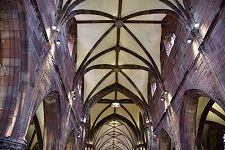 Ceiling of the Choir |
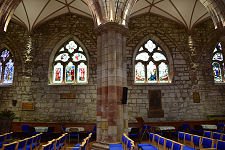 View Across the Nave |
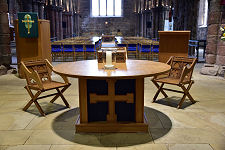 The Crossing |
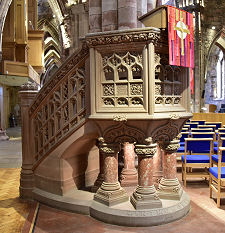 The Pulpit |
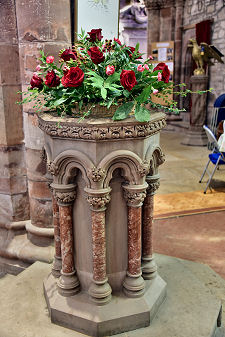 The Font |
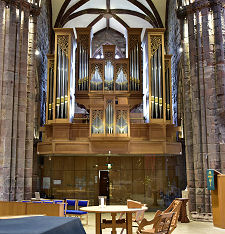 The Organ |
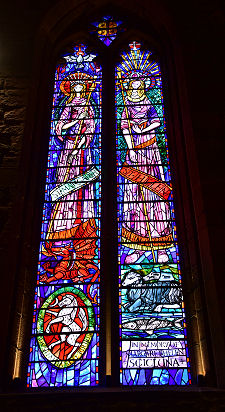 The Scicluna Window |
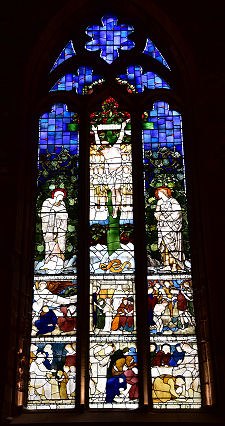 Window from St Michael's, Torquay |