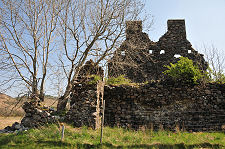
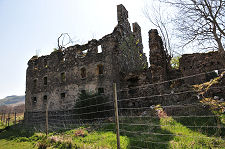
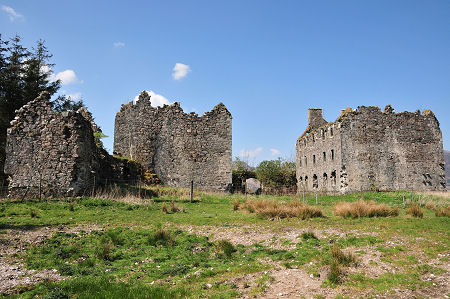
 Bernera Barracks from the East |
The Glenelg Ferry, linking the mainland with the Isle of Skye, is a reminder that the fastest, indeed the only practicable, overland route to or from Skye was for centuries via the foot of Glen Shiel and Glenelg, then across the narrows of the Kyle Rhea. A second reminder of the same thing is, despite its size, rather less obvious. A few hundred yards to the north of Glenelg stand the very substantial remains of Bernera Barracks.
In the aftermath of the 1715 Jacobite uprising the Government built new barracks at four strategically important locations across the Highlands, with the best known being at Ruthven Barracks near Kingussie. Bernera Barracks, completed in 1723, is similar to Ruthven, though built to accommodate more troops (up to 240). It was designed to provide defence against light attack and a secure base from which troops could patrol the surrounding area. Most importantly, it was intended to ensure that the important route between the Isle of Skye (and by extension the Western Isles) and the mainland was securely guarded.
Work began on Bernera Barracks in 1719, and it is often reported that as well as being quarried from rather nearer at hand, stone was also robbed from the Glenelg Brochs, Dun Telve and Dun Troddan, in 1722. This is one of those stories that are repeated in just about every source, but which fall short of being entirely convincing. (Continues below image...)
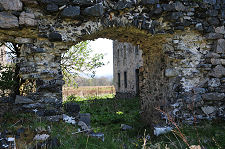
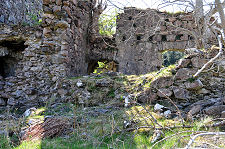
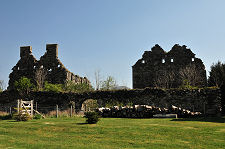
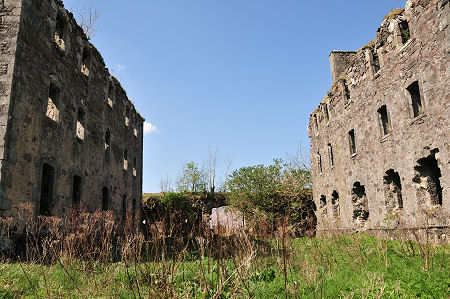 The Barracks Courtyard, Seen from the East |
Bernera Barracks played no significant part in the 1745 Jacobite uprising, though it presumably had a role in the widespread suppression of Jacobite clans across the Highlands and Islands that followed. By 1795 a visitor recorded that the barracks were already in a state of disrepair, and the military presence has been scaled back to a corporal and a few privates. The army left for good in 1797, and the barracks appear to have found little later use beyond temporary accommodation during the Highland Clearances.
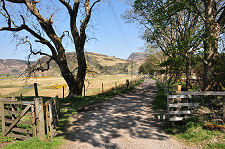
There is a track from the centre of Glenelg that takes you the short distance (via a detour around the front garden of the aptly-named Barracks Cottage) to the barracks. It comes as a real surprise to find that such a large structure can have survived so completely, and that it seems so invisible in the landscape until you are close to it.
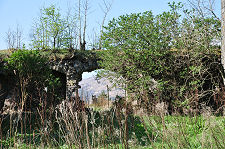
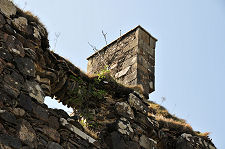
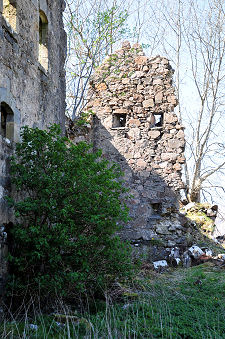
It is worth saying, though, that while the barracks may be largely complete (other than a missing wall that would have run along its eastern side and enclosed the rear of the courtyard), it is obviously in a very poor state of repair. Although the main structure is clearly strong enough to support the trees that grow within it and from the tops of its walls, anyone wanting to take a really close look is running a high risk of having something heavy drop on their head. All the photos on this page were taken from outside the fence that surrounds the ruin: this is not a place that invites close acquaintance.
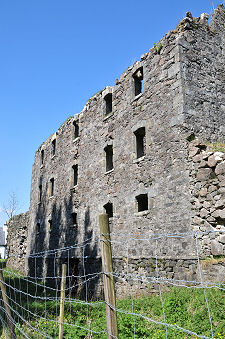
The barracks comprises two main accommodation blocks, each double the size of its counterpart at Ruthven Barracks. There are also the remains of two towers, at the south-east and north-west corners, though these were probably more to provide services than defence. The western curtain wall remains to its original height, while the absent eastern wall provides a view into the courtyard that would otherwise be blocked.
It is a shame that Bernera Barracks cannot be consolidated and made safe in the same way as Ruthven Barracks. The result would be both fascinating and a real asset to the area.
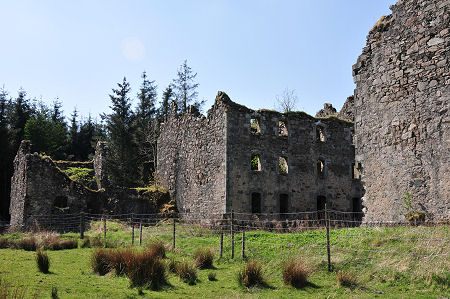 Bernera Barracks Seen from the North-East |
|
|
|
Visitor InformationView Location on MapGrid Ref: NG 815 198 What3Words Location: ///swaps.manifests.beats |
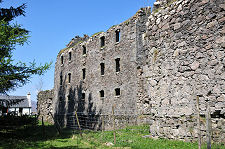 Exterior of the South Block |
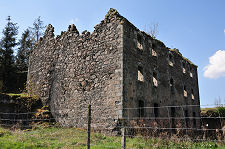 Inner Face of the South Block |
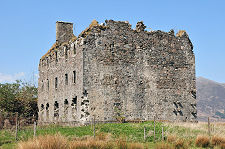 North Block from the South-East |
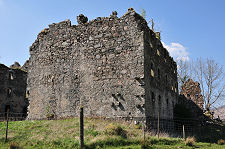 North Block from the North-East |
 The Barracks from the West |
 The Southern Block |