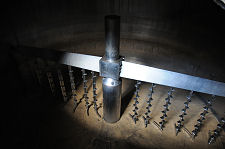
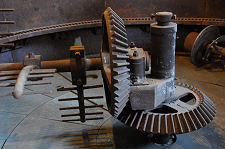
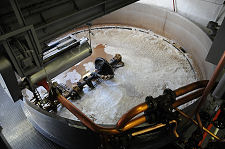
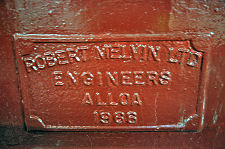
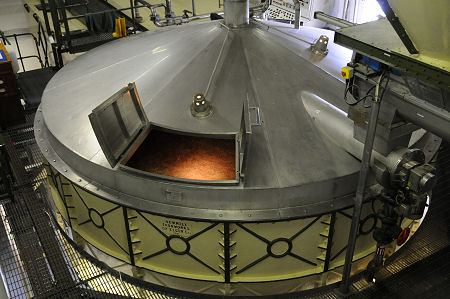
 The Mash Tun at Ardbeg |
Think of an old-fashioned teapot, the sort your granny had before they invented tea bags. Add in a device that stirs up the tea leaves as they brew and a floor which acts as a sieve to allow the liquids to drain away while leaving the solids in the vessel. Finally, make it much, much bigger, and make it from steel or iron rather than the china of the teapot. Congratulations, you have just built a mash tun...
The basic idea is similar in all malt whisky distilleries, though as with every other stage in the process there are subtle variations from one distillery to the next which contribute to the huge variety of malt whiskies, and to the infinite fascination of visiting the distilleries. A basic description of the process is as follows. The ground down malted barley, or grist, emerging from the malt mill is fed into the mash tun together with a charge of water heated to 64°C. This temperature is high enough to dissolve many of the sugars in the grist, but low enough to allow the enzymes present to continue the chemical processes begun during germination.
After a period of mashing the "wort", or liquid, is drained from the tun and collected in a tank called the underback. More water, this time at a temperature of about 80°C, is added to the mash tun to dissolve still more of the sugars in the grist. This, too, is drained off to the underback where, mixed with the first brew, it becomes the starting point for the brewing process in the washbacks. (Continues below image...)
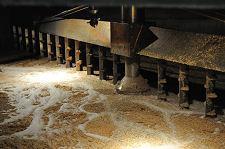
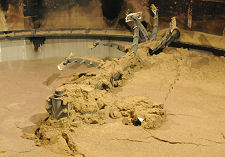
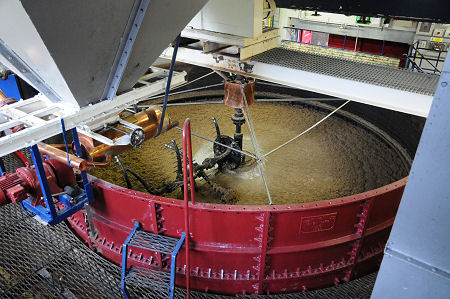 The Traditional Open Topped Mash Tun at Deanston |
A final charge of water at a temperature of around 85°C is added to the mash tun to dissolve anything worthwhile still left in the residue. This water, known as the "sparge", is then drained off and is subsequently used as the first charge of water to be added to the next batch of grist. The solid residue in the tun, called "draff", is cleared out of the mash tun (by shovel in many distilleries) and taken away to be used as animal feed. The process then begins all over again, using a fresh batch of grist and reusing the sparge from the last run at at a temperature of 64°C to begin the next brew.
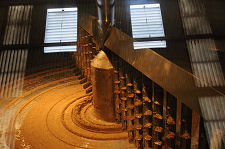
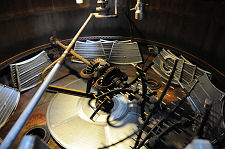
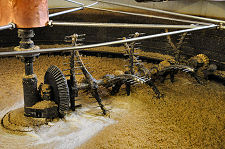
During each stage of the process the mix is continuously agitated, either by an agitator circulating above the floor of the mash tun, or by a series of bladed rods projecting down into the vessel from a rotating arm that extends across the width of the mash tun. The difference between the two is easy to overlook but does have some significance. Traditionally, malt whisky distilleries had mash tuns in which a geared arm projecting from a pole in the centre to the outside of the vessel went round and round. Projecting from the arm was a series of what might be called rakes which rotated around the arm.
You can still find many distilleries in which this traditional form of agitator continues to be used. However, since the 1970s an alternative arrangement has spread across many distilleries. In this the rotating arm crosses the diameter of the tun, and remains above the level of the mash within it. A series of rods project from it down to the floor of the vessel, and on each is a series of blades. The second type of vessel is properly called a lauter tun, or a lauter mash tun: in practice the sign invariably says "mash tun". The name comes from the German to filter, "lautern".
In principle a lauter tun could be used continuously, spraying water at a steadily increasing temperature into the tun while at the bottom the wort drained into the underback. In practice distilleries tend to stick to the traditional method of three "infusion mashes" even when using lauter tuns. The resulting process is known as a "semi-lauter" system. The reason why it has taken over from the traditional rotating rake approach in many distilleries is that it succeeds in extracting about 1% more fermentable material from a given quantity of grist. Over time that represents a significant additional level of efficiency.
All distilleries have at least one mash tun, while some have two. They are usually made from stainless steel to ease cleaning though some, like those at Dallas Dhu, Clynelish, Ardbeg, Bruichladdich, Deanston and Springbank are made from sections of cast iron bolted together: a tribute to the Victorian engineering that probably produced them, but presumably requiring more work to keep clean. Another difference is that while most mash tuns have tops, usually made of copper or stainless steel, a number are still open-topped.
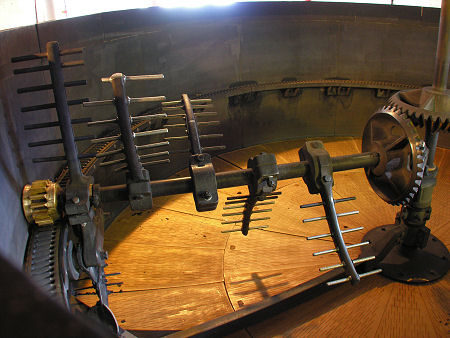 Inside a Traditional Mash Tun at Springbank |
|
|
|
Making Malt Whisky: |
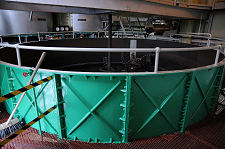 Open Topped Tun at Bruichladdich |
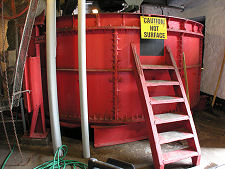 And Another at Springbank |
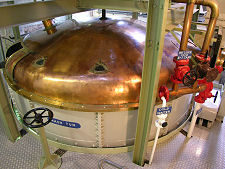 Mash Tun at Dallas Dhu |
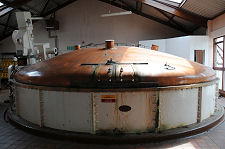 Clynelish Distillery |
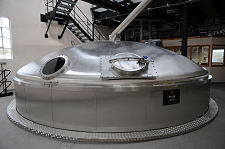 Stainless Steel at Glen Ord |
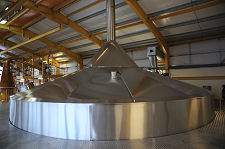 UFO Inspired Mash Tun at Glenlivet |
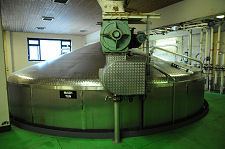 More Stainless Steel at Ben Nevis |
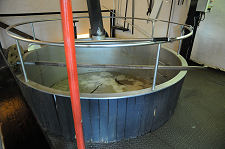 Diminutive Mash Tun at Glenturret |
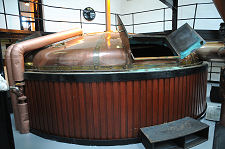 Wood Clad Mash Tun at Bowmore |