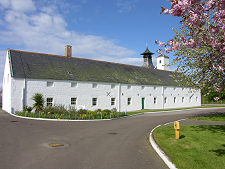
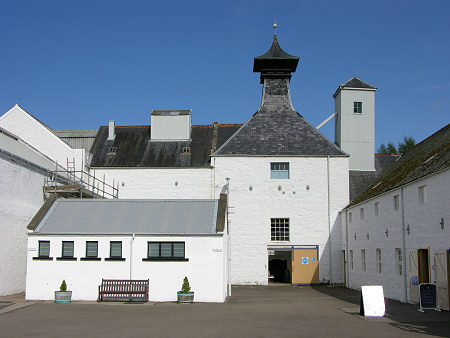
 Reception and Visitor Centre, on Right, and Kiln |
After a period of closure, it was announced in July 2024 that Dallas Dhu Distillery would reopen as a working distillery with a visitor centre and that "Aceo Distillers Company Limited (Aceo) will take over the management of distillery operations, implementing a phased program of development of the site. Historic Environment Scotland will retain guardianship of the site on behalf of Scottish Ministers." Timescales were unspecified: watch this space!
Visiting a disused distillery maintained in working order by Historic Environment Scotland can seem a slightly odd idea. In practice it turns out to give an excellent insight into the distiller's art. For without the health and safety, security and excise restrictions that always go with a tour of a working distillery, you really can get much closer to what actually happens in a distillery. You can find out more about Making Malt Whisky from our series of feature pages showing the stages in the process.
Dallas Dhu Distillery lies just south of Forres on a minor road that branches off the A940. It is adequately signposted, but you do have to overcome the sense of being sent into a housing estate at one point.
The distillery was built in 1898-9 on the estate of Alexander Edward of Sanquhar by a Glasgow based whisky blending company, Wright and Grieg Ltd. Their main blend was called Roderick Dhu and sold well in the 1880s and 1890s, especially in India, Australia and New Zealand.
Dallas Dhu was located on the Altyre Burn to ensure a good supply of the most important raw material, water. Excellent barley was also available nearby, and the site was served by the (now long closed) railway line from Forres to Aviemore.
Dallas Dhu's fortunes fluctuated over the following 80 years, and its ownership changed more than once. The distillery was closed from 1929 to 1936; and the stillhouse burned down in 1939, being rebuilt just in time to be closed once more during World War Two.
Significant investment in the 1960s and 1970s helped bring the distillery up to date, but by the early 1980s it was clear that there were more distilleries than could possibly be needed to meet forecast demand. By 1983 Dallas Dhu was owned by the Distillers Company, who took the decision to close some of their smaller and older distilleries to reduce their capacity and costs. One was Dallas Dhu.
At the same time, the importance of distilling to Scotland's heritage was becoming more widely recognised. The organisation that is now Historic Environment Scotland was therefore looking for a distillery to preserve. Of all those it looked at, Dallas Dhu was about the most complete and original: and it had the added advantage of being smaller than most and relatively easy to manage and maintain. Dallas Dhu therefore reopened as a visitor attraction in 1988.
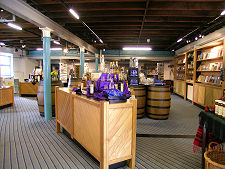
A visit to Dallas Dhu begins, as with most distilleries, at the Visitors' Centre. Here you are issued with an audio "wand" that gives a running commentary on each of the key stages in the distilling process as you stroll around. This is a great idea that allows you to tour at your own pace, or even take a second look at areas of particular interest.
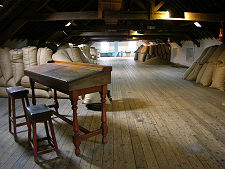
The first important element in the tour is one that is becoming increasingly rare in visits to working distilleries, the malt barn. Here you get a real sense of the way the barley was steeped then laid out to sprout. You then proceed to the kiln, the building surmounted by the kiln head or pagoda that is so characteristic of distilleries, yet which is now no longer used in so many of them.
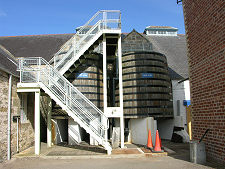
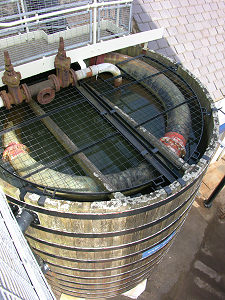
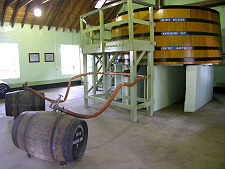
After the kiln, the going becomes more familiar to visitors of working distilleries. The next main stage involves the copper topped mash tun in which the crushed malt was soaked with hot water. This feeds through to the huge barrels in which the initial fermentation took place: the wash-backs.
Anyone who has ever stuck their nose into a wash-back at a working distillery will notice the absence of some very characteristic smells at Dallas Dhu; but against this must be set the ability to look as closely as you like at the equipment.
This is especially noticeable in the still room. This houses the two stills used at Dallas Dhu, and it takes you a while to realise the main difference from a working distillery: the absence of the usually oppressive heat of the still room.
Other differences are equally striking. We'd never before, for example, seen the insides of a still. And you'd certainly not be invited back if you tried to photograph inside a still in a working distillery.
And when you come to the spirit safe, you again appreciate the differences from a live distillery. Perhaps you lose the sense of the stream of clear spirit flowing through the safe. But you would most certainly not be able to manipulate the controls yourself if spirit was still involved.
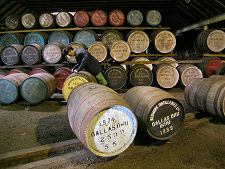
Moving on again, visitors are taken through the cask-filling area to the bonded warehouses; and finally back to the Visitors' Centre. Here one tradition well known to visitors of working distilleries is maintained. You are offered the chance to taste a dram of the product, though (understandably) a blend rather than the increasingly scarce and expensive single malt still available from the years before Dallas Dhu ceased production.
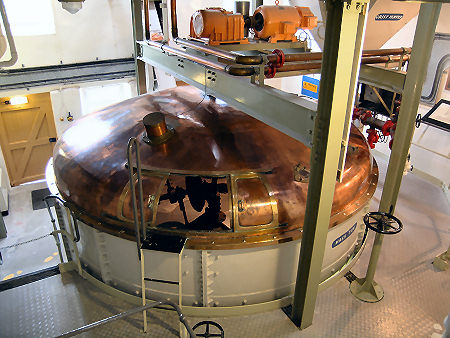 The Mash Tun |
|
|
|
Visitor InformationView Location on Map4 Star Visitor Attraction. Tel: 01309 676548. Post Code: IV36 2RR Grid Ref: NJ 035 566 www.historicenvironment.scot HES: Distillery Web Page What3Words Location: ///nets.scorecard.livid |
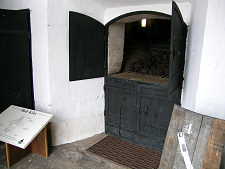 Kiln |
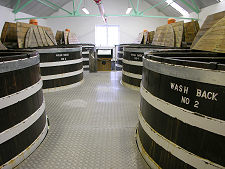 The Wash Backs |
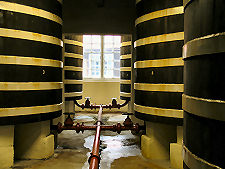 Lower Portions of Washbacks |
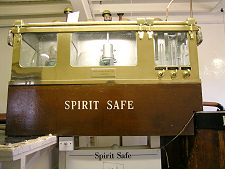 Spirit Safe |
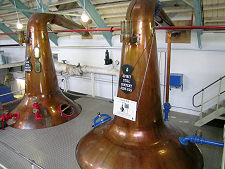 The Stills |
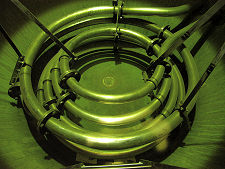 Still Interior |
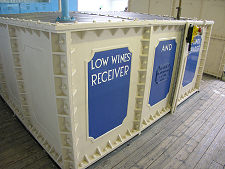 Low Wines Receiver |