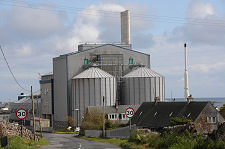
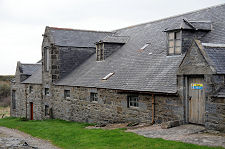
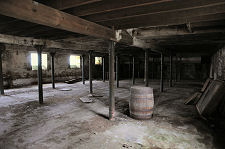
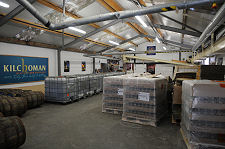
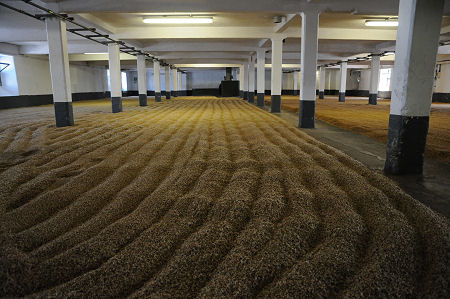
 Floor Maltings at Laphroaig |
Malt whisky is made exclusively from malted barley. Spirit made in Scotland from barley plus other grains that has been matured for three years in oak can also be called Scotch whisky; but we are concentrating here on the production of malt whisky, so it is to barley that we turn as the starting point.
There's a view in much of the distilling industry that only three things are important about the barley it uses. The first is how much sugar it produces as it converts its natural starch during germination. The second is how much peat smoke it has been exposed to in the kiln. And the third is how little solid product it is likely to carry through the brewing process into the wash to clog up the wash still. This is slowly changing. The idea that the barley used can also have an effect on the taste of the product dawned on parts of the brewing industry during the real ale revival of the 1970s, and is now becoming accepted by some distillers too.
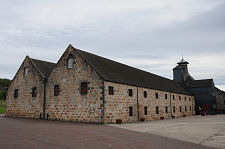
Barley in its native form is a rare sight in distilleries these days. The pagoda that traditionally tops the kiln that brings the malting process to a halt has become the symbol of the distillery, to the point that some modern distilleries that never had a maltings carry pagodas. This symbolism continues despite (or perhaps because of) the fact that the number of distilleries with operational floor maltings and working kilns has diminished dramatically. Many sources say there are just six or seven, but the recent launch of a number of new distilleries means it is probably now more, and a number of longer-established distilleries have plans to reintroduce floor maltings. (Continues below image...)
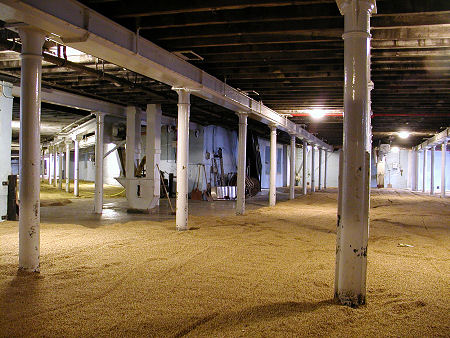 "Y" Shaped Floor Maltings, Highland Park |
There are three distilleries with floor maltings on Islay: Laphroaig, Bowmore, and Kilchoman. Two more are on the mainland: Balvenie in Speyside and Springbank in Campbeltown. And a sixth is in Orkney: Highland Park. It is worth bearing in mind that even where a distillery has its own floor maltings, it may also buy in malted barley to supplement what it produces itself, sometimes in considerable quantities: maltings have rarely expanded to keep up with capacity increases in the rest of the distillery process.
Most distilleries buy in all their malted barley from the large scale industrial maltings such as the one at Port Ellen on Islay, or those near Burghead or Muir of Ord. These operate more quickly and efficiently than floor maltings, and the distiller can stipulate precisely the specifications of the malt to be received, all the way down to the exact degree to which it has been peated. Some, including Benromach, makes a point of buying in organic malted barley. For the rest of this page, however, we discuss floor maltings and you will just have to accept that most distilleries simply don't have them.
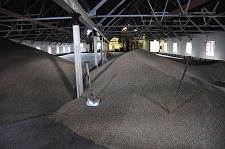
Barley arriving at the distillery is conveyed up to the barley loft, which usually occupies the top floor of a building of at least three floors. At this stage it will be relatively dry (with a moisture content of just over 10%) and dormant. Barley is essentially a seed that contains some genetic instructions for the next generation plus a store of starch for energy to be used by the growing plant.
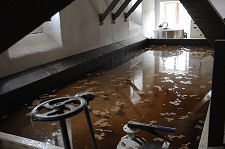
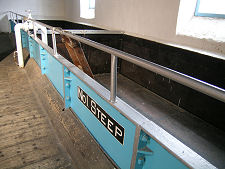
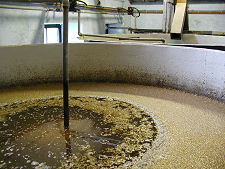
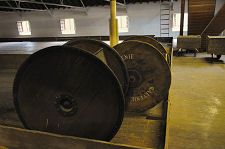
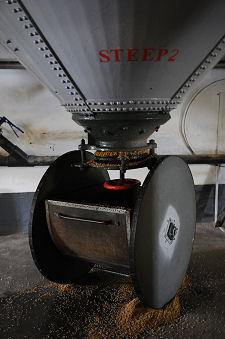
The barley is placed in a tank of water to steep. Here it is alternately soaked and dried for up to 48 hours until it begins to germinate: to sprout shoots and start to convert its starch into sugars that can be used in the brewing process. The aim is to end up with grain that has a moisture content of 46% and a strong, consistent growth. At this point the barley is laid out, to a depth of up to a foot, on the floor of the maltings, usually on the level or levels below the barley loft. This process is usually carried out using "chariots". At Highland Park the malting floors are, very unusually, "Y" shaped. At Glenglassaugh Distillery, which does not currently have an operational maltings, the old malting floor has a sign proclaiming it to be the "withering floor".
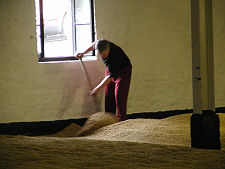
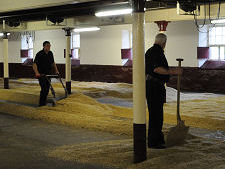
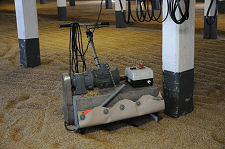
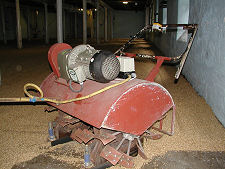
Over the next four to six days the malt, or "piece", is turned at regular intervals to allow heat and carbon dioxide to dissipate, and to prevent the growing roots from forming a mat. This is done either by hand with a malt shovel or by a kind of rotavator. During this process the moisture content of the barley reduces through evaporation from about 46% to about 43%. When the maltsman feels the right amount of sugar and enzymes have been produced, the green barley is collected and moved on to the next stage, the kiln, where the malting process is stopped by heat.
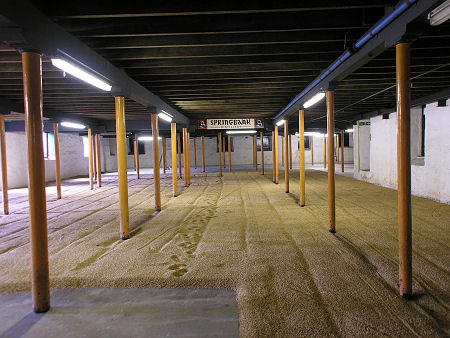 The Floor Maltings at Springbank Distillery |
|
|
|
Making Malt Whisky: |
 |
 Barley Loft, Balvenie |
 One of the Steeps at Balvenie |
 Steeps at Dallas Dhu Distillery |
 Steeps at Highland Park |
 Chariots at Balvenie |
 Chariot Collecting Malt from a Steep |