 Burghead Harbour |
Burghead has an ancient history. The easily defended headland was fortified during the early Iron Age and may have been settled considerably earlier. From the 300s what we now call Burghead became an important centre for the people referred to by the Romans as the Verturiones, who went on to establish the Pictish Kingdom of Fortriu: with, very probably, Burghead as its capital.
Over the next 500s years what evolved here was a large fortress, covering an area of three hectares or 7.5 acres. This made it three times the size of any other centre of power in Early Historic Scotland. The Burghead Promontory Fort seems to have been occupied from the late 300s and continued as a major centre until the late 800s.
In 884 Torridun, as it was known at the time, was captured by Sigurd the Powerful, the Norse Earl of Orkney. The indications are that Sigurd rebuilt the fortress and it then became a centre of Norse power in Moray. Under the Norse the fortress became known by the Danish name Burghe, which much later became Burghe-head. The Norse were eventually expelled from this part of the country by the Scots in 1010.
For the next significant episode in Burghead's history you need to wait until 1750, when the Stephen family began to build ships in the small fishing village that had developed here. Meanwhile, the spectacular earthworks that continued to stand on the promontory caused considerable interest among early antiquaries, who tended to attribute them either to the Norse or to the Romans, who almost certainly penetrated this far into Caledonia.
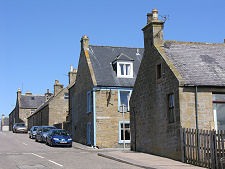
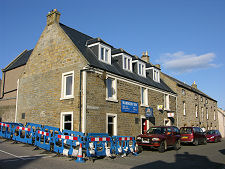
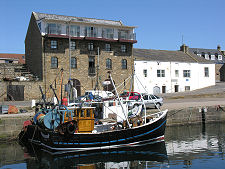
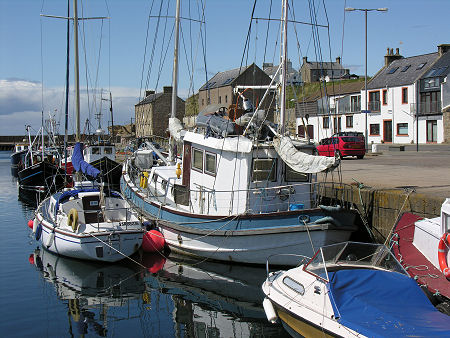
Everything changed in 1805. The village and surrounding land was brought by William Young of Inverugie, who laid out a much larger settlement on a regular, gridded street plan. From 1807 the harbour you see today was built by Thomas Telford, complete with surrounding three storey stone warehouses, three of which remain. A coastguard station and fish curing facilities were also built from 1807, and Burghead rapidly became an important herring fishing port.
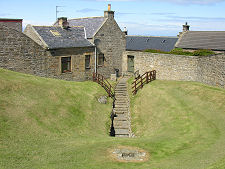
The result was a thriving town, but in the process most of the Pictish fortifications were obliterated and today only partial remains can be seen around the outer end of the headland. The stone from the fortress ramparts was reused in the construction of the new harbour. During the destruction of the fortress 30 Pictish stones were discovered inscribed with pictures of bulls. Only six survive and it is assumed that the other 24 were simply used to help build the harbour. During the building work the fortress well was cleared, revealing a flight of 20 steps down into a remarkable stone tank reminiscent of a Roman bath. This was roofed over and today Burghead Well serves as an unusual and rather mysterious visitor attraction.
By 1834 Burghead was important enough to warrant a regular steamer service to Glasgow via the Caledonian Canal, calling at Cromarty en route. And it was also home to 40 fishing boats. The fishing industry has declined in recent years, but Burghead remains home to a number of vessels.
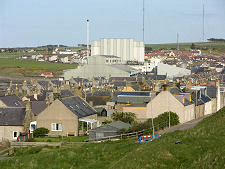
From the 1960s Burghead also became an important centre for the malting industry, with barley being malted here before being transported, initially by rail, to Speyside's distilleries. A further large maltings was built a little to the south of Burghead in 1980, though the rail link ceased in 2000. The Burghead Maltings produce some 85,000 tonnes of malted barley each year, enough to make a little over 100 million bottles of malt whisky or about 20% of Scotland's total output.
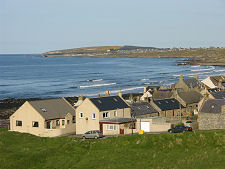
Burghead today is an attractive mix of planned town, thriving harbour and holiday resort. Little may remain of the Pictish fortifications on the headland, but the area does afford wonderful views back over the town and along the coast.
Telford's surviving warehouses by the harbour have been converted into extremely attractive flats. Meanwhile the dunes and forest to the south opens up a completely different environment for visitors now linked by attractive grassy areas around the old railway sidings.
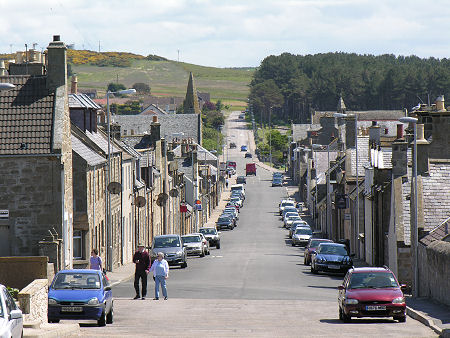 Grant Street |
|
|
|
Visitor InformationView Location on MapWhat3Words Location: ///passage.superbly.envy |
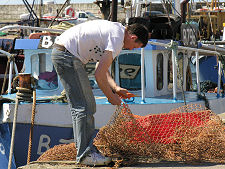 Mending the Nets |
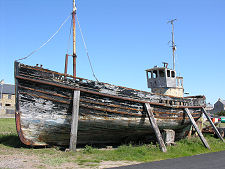 WK43: "Harvest Reaper" |
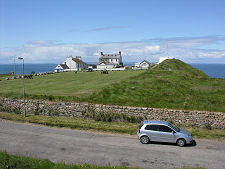 Headland Site of Pictish Fortress |
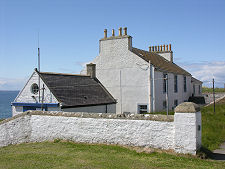 Coastguard Station |
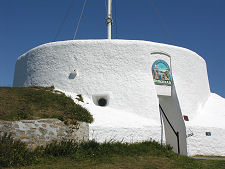 Visitor Centre |