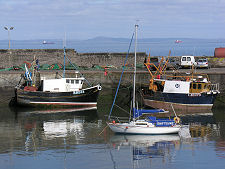
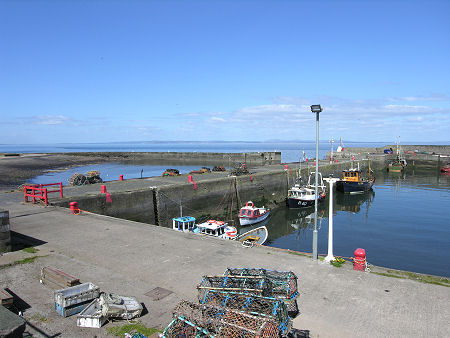
 Port Seton Harbour |
It is difficult to tell the difference between Cockenzie and Port Seton. The two settlements have long merged into one another and on maps the whole phrase is used as a single name. These days it is fair to think of them as one large village with two harbours: Port Seton harbour being half a mile to the east of Cockenzie harbour.
Cockenzie was the first to be established. There had probably been a village around its natural harbour long before it was chartered as a burgh by James VI in 1591. It then grew as a convenient means of exporting the coal being unearthed around Tranent. Like nearby Prestonpans, it also became a centre for the extraction of salt from sea water in metal pans heated over coal fires.
The origins of Port Seton harbour lie a little inland at the tiny hamlet of Seton, where Seton Palace was built by the Setons in the early 1600s. The 11th Lord Seton built a harbour at what naturally became known as Port Seton in 1656. This grew primarily as a fishing harbour, though it also serviced the Setons' estates.
The Setons backed the Jacobite cause in the 1715 uprising and their estates in the area were forfeited. The York Building Company, which took over management of the estate's mining interests, built the Tranent Wagonway in 1722. This was a horse-drawn railway carrying coal from the pits around Tranent to the harbour at Cockenzie.
During the 1745 Jacobite uprising the Battle of Prestonpans took place a mile south of Cockenzie and close to the line of the waggonway. History was made when the waggonway was used to transport troops to the battle, marking the railway's first ever use in warfare.
Cockenzie was also home for many years to boatyards producing fishing vessels and yachts. The sheds and slipways remain, but the last vessel was produced in the mid 1990s. Fishing remains important to the whole community. This is obvious from the harbours, unusual along this coast in being home to more working vessels than pleasure craft. The importance of fishing is also obvious from the continuing presence of traditional fish merchants and curers in the village.
One of the more obvious recent developments took place in the 1960s when the Cockenzie Power Station was built on the coastal site of a disused coal mine just to the west of Cockenzie and Port Seton. The site was chosen to make use of the excellent coal supplies available locally, the good rail links, and the availability of seawater for cooling: hence the absence of cooling towers.
But though the power station dominated westward views from the village, there were less attractive neighbours you could have had. And and the presence of the power station probably helped protect the communities here from being swamped by their proximity of Edinburgh, only a dozen miles to the west. As a result the villages retain the sense of living and working places rather than dormitories. In many ways Cockenzie and Port Seton feel much more like the sort of fishing villages found on the coast of Aberdeenshire or Moray than somewhere right on the doorstep of Scotland's capital. Cockenzie Power Station was demolished in September 2015 and that will probably open up the village to a faster pace of future development.
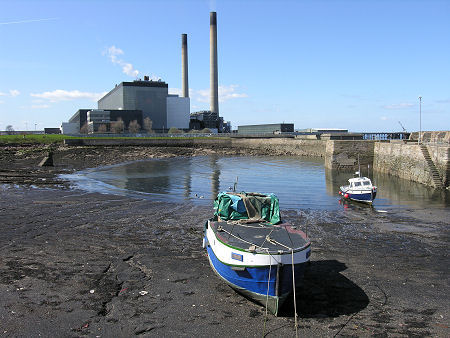 Cockenzie Harbour and Power Station (Seen Note in Text) |
|
|
|
Visitor InformationView Location on MapWhat3Words Location: ///months.emulated.approve |
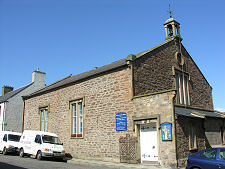 Old Parish Church |
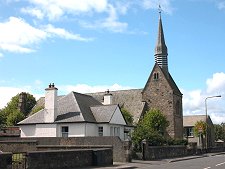 Chalmers Memorial Church |
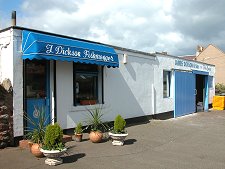 James Dickson & Son, Fish Merchants & Curers |
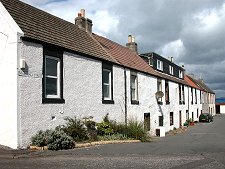 Salt Workers' Cottages, Cockenzie |