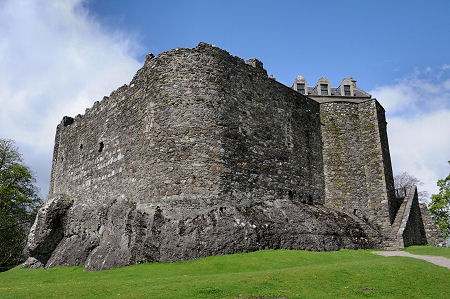
 Dunstaffnage Castle on its Rock |
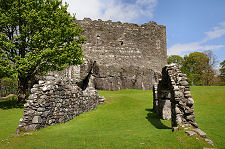
Standing atop a rock outcrop three miles north of Oban, Dunstaffnage Castle is an impressive fortification overlooking what was once the most important junction on the sea-lanes off the west coast of Scotland.
The strategic location, and the presence of such an inviting lump of rock on which to build, means that this has been a defended site for nearly 1,500 years. In the 600s the Kings of Dalriada, the Kingdom of the Scots who migrated to Argyll from Ireland, built a stronghold here. It is even suggested that this was the original keeping place of the Stone of Destiny.
By 1249 the fortress here was held by the Macdougalls, appointed by King Håkon IV of Norway. In July 1249 Dunstaffnage was to be the first target of King Alexander II in his campaign to seize the Hebrides from Norwegian rule. However, with his fleet assembled in Oban Bay, Alexander died in unexplained circumstances on the island of Kerrera. Dunstaffnage Castle and the Macdougalls lived to fight another day: a day that came just 60 years later. (Continues below image...)
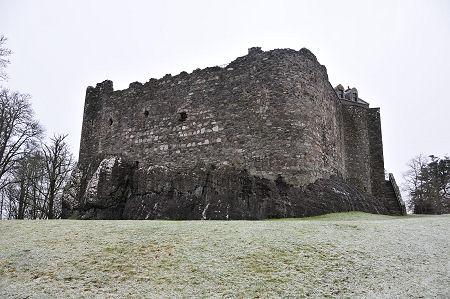 Dunstaffnage Castle in Winter |
Much of the castle you see at Dunstaffnage today was built by the Macdougalls in the 1200s. It is not clear whether it was this castle or its predecessor on the site that was Alexander's target in 1249. The castle did, however, transfer to royal possession when it was captured after a siege by Robert the Bruce in 1309. The Chiefs of Clan MacArthur were subsequently appointed as hereditary Captains of Dunstaffnage Castle, and it remained in their hands until 1470, when custody was transferred to the 1st Earl of Argyll, Colin Campbell. In 1502 the castle was passed from the Earl to his cousin, whose family still hold the title of hereditary Captain.
Dunstaffnage was burned in May 1685 during an attempted uprising by the Earl of Argyll against James VII/II supported by Dutch troops (see our Historical Timeline). His uprising was quashed and the Earl was executed, but too late to save Dunstaffnage.
During the Jacobite uprising of 1745, Dunstaffnage was garrisoned by government forces. It also became the temporary prison of Flora MacDonald in 1746 after she was arrested for assisting Bonnie Prince Charlie. Still visible along the west curtain is a range of arrow slits 'fish-tailed' at the base showing they were converted for use with firearms.
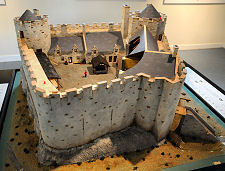
The basic shape of Dunstaffnage is an irregular quadrangle, largely determined by the contours of the rock on which it stands. The corner towers, two of which remain today, are tucked into the structure of the curtain wall rather than projecting from it as is the norm with such structures. Again this is dictated by the rocky outcrop.
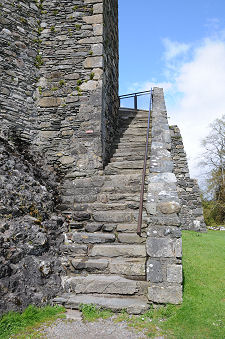
A projecting gateway was added to the castle in the early 1500s, largely obscuring the eastern tower. A century later the upper part of the gatehouse was reconstructed and the lower floor subdivided. The original great hall stood on the inner face of the north-east wall at first floor level and adjacent to the principal north tower. Its blocked up windows can still be traced in the east curtain wall.
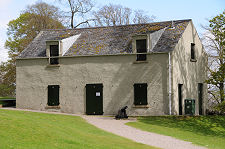
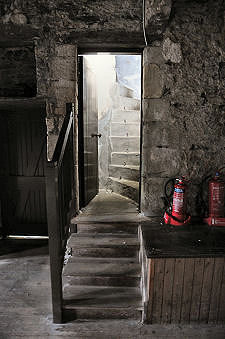
In 1810, the existing gatehouse was gutted by fire, destroying the principal residence of the then Captain. However, the courtyard buildings remained in occupation until the end of the 1800s. The hereditary Captain remains keeper of the castle to this day. The gatehouse is still occasionally used by the current Captain of Dunstaffnage, but has been opened to the public. The interior is intact, if a little spartan.
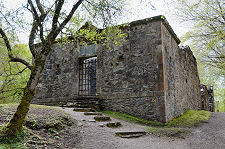
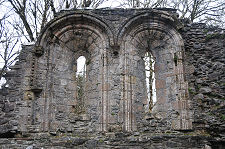
A short walk south-west from the main castle building is Dunstaffnage Chapel, probably built in the second quarter of the 1200s. The remains suggest that this was originally highly decorated, with the interior being divided into a chancel and a nave by a wooden screen. It seems likely that the chapel fell out of use after the Reformation and it was apparently in ruins when a roofless burial aisle was added to its east end in 1740 by the Campbells of Dunstaffnage, whose monuments are amongst those still standing within the shell of the building. The walls of the aisle incorporate a number of fragments of moulded or decorated stone obviously reused from the chapel.
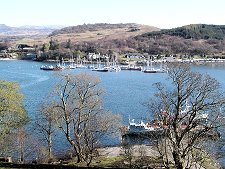
Dunstaffnage Castle is surrounded by attractive woodland and grassy areas sweeping past the visitor centre to the shore of Dunstaffnage Bay. Here you can enjoy the views across the moored vessels associated with the nearby marine laboratory to Dunbeg and, further away to the east, to Connel and the bridge over the mouth of Loch Etive and the Falls of Lora.
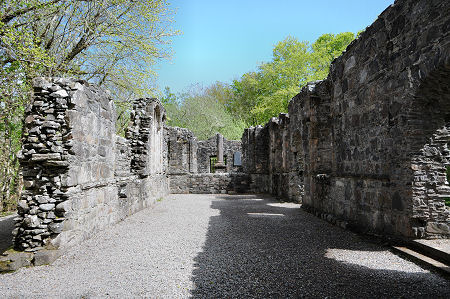 Dunstaffnage Chapel |
|
|
|
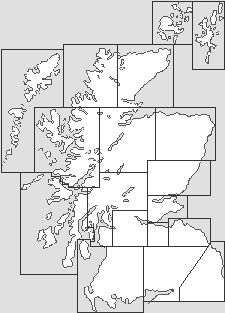
Visitor Informationwww.historicenvironment.scotHES: Castle Web Page View Location on Map Post Code: PA37 1PZ Grid Ref: NM 882 344 What3Words Location: ///seashell.tinkle.labs |
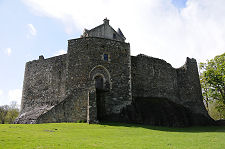 ...And from the East |
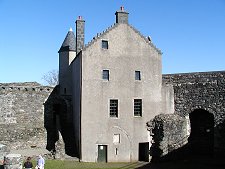 The Gatehouse |
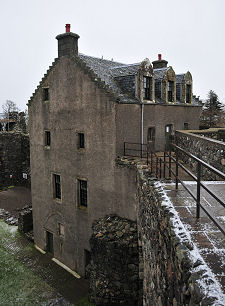 The Gatehouse from the Wall |
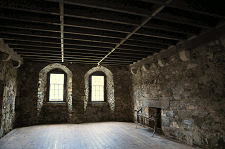 Inside the Gatehouse |
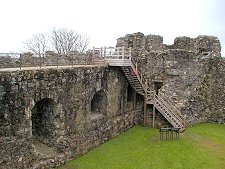 The Wall Walk |
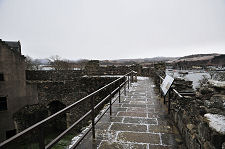 The Wall Walk in Winter |
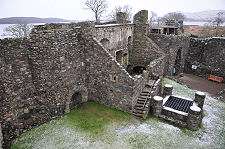 The North-West Range |
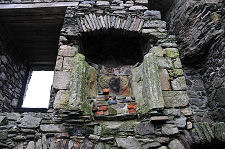 An Upper Floor Fireplace |
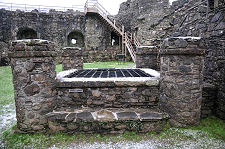 Castle Well Castle Well |