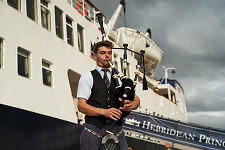
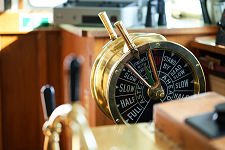
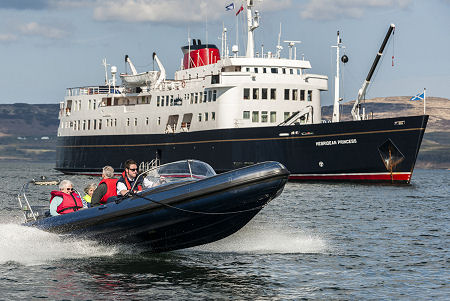
 Hebridean Princess (Image Courtesy Hebridean) |
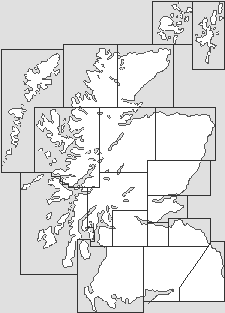
There are may ways to see the Highlands and Islands of Scotland. Without doubt the best, by far, is on board the Hebridean Princess. This exclusive and intimate 5 Star cruise ship has been sailing these waters over three decades and offers a range of cruises that takes in the Inner and Outer Hebrides, the Northern Isles, the west coast of Scotland from the Clyde to Sutherland: plus occasional excursions wider afield.
Unique is an over-used word, but it really does apply to the Hebridean Princess. She is unique because she spends almost all her time cruising the most beautiful parts of the most beautiful country on Earth. And she is unique because, with a maximum of 48 guests, she is run on a personal scale where individuals matter: by the end of the cruise everyone knows everyone else. We have heard the Hebridean Princess likened to a floating country house hotel. A more accurate description might portray her as a floating Edwardian country house, with the passengers staying as house guests. This captures the level of comfort and personal service you enjoy; the varied programme of activities and visits throughout the week; and the all-inclusive nature of a cruise on board.
There are four key components to the success of the Hebridean Princess: the waters in which she sails; the intimate scale of the operation; the standard of service and accommodation on board; and the ship herself.
Had the Highlands and Islands of Scotland been designed by hand rather than created over millions of years by the interplay of geology and climate, it's pretty clear the designer must have had a nautical background. The west coast is extremely complex, deeply indented by sea lochs and in places very remote. Meanwhile most of the inhabited islands can only be reached through effort and close attention to the ferry timetables, and most of the larger number of uninhabited islands cannot be reached at all unless you have a boat of your own.
Throughout much of history the Highlands and Islands saw residents, and frequent invaders like the Vikings, travel by sea rather than overland. As recently as the middle of the last century an extensive network of steamers and puffers carried mail, passengers and goods to the islands and to many remote mainland outposts. It is only in recent decades that new or improved road links, ferries, bridges and causeways, have opened up some, though by no means all, of these places to motorised traffic. To travel on board the Hebridean Princess is therefore the nearest that most of us will ever come to seeing the Highlands and Islands in the way many generations of our ancestors saw them: and, perhaps, in the way their designer intended.
The intimate and very human scale of the cruising experience on board the Hebridean Princess offers many advantages. The first, already referred to, is that you soon find yourself sailing with people you know, quickly developing friendships with fellow passengers and with the crew who do so much to ensure your cruise is a memorable one.
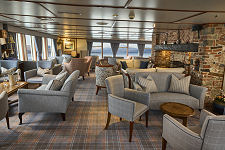
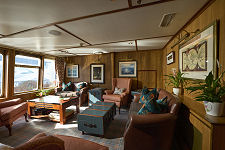
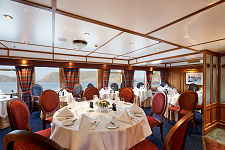
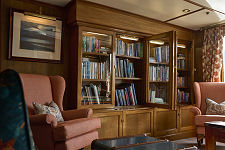
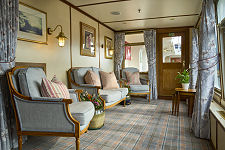
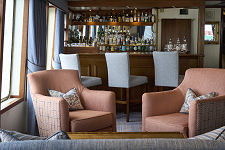
Another advantage is that while the Hebridean Princess may be a small ship, she is large enough to allow the maximum number of 48 guests plenty of elbow room. All the passengers can be seated at once in the comfortable Tiree Lounge; and all can dine at once in the opulent Columba Restaurant. Meanwhile there are many other smaller public areas including a nice library, a conservatory and a look-out lounge. There are also extensive areas of outside deck from which to enjoy the views: including most of the boat deck, the large rear Skye Deck, and sheltered promenade decks.
Perhaps most importantly, however, is that a maximum of 48 guests means that you can visit places without spoiling their essential character. This number of people is easily absorbed in even the smallest of the settlements the Hebridean Princess visits: and when landing on an island with a tiny population such as Ulva Rum or Eigg you find you are still able to spread out and enjoy the place in its own right.
The third factor in our list above is the standard of service. The ship's crew of no fewer than 38 numbers not much less than the maximum number of passengers and from the moment you board (and before, if you take the excellent booking staff into account) until the moment you leave, nothing is too much trouble and nothing is left to chance. Every aspect of the service is superb, from the impeccable standard of housekeeping and the attentiveness of the lounge staff, to the friendly efficiency of the waiting staff in the Columba Restaurant and, something not usually a consideration in a 5 Star hotel, to the lengths the boatmen will go to to ensure you have enjoyable and safe trips ashore: even if a diversion to try to see an otter cannot always be guaranteed to reveal one of these elusive creatures.
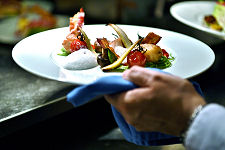
The dining experience on board the Hebridean Princess is superb. Fine dining is the order of the day and during the course of a week you will work your way through a hugely varied set of menus. With, typically, a week on board, you will probably find you have to pace yourself in order to enjoy the food to the extent it deserves. It is quite possible to have large lunches and dinners following full breakfasts every day: and fit morning coffee and afternoon tea into the gaps at a pinch. But the lunch menu also offers lighter options and after a day or so you are likely to find yourself favouring them. We also found the afternoons tended to work better if we avoided the excellent daily selection of house wines until dinner: but like everything else on board, this is a choice for the individual.
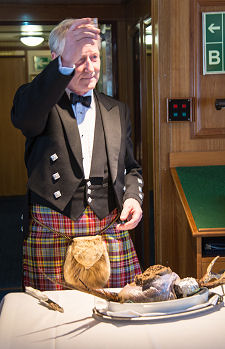
The country house feel is helped by a dress code for dinner which, after an informal first night, is "jacket and tie" most evenings, and dinner jacket (or kilt) for men and equivalent for women for Gala Dinners, of which there are usually two on a week-long cruise.
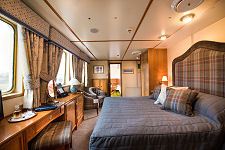
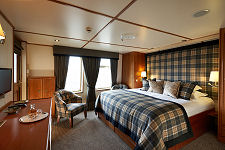
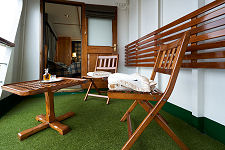
The Hebridean Princess has 28 cabins across four decks. One is a suite with an additional day room. 14 have twin or 6ft wide double beds; five have double beds; one is a single available for sale as a double; and eight are singles. The other major factor to bear in mind when selecting a cabin is the view on offer. The cabins on the Promenade and Princess Decks have windows, including one which opens. Four of them also have a private balcony area accessed via a door from the cabin. The cabins on the Waterfront Deck have at least two opening portholes. And the cabins on the Hebridean Deck come without windows or portholes, but with plenty of ventilation.
The Hebridean Princess has been cruising these waters as a cruise ship since 1989 and has a reputation as a happy ship, something to do with the innate character of the ship herself and not just the disposition of the crew and passengers. She is just 235ft or 72m long and and displaces just 2,112 tonnes, which allows her to access small harbours and sheltered inlets unavailable to larger vessels. When sailing she travels everywhere at full speed, but as that is 12kts or just under 14mph, you have plenty of time to watch the world go by. Stability and maneuverability are aided by her stabilisers and her bow thrusters.
Although operating as a cruise ship since 1989, Hebridean Princess was actually built in 1964 at the now long closed shipyard of Hall Russell in Aberdeen. She started life as the car ferry Columba for David MacBrayne Ltd capable of accommodating 50 cars and up to 870 passengers: with a secondary and much less publicised role as a floating seat of Scottish government should the Cold War turn hot. She spent much of her working life linking Oban with Mull and other islands, and she retired as a car ferry in 1988. The following year she emerged as the Hebridean Princess and has been cruising Scottish waters - with occasional excursions to more distant destinations - ever since.
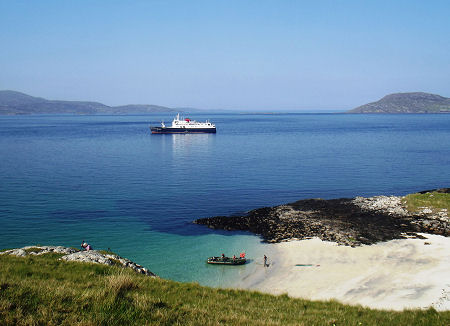 Hebridean Princess and a Hebridean Beach Landing (Image Courtesy Hebridean) |
|
|
|
Visitor InformationHebridean Island CruisesKintail House, Carleton New Road, Skipton, North Yorkshire, BD23 2DE. Tel: 01756 704 700. Further info: www.hebridean.co.uk |
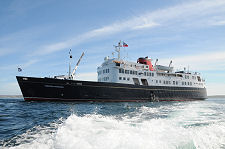 Hebridean Princess |
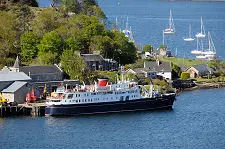 Berthed at Oban* |
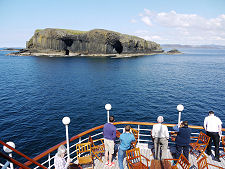 Visiting Staffa |
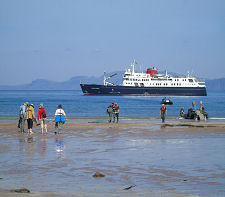 A Beach Landing |
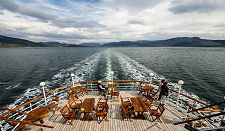 The Skye Deck |
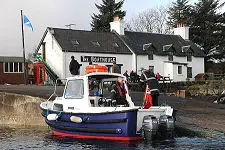 Visiting the Isle of Ulva* |
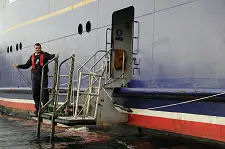 Returning After a Trip Ashore* |
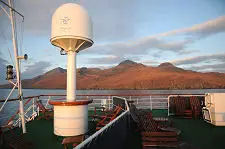 Rum in Early Morning Light* |
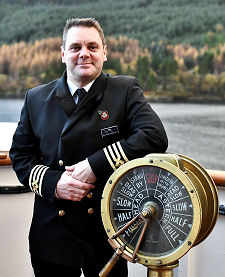 The Captain |
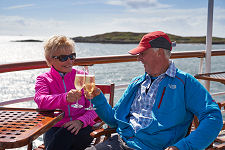 Drinks on Deck |
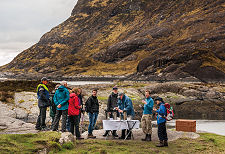 A Footloose Cruise |
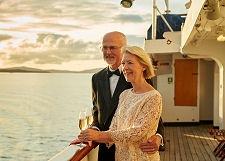 Watching the Sunset |
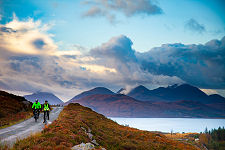 A Cycling Excursion (Images Without Asterisk are Courtesy Hebridean) |