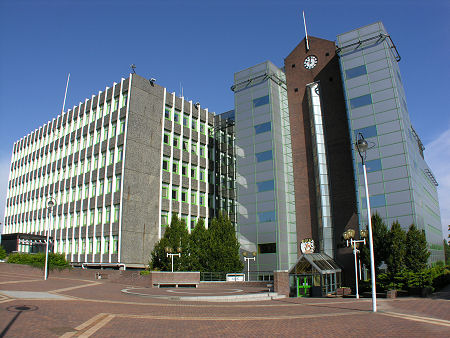
 Fife Council Headquarters |
Glenrothes in Fife should not be confused with Rothes in Moray, although the two are linked by history. Until 1700 the main home of the Leslie family, the Earls of Rothes, was in Rothes. The Earl of Rothes sold his Moray estates to the Seafield family in about 1700, and moved the family's main home to their estates in Fife.
The family's links with the area are remembered in the name of Leslie, a small town on the north bank of the River Leven immediately to the west of Glenrothes where the family built their home, Leslie House. Fast forward from 1700 to 1948. Fife's main industry at the time was coal mining and it was decided to place one of a number of new towns then being established across Scotland along the line of the River Leven Valley between the existing towns of Leslie and Markinch.
The name chosen for what would become the UK's most northerly new town came direct from the historical owners of the land on which much of it was to be built: Glenrothes.
Glenrothes was planned to provide homes, employment and facilities for 70,000 people, and built largely on low rise garden town principles. Early settlement and development was largely associated with the collieries in the area, with many families moving in from the declining coal mining areas in west central Scotland.
Development revolved around a series of "neighbourhoods", housing areas which were avoided by through traffic and which were named after the farms that previously occupied the land they now stand on. Hence names like Tanshall, Macedonia, Rimbleton and Auchmuty.
The growth of Glenrothes in its first couple of decades was hampered by a number of factors. The first was the demise of the mining industry in Fife, which provided many of the available jobs in the area.
The second was a lack of easy communications links. The development of the new town was meant to be accompanied by a dual carriageway linking to it from the west. But the East Fife Regional Road - the A92 - was only finally completed in 1990. And Glenrothes has never had its own railway station, although nearby Markinch does have one. Not many fell for the "badge engineering" that saw the creation of Glenrothes with Thornton Station in Thornton, some three miles south of the centre of Glenrothes.
But the A92 was eventually dualled. And good rail links are available via the many trains serving Kirkcaldy, five miles south of Glenrothes. Glenrothes even has its own airport south-west of the town near the village of Kinglassie. This started life in the 1960s as a grass airstrip and the runway of what became known as Fife Airport was paved at the end of the 1970s.
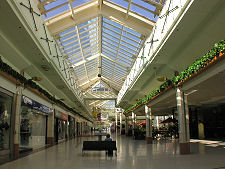
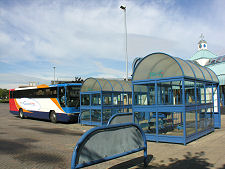
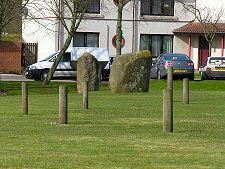
Meanwhile more, and more varied, jobs were coming to Glenrothes: as did the HQ of Fife Regional Council, and Fife Council, which replaced it. And with the new jobs came schools, colleges, homes, and all the services needed by an ever growing population. The focus of the town today is the Kingdom Centre. The first phase of this appeared in 1960. A series of extensions have taken place since, producing the vast indoor shopping centre you find today. Close by is the large bus station. One housing estate built in the 1970s had its design changed to accommodate the 6,000 year old Balfarg Henge, which now serves as a fascinating focus for the estate. Also on the western side of the town is the Balbirnie Stonce Circle, dating back to around 2000BC. Nearby is Balbirnie House, now a fine hotel.
As with any new town anywhere, Glenrothes is easy to find your way around: but only if you know it well. The overall impression it leaves is of pleasant modernity. And you do get the feeling that if those responsible for designating this area a new town in 1948 could see it now, they'd be pretty pleased with the result.
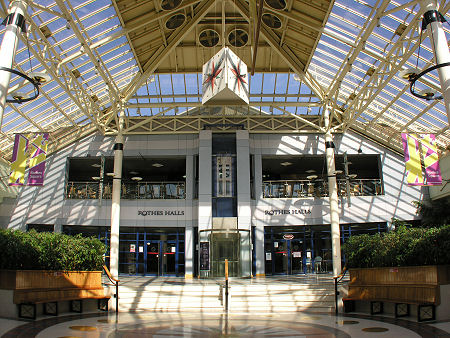 Rothes Halls |
|
|
|
Visitor InformationView Location on MapWhat3Words Location: ///atomic.reform.fills |
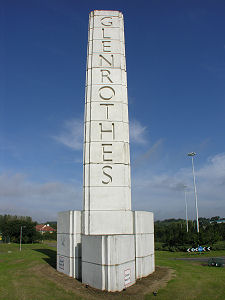 Welcome to Glenrothes |
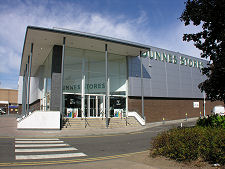 Dunnes Stores |
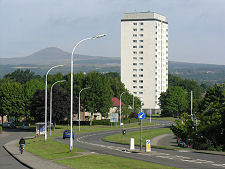 Flats and East Lomond |
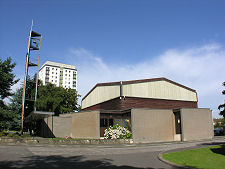 St Columba's Church |