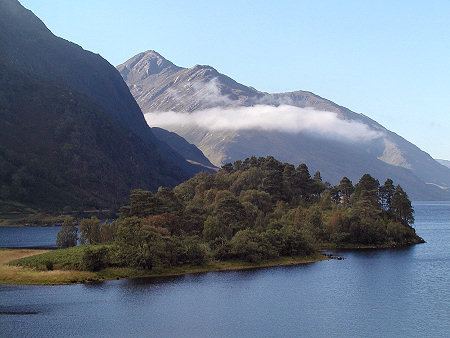
 View Down Loch Shiel from Glenfinnan |
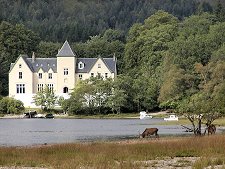
Glenfinnan lies at the head of Loch Shiel, which stretches south-west for twenty miles to Acharacle, where it fails by a mere two miles to meet the sea. In 1896 a mail steamer began a service along the loch to connect Acharacle with the railway at Glenfinnan. This service sadly ceased in the 1960s, though cruises on Loch Shiel are still run from a pier near the Glenfinnan House Hotel in summer.
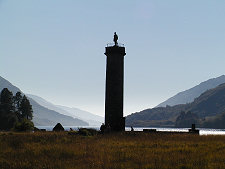
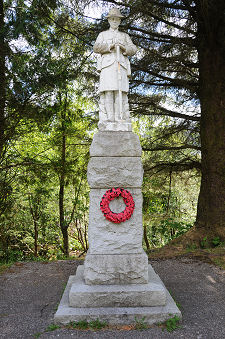
Glenfinnan owed its development to three factors: the road, the railway and the Jacobites. Thought not in that order as the Jacobites were here first. It was at Glenfinnan that Bonnie Prince Charlie first raised his standard on 19 August 1745 in his ill-fated but so very nearly successful attempt to place the Stuarts back on the thrones of Scotland, England and Ireland. For the full story read our page about the Glenfinnan Monument, which commemorates the event.
Thomas Telford came next. The Commissioners for Highland Roads and Bridges asked him to build what was originally called the Loch na Gaul road from Fort William to Arisaig. This was completed in 1812. The road has since become better known as the Road to the Isles and after decades of upgrading and rebuilding is now a high quality route that ends at Mallaig. There will be those who mourn the passing of the single track stretches that once gave this road so much of its character. Anyone who ever met a fish lorry on a blind corner on the once tortuous stretch south of Arisaig will not be among them.
Then came the railway. In the years up to 1901, Sir Robert McAlpine took on a huge civil engineering challenge with the building of the Mallaig Extension of the West Highland Line from Fort William west to Mallaig, though that was not the originally intended destination. One of the largest structures on the railway is the Glenfinnan Viaduct. This is 416 yards long and made up of 21 arches, the tallest of which is 100ft high. What is less obvious from a distance is that the viaduct is also curved, leading the track round the head of the River Finnan valley.
The viaduct is made of concrete, something else not often appreciated. When the railway opened the official handbook noted: "Many authorities on matters of taste, declared when this viaduct was first proposed, that it would prove a monstrosity, sufficient in ugliness to take away all the charm and beauty of the scene. Few would endorse this opinion now." We wholeheartedly agree, though perhaps with fewer commas.
Glenfinnan Station is a little to the west of the viaduct, approached by trains through a deep cutting. A number of stations on this line have lost their original station buildings. Glenfinnan hasn't, largely because of the efforts of enthusiasts who have converted the buildings into a railway museum. And across the station car park are two old railway carriages. One is now a Sleeping Car, while the other is the Dining Car, complete with a verandah on its southern side overlooking the trees in the valley below and offering excellent, good value snacks and refreshments. The Sleeping Car carries on a tradition that at Glenfinnan dates back to the 1930s, and which used to be common at many stations on this line.
Glenfinnan is a settlement scattered along the main road. The NTS Visitor Centre associated with the Glenfinnan Monument lies at the east end. A side road leads to the head of Loch Shiel, the Glenfinnan House Hotel and Loch Shiel Cruises. Further to the west you find more of the village, including the Prince's House Hotel.
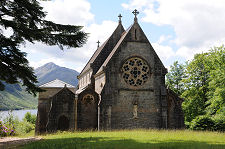
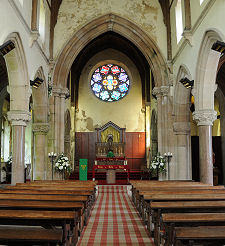
As the road begins to climb out of the River Finnan valley it passes what may be the best located church in Scotland. The Roman Catholic Church of St Mary and St Finnan is a large Gothic building with stunning views down Loch Shiel. It was designed by Edward Welby Pugin, son of the better known Augustus Welby Pugin, who helped design the House of Commons in London.
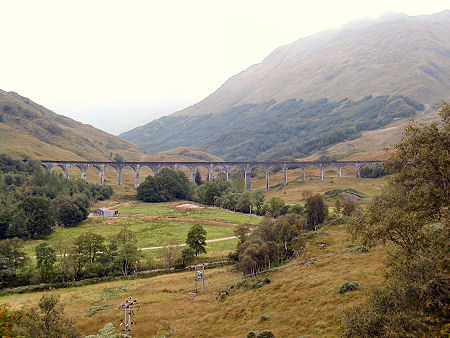 The Glenfinnan Viaduct |
|
|
|
Visitor InformationView Location on MapWhat3Words Location: ///thud.casual.newsstand |
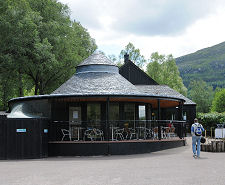 NTS Visitor Centre |
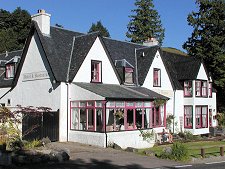 Prince's House Hotel & Restaurant |
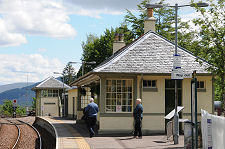 Glenfinnan Railway Station |
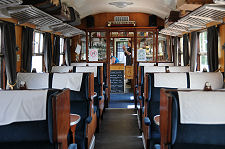 Glenfinnan Dining Car |
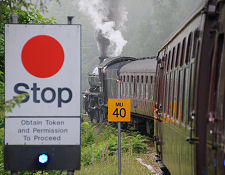 Jacobite Steam Train Leaving Station |