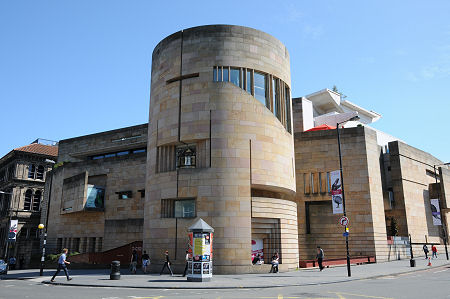
 The National Museum of Scotland from George IV Bridge |
The National Museum of Scotland stands on the south side of the centre of Edinburgh, a few hundred yards' walk from the Royal Mile and overlooking Chambers Street and George IV Bridge. There used to be two museums here: the thoroughly modern Museum of Scotland, completed in 1998, and the neighbouring Royal Museum, built between 1861 and 1888.
The two merged to become the National Museum of Scotland in 2006, a change of identity which reflected the reality of visitors being able to pass freely between them at a number of different levels. In April 2008 the older part of the museum closed its doors to visitors. It reopened on 29 July 2011 after a £47.4m transformation of the building. The result, quite simply, is magnificent, and it is hard to argue with the museum's claim to be "one of the world's great museums". Further galleries were added in 2016.
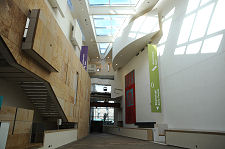
The transformed parts of the museum retain all the character and splendour of the original building, albeit returned to an "as new" condition. Meanwhile, the space available for the display of the museum's treasures has been greatly increased with the provision of sixteen new galleries and the refurbishment of a number of existing ones; a large new entrance has been created at street level from what was previously storage space; a three story learning centre has been built at the rear of the building; visitor facilities have been greatly improved with a ground floor brasserie and a Balcony Café; and the building is now fully accessible, with street level access at both ends of the museum, and glass lifts and escalators to upper floors.
The overall effect has been to increase the space available to the public by 50%, and to allow the display in the transformed building of some 8,000 objects, 80% of which had previously been in storage and had not been seen by the public for generations, if at all.
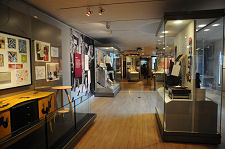
The two main buildings forming the Museum of Scotland each have their own fairly complex geography, but it greatly helps finding your way around when you realise that there is a strong logic in the way the displays are arranged across the museum as a whole. It is also helpful to know that the two parts of the museum are linked with one another at different levels, so you can adopt a wide range of strategies on your visit: following the different themes, or simply wandering between subject areas as the whim takes you. This is not a museum where you can possibly hope to see everything on a single visit: but as entry is free, there is no reason why you should not visit as often as you like.
The overall logic behind the organisation of the museum is that the west end (the 1998 building shown in the header image) is home to the museum's Scottish galleries. These tell you the story of Scotland from the earliest times, recounting the history of a nation and its people through a complex series of interlinked levels that take you from prehistory in the basement up to modern Scotland at the top of the building. Displays are generally fairly intimate, with even those housing the largest exhibits giving little away about the wider structure of the building.
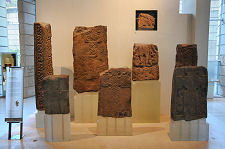
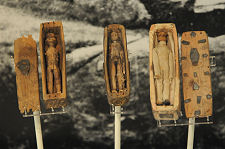
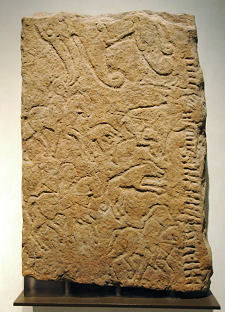
Everyone will have their own favourites, but this end of the museum is home to many wonderful carved stones from around Scotland that are worth a visit in their own right. Meanwhile, a slightly hidden corner of an upper floor is where you can find the rather spooky Arthur's Seat Coffins, tiny coffins containing wooden figures unearthed on Arthur's Seat in Edinburgh in 1837. Their meaning will probably never be known, but they achieved a lasting fame through featuring in the plot of one of Ian Rankin's Inspector Rebus novels.
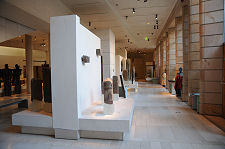
Moving east into the refurbished Victorian building brings you to three levels dealing with aspects of technology. Carry on into the main part of this building, either side and to the rear of the enormous, and beautiful, Grand Gallery, and you encounter a series of galleries. These look at European and world culture and history, before progressing on to further galleries dealing with the natural world, the story of our planet, and the place of our planet in the wider scheme of things. Individual galleries have a diverse range of subjects, including ancient Egypt; the far east; Artistic Legacies; Art and Industry; and the superb Animal World and Wildlife Panorama, in which animals are displayed at ground level, swimming (in mid air and including a hippopotamus) at middle floor level and flying at upper floor level.
Meanwhile the Grand Gallery itself has become an integral part of the display space. The large north wall is home to Window on the World, an 18m high display of 800 objects in what is the UK's largest single museum installation: while one of the balconies is an ideal space for looking at Traditions in Sculpture. Below the Grand Gallery is the huge new entrance hall, while to its rear is "Discoveries". This is home to the Millennium Clock, which was a firm favourite in the old museum where it stood at one end of the Grand Gallery. Further to the rear a Scottish Aviation Bulldog light aircraft appears to be enmeshed in the structure of the ceiling space, leading to the inevitable question: "How did they get that there?"
The museum's story began in 1854, when Parliament authorised funds. The foundation stone was laid by Prince Albert in 1861 and building took place in a series of stages, the last of which was finished in 1888. It was built to provide a suitable home for the various collections then held by the University of Edinburgh.
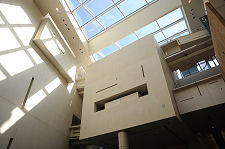
The Royal Museum building was designed by Captain Francis Fowke of the Royal Engineers, who also designed the Royal Albert Hall. The building stands on the south, usually shadowed side, of Chambers Street and the exterior was given a Venetian Renaissance design. The interior comes as a real surprise, being flooded with light from a remarkable glazed roof 78ft above the floor level. It is no surprise to find that the interior design, and the roof in particular, was heavily influenced by London's Crystal Palace, built for the Great Exhibition ten years earlier in 1851.
In the 1990s the Museum of Scotland building was added immediately to the west, with architects Benson & Forsyth being appointed in 1991 and the building finished in 1998. The design is geometric and modernist, but with a number of shapes and forms, especially the circular tower at its corner, that reflect traditional Scottish castle design. The outer surface is finished in sandstone from Moray, and the building was nominated for the Stirling prize for architecture in 1999. When completed, the new museum became home to Scottish collections previously housed in the National Museum of Antiquities of Scotland, or on display in the Royal Museum.
You could quite literally spend days absorbed in all that the National Museum of Scotland has to offer. And you can feed more than just the intellect and the imagination while visiting. The middle level balcony on the south side of the Grand Gallery offers great views from the Balcony Café, while one end of the street level entrance hall is home to the museum brasserie. Meanwhile, the Tower Restaurant can be found on Level 5 of the west end of the museum. Offering spectacular views of Edinburgh Castle, the excellent food, wine and service have gained the Tower Restaurant an AA Rosette and ensured that it has become one of the places to dine in Edinburgh.
But you don't have to dine to be able to enjoy remarkable views of Edinburgh Castle, or the rest of the city. Level 7 of the newer building is a roof terrace. The plants that surround it tell the story of the Scottish landscape, but your attention is almost certain to be drawn to the unique views of Edinburgh that the terrace offers.
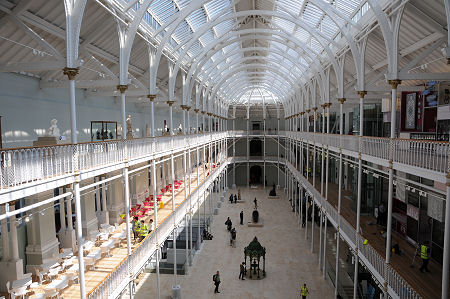 The Grand Gallery |
|
|
|
Visitor InformationView Location on MapSTB 5 Star Museum. Chambers Street, Edinburgh, EH1 1JF. Tel: 0300 123 6789. Grid Ref: NT 257 733 National Museum of Scotland Opening Hours Admission Accessibility What3Words Location: ///beyond.home.joined |
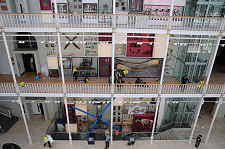 Window on the World |
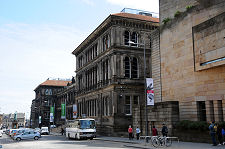 The Museum from Chambers Street |
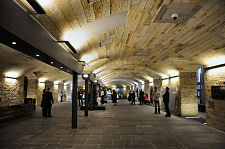 Entrance Hall |
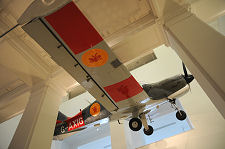 Scottish Aviation Bulldog |
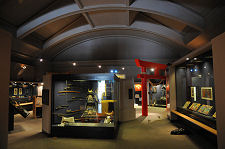 Looking East |
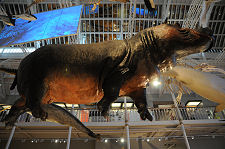 Animal World: Swimming Hippo |
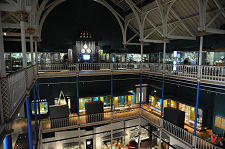 European Styles and Ancient Egypt |
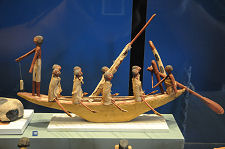 Model Boat, Ancient Egypt |
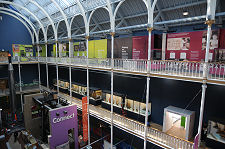 The Connect Gallery |
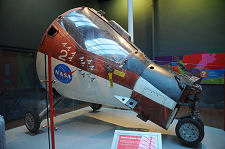 Gemini Space Capsule |
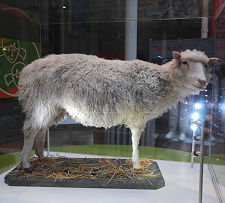 Dolly the Sheep |