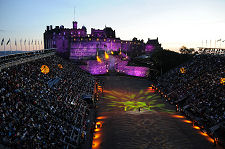
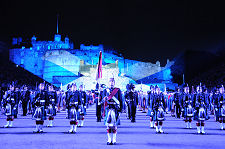
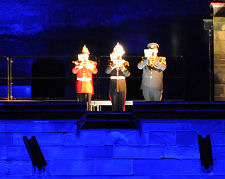
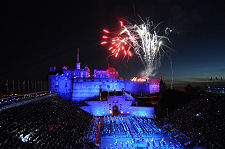
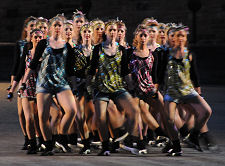
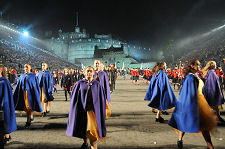
The Royal Edinburgh Military Tattoo in 2024 (Image Courtesy The Royal Edinburgh Military Tattoo) More Tattoo Images |
The Royal Edinburgh Military Tattoo began life in 1950 as the Army's contribution to the Edinburgh International Festival, then three years old. The programme comprised just eight items and in the first year there were no stands: the audience watched from the Esplanade itself. Stands for spectators first appeared the following year, but have grown very considerably since.
Over the years the Edinburgh Tattoo has gained a reputation for excellence and spectacle that is unmatched anywhere. A typical reaction of first time visitors was that of the Taiwanese lady journalist we met at the first Tattoo we attended: "It makes your spine tingle!"
The first overseas participants in the Tattoo were the Band of the Royal Netherlands Grenadiers in 1952, and since then some 46 countries from all parts of the globe have taken part. On average, there are around 1,000 participants in the Tattoo each year. And if the cast list is truly international, so is the audience. Of about 220,000 people who see the Tattoo live each year, some 70% come from outwith Scotland, and of them half are from overseas. A further 100 million watch it each year on TV around the world. What was previously know as the Edinburgh Military Tattoo was granted the right to be called the Royal Edinburgh Military Tattoo in 2010.
The tattoo reflects a military tradition that dates back centuries, to an age when the pipes and drums of regiments stationed in the Low Countries marched through the local town each evening to signal to soldiers that it was time to return to barracks. The word "tattoo" itself is thought to come from the Dutch "doe den tap toe" meaning it was time for innkeepers to "turn off the (beer) taps".
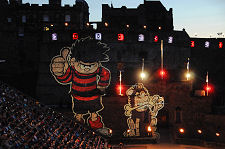
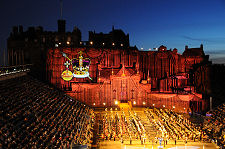
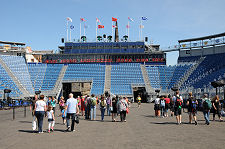
 A Closer View of the 2024 Tattoo (Image Courtesy The Royal Edinburgh Military Tattoo) |
For the audience, the experience begins with the walk up Castlehill towards the bulk of the stands that loom over the Castle Esplanade. The process of getting some 8,600 people into their seats is as slick and well rehearsed as the show itself. Normal performances of the Tattoo are timed to allow full appreciation of the last of the post-sunset light, silhouetting the imposing bulk of Edinburgh Castle. Catch it on the right day and this can itself add dramatically to the spectacle of the event. Catch it on the wrong day and waterproofs are essential.
The programme for the Tattoo varies from year to year though some elements are constant. The massed pipes and drums of the British armed forces, usually incorporating guests from many different parts of the world, are at the core of any Tattoo. And the show always features a lone piper located high on the battlements of Edinburgh Castle.. Most of the images on this page and on the additional page of Tattoo images were taken at shows over a number of years.
Each year the theme of the Tattoo changes. The 2025 Show, "The Heroes Who Made Us", marked the 75th anniversary of the Tattoo and honoured both its history and the everyday heroes who knit our society together with their volunteering, courage, or the inspiration their lives provide. Following on from "Voices" (2022), "Stories" (2023) and "Journeys" (2024), "The Heroes Who Made Us" included music, dance and precision performance that showcased the very best of the last 75 years of the Tattoo story. With the British Army as the 2025 lead service, there were performances by the Massed Pipes and Drums, The Royal Edinburgh Military Tattoo Performers, the Band of the Polish Border Guard, the Top Secret Drum Corps, the United States Honour Guard Drill Team, the Ukraine Naval Forces Orchestra, the United States Old Guard Fife and Drum Corps, and the Lone Piper.
The changes from year to year ensure the Tattoo never becomes stale and help ensure that many people return time after time. At the end of each show the Finale brings onto the Esplanade all the performers from that night's event for a climax that includes the taking of the salute. Participants then march down Castlehill to embark on coaches that take them back to their barracks before the spectators follow them.
No description, no set of images, and no TV presentation can possibly do justice to the true Tattoo experience. Location, atmosphere and stunning performance combine to form an unforgettable evening's spectacle.
If you want to see the 2026 show, "A Call To Gather", for yourself, be warned: tickets start to sell out quickly once they go on sale and you will need to be quick to reserve your seat! See the Tattoo's own website, linked from the Visitor Information section of this page, for further information.
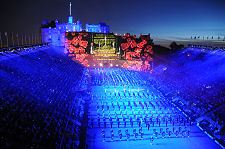
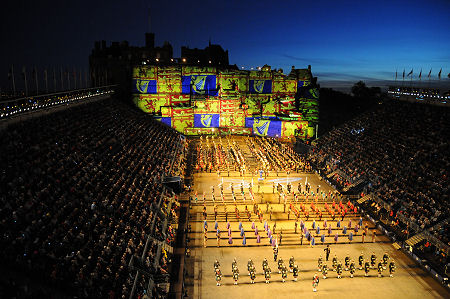 The Royal Edinburgh Military Tattoo Celebrates HM The Queen's Diamond Jubilee in 2012 More Tattoo Images |
|
|
|
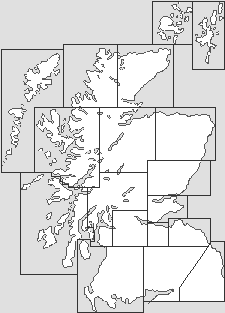
Visitor InformationView Location on MapRoyal Edinburgh Military Tattoo: 2026 Dates: 7-29 August 2026. Tattoo Office, 1-3 Cockburn Street, Edinburgh, EH1 1QB. Tel: 0131 225 1188. tickets@edintattoo.co.uk www.edintattoo.co.uk More Tattoo Images What3Words Location: ///agents.caller.cycles |
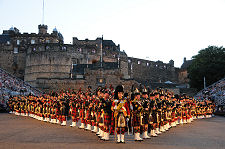 The Massed Pipes and Drums... |
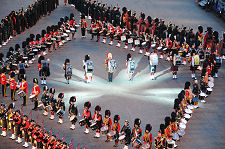 ...In Diamond Formation |
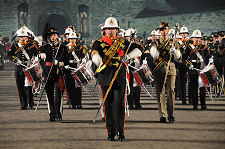 Band of the Royal Marines |
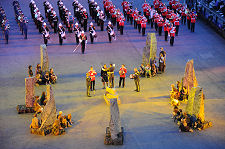 Music Inspired by the Film Brave |
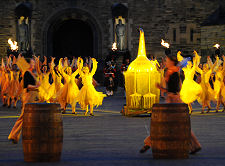 Massed Highland Dancers |
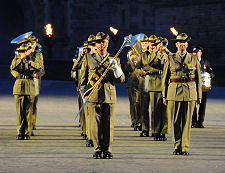 Australian Defence Force Band |
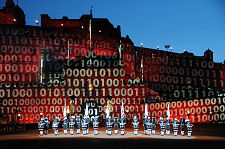 Top Secret Drum Corps |
 Top Secret Drum Corps (Image Courtesy The Tattoo) |
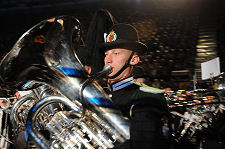 King of Norway's Guards Band |
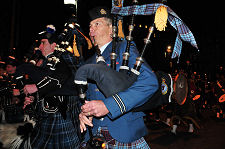 Participants Leaving the Tattoo |
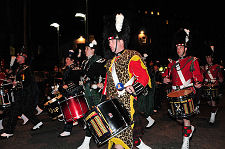 Participants Leaving the Tattoo |