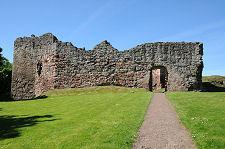
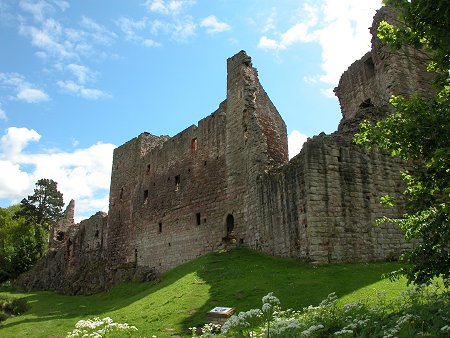
 Hailes Castle from the North-West |
Hailes Castle lies on minor roads a mile and a half south-west of East Linton. It was built on a rocky bluff overlooking the River Tyne to its north, while to its south the ground rises steadily to the ancient hill fort on the top of Traprain Law, three quarters of a mile away.
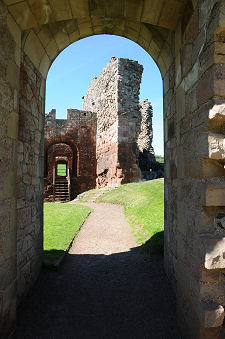
From the road, or the approach path, the castle seems to comprise just the ruins of a couple of towers and a detached stump, plus a length of curtain wall. The reality is very much more than this suggests. To truly appreciate Hailes Castle you need to see it from the far, north, side. Fortunately you can easily do so by making your way around the west end of the castle, or through the small gate in the north wall by the kitchens.
In its northern side the castle towers over the the Scottish River Tyne (not to be confused with its better known namesake in England). From the riverbank it is still possible to gain a feel for the full scale of what was once a fine and very impressive structure. There's a path alongside the river here, and a viewpoint just beyond a small stream allows you to look back along the length of the castle. If you catch it late on a summer's day you can even find this side of the building bathed in oblique sunlight.
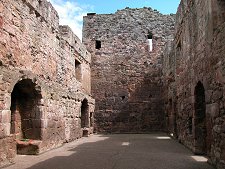
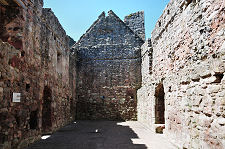
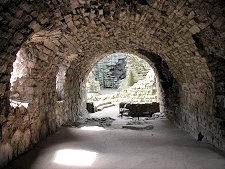
Back within the castle there remains a surprising amount to explore. The vaulted kitchens are very striking. Above them is the largest built space remaining in the castle. This served as the great hall, although part of the space was probably partitioned off to serve as a private chapel. (Continues below image...)
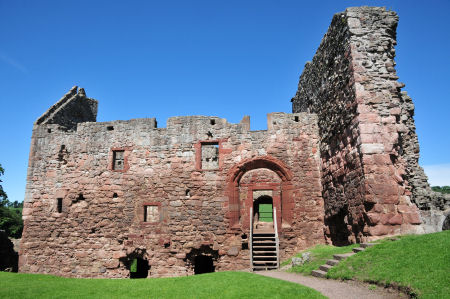 The North Range |
Hailes Castle is thought to contain some of the oldest standing stonework in Scotland. This is found in what is left of the original castle, built here in the 1240s. The seriously ruined tower in the centre of the north range of the building was at the heart of this: it is most easily distinguished today, from the inside at least, by its conversion in later centuries to a doocot or dovecote. Together with the rooms to its east, this formed the original fortified mansion of Hugo de Gourlay and his family.
The de Gourlay family supported the English during the Wars of Independence, and as a result of backing the losing side were stripped of their lands after the Battle of Bannockburn in 1314. The castle and lordship of Hailes was subsequently granted by Robert the Bruce to Sir Adam de Hepburn.
The Hepburns dramatically expanded the castle during the 1300s and 1400s. The existing building became the centre of a long north range, extending to a low tower at the east end, still visible in the form of a finger of stone pointing skyward. And at the other end they built the huge four storey West Tower.
The castle built by the Hepburns was completed by a curtain wall around its south side, with a moat beyond. The end result would have been one of the best placed and most spectacular small castles in Scotland, perched on its natural rock outcrop and defended by the river to the north, the moat to the south, and thick stonework all around.
The castle saw its share of action. In 1401 Hailes Castle was attacked twice by English forces under Henry "Hotspur" Percy, on both occasions successfully fighting off the attackers. It was attacked with more success by by the pro-English Archibald Dunbar in 1446, who is said to have killed "all he found therein". In 1547, the then owner Patrick Hepburn, the 3rd Earl of Bothwell, opposed the Regent acting for the young Mary Queen of Scots, and was forced to surrender the castle. And a year later Hailes Castle was captured by English forces, only to be quickly recaptured by the Scots, who then removed the gates to prevent further use by the English.
The end of the Hepburns' tenure came two decades later. The last of them to hold Hailes Castle was James Hepburn, the 4th Earl of Bothwell. He was involved in the murder of Mary Queen of Scots' second husband, Lord Darnley, in February 1567. And on 27 April 1567 he kidnapped Mary while she was en route back to Edinburgh from seeing her son in Stirling. He took her to Dunbar Castle, where, depending on which version of history you believe, he forced her to agree to marry him, or they consummated a course of action already agreed between them.
On 5 May 1567 Mary Queen of Scots, and James Hepburn left Dunbar for Edinburgh, where they married 10 days later. Their marriage led swiftly and directly to Mary's forced abdication; to Bothwell's flight into exile and eventual death; and to the forfeiture of all of his lands including Hailes Castle. The castle then went into a period of decline before being largely dismantled by Cromwell's forces in 1650.
But to return to May 1567. Mary and James did not travel directly from Dunbar to Edinburgh. Instead they took two days for the journey, spending the night of 5/6 May at Hailes Castle: the calm before the storm that then engulfed them...
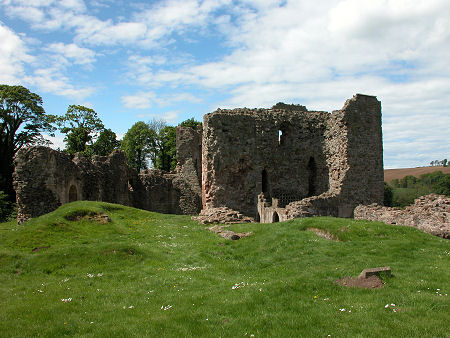 The Castle from the East End |
|
|
|
Visitor Informationwww.historicenvironment.scotHES: Castle Web Page View Location on Map Grid Ref: NT 574 757 What3Words Location: ///guarded.novel.wrist |
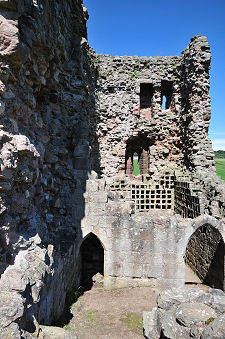 Remains of Original Tower House |
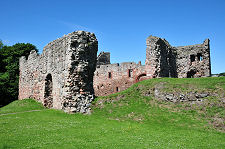 The Damaged Curtain Wall |
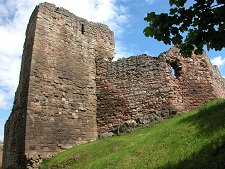 West Tower from the South |
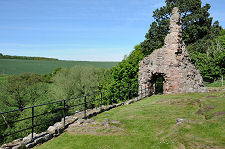 The East Tower |
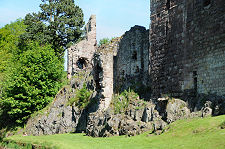 The East Tower from the Riverside |
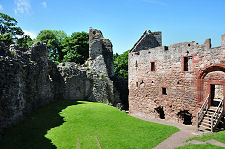 The Courtyard |
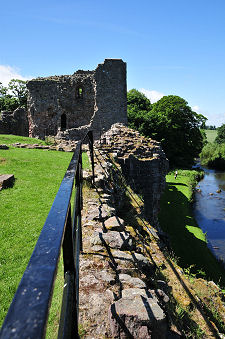 Castle and River, Looking West |
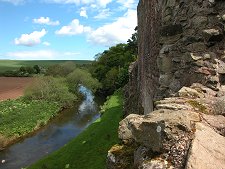 Castle and River, Looking East |