 Looking West Along High Street |
Dalkeith, which lies about a mile outside the line of the Edinburgh City Bypass, is the largest town in Midlothian and its administrative centre. There was a time when it was all too easy to write off Dalkeith as little more than a bottleneck that caused traffic jams on the A68 and slowed down progress towards or away from Edinburgh.
Things changed for the better when the Dalkeith Bypass opened to traffic in September 2008, taking the A68 and its traffic well clear of the north-east side of the town. The other reason why passing travellers might have tended to overlook Dalkeith is that in the 1970s a triangular area comprising the old heart of the town was ripped out and replaced by the sort of buildings developers put up across the country at the time. The outcome was not an improvement.
But when you take a little time to explore Dalkeith you begin to appreciate the important role it has played for the better part of a thousand years, functioning as a market drawing in produce from all across southern Scotland, much of which then went to feed Edinburgh. And when you look more closely, you can see just how attractive parts of it really are, and appreciate how grievously it was damaged by the 1970s redevelopment. (Continues below images...)
 Church of St Nicholas |
 Wide Angle Shot of the Corn Exchange |
One key indicator of its past importance as a market town is the number, size and quality of the hotels and hostelries on view. The town is also home to a superb Indian restaurant, Itihaas.
Perhaps the most interesting part of the town is the High Street, which runs north-east from the central area as an increasingly broad tree-lined avenue that was once home to Dalkeith's regular markets. On one side of the High Street is the Corn Exchange, once Scotland's largest indoor grain market.
On the opposite side of High Street is the Church of St Nicholas. This is an interesting mix, a building whose origins (and in part, structure) date back to the years either side of 1400. Most of what you see today dates back to a major refurbishment in the early 1850s. The exception is the ruined choir which had long before fallen into disuse and been abandoned.
At the east end of the High Street, the A6094 veers sharply off to the right leaving a stub of road leading to Town Gate. This is the main entrance to Dalkeith Country Park. The park is a remarkable place offering nature, wildlife and walking trails in the thousand-acre estate of the magnificent Dalkeith Palace, the seat of the Dukes of Buccleuch from 1642 until 1914. Today it is owned by the Buccleuch Living Heritage Trust and operated as a visitor attraction. In the corner of the park nearest Town Gate is St Mary’s Scottish Episcopal Church, originally built as a family chapel by the 5th Duke of Buccleuch, it was subsequently consecrated for wider use.
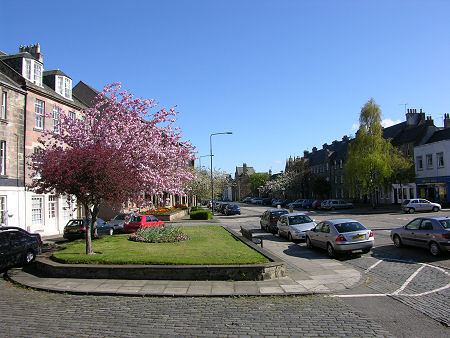 Looking East Along High Street |
|
|
|
Visitor InformationView Location on MapWhat3Words Location: ///aced.appoints.tropic |
 Estate Agents |
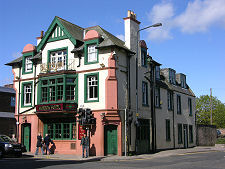 Harrow Hotel |
 Bank of Scotland |
 1970s Shopping Parade |
 Miner and Farmer |
 St Mary's Church |
 Dalkeith Palace |
 Dalkeith Country Park |


