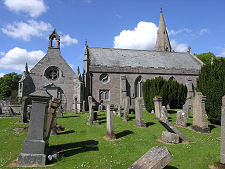
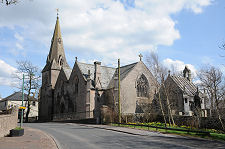
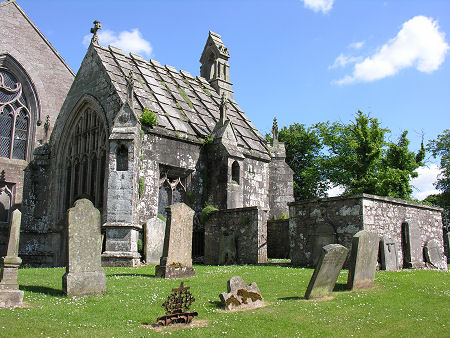
 St Mary's Aisle from the North-West |
At the west end of the village of Carnwath stands its parish church. At first sight this looks like a fairly standard 1800s church with spire. But immediately to its west is a small stone building built in an altogether more elaborate style and obviously dating back to a much earlier era. This is St Mary's Aisle.
St Mary's Aisle was once the north transept of St Mary's Church. This was founded in 1386, and was expanded into a collegiate church in 1425 by Thomas, First Lord Somerville. Here the ecclesiastical college, comprising a provost and six prebendaries or canons, would spend time each day praying for the souls of the Somerville family.
Collegiate Churches were generally endowed by the great and the good (and the rich) of the land. Each was served by a small religious community whose primary role was to pray for the souls of their benefactor, his wife, and his family. Presumably the idea was to relieve the great and the good of the onerous burden of praying for their own souls. Lennon and McCartney may have been right in suggesting that "money can't buy you love": but in the Scotland of the 1400s many believed it could buy you salvation.
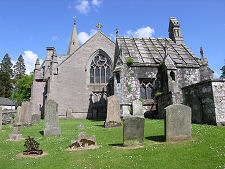
By the mid 1400s, St Mary's comprised a nave and chancel plus transepts to the north and south. St Mary's Aisle started life as the north transept of the church, which means that the chancel would have been immediately to the south of today's parish church with the nave extending off to the west of it. If the quality of the architecture of the aisle is anything to go by, St Mary's Church must have been a remarkable building.
St Mary's Church ceased to be used in 1799 when, according to some sources, the current Parish Church was built. Other sources date the current church to 1867: it seems likely that the later date was when a 1799 church was renovated. Either way, it is difficult to imagine the new church being built without the old one, which would have blocked much of its light, being demolished.
By the 1860s, all that was left of the old church were St Mary's Aisle and some outlines of walls in the grass. The north transept had been used for centuries as a burial aisle by the Somerville family, and when the rest of the church was demolished it seems to have been converted to a free standing aisle to serve a similar purpose for the Lockhart family.
It is fascinating to try to work out why - and how - the new church was built so close to the one it replaced. There is a gap between the east wall of the aisle and the west wall of the more recent church, but their buttresses interleave, effectively filling the gap completely.
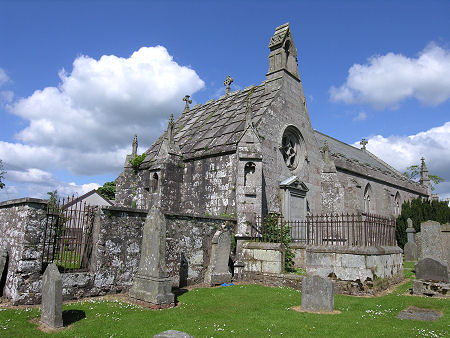 St Mary's Aisle from the South-West |
|
|
|
Visitor InformationView Location on MapGrid Ref: NS 976 464 What3Words Location: ///hillsides.noses.distract |
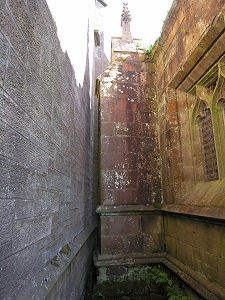 The Gap Between Church and Aisle |
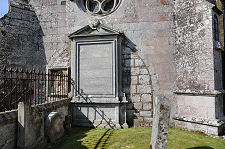
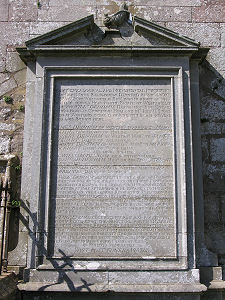 Denham Memorial |