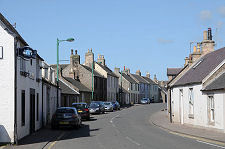
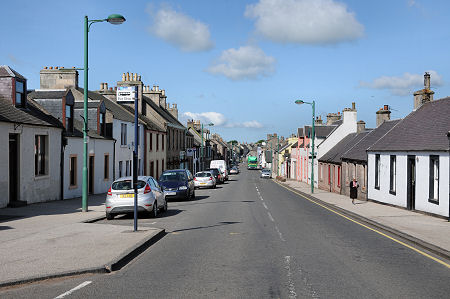
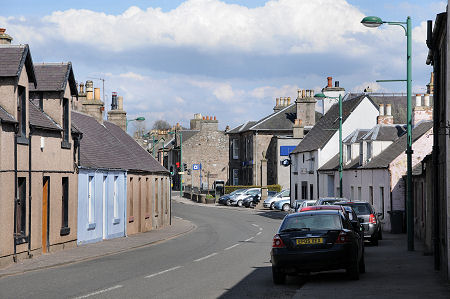
 Carnwath Main Street from the East |
The Pentland Hills press hard against Edinburgh's south-west edge, barely leaving room for the city bypass to squeeze between the slopes and the suburbs. The Pentlands have been crossed for centuries by tracks and drove roads, but in the age of the motor car they have become an impenetrable barrier to movement, uncrossed by modern roads for a distance of 20 miles south-west of the Edinburgh bypass. At the far "tail" of the Pentlands is the highly individual village of Carnwath.
Its location makes Carnwath an important junction. From here the Glasgow to Peebles road, the A721, heads along the southern side of the Pentlands, and back to Carluke en route to Glasgow. Meanwhile the Ayr to Edinburgh road, the A70, runs from here along the exposed north side of the Pentlands, and south-west into Ayrshire.
The village itself largely comprises a single street three quarters of a mile long, set in open moorland at a height of some 750ft, and sloping downhill from east to west. Its strategic location at the crossroads of major cross-country routes, and on ground rising north from the River Clyde, which passes just a mile to the south, led to the development of a castle here in the 1100s.
Carnwath Castle was built in about 1165 by William de Somerville. It appears to have been abandoned some time later in favour of Couthalley Castle, which stands a mile north-west of the village. It is possible that Carnwath Castle only ever existed as a wooden structure, and nothing remains of it except the impressive motte or artificial mound on which it was built. This can still be seen at Carnwath Golf Club, founded in 1907 at the west end of the village. The motte was unusually large and steep sided, and it is said that access to the castle that stood on top of it was via a tunnel and a set of steps that emerged within the structure.
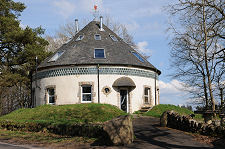
The site of the clubhouse of the golf club was formerly the location of Carnwath House, much of which could be dated back to the early 1800s, but which was built round a much earlier structure. We've yet to see a clear chronology of the dates of occupation of the original Carnwath Castle, of Couthalley Castle which replaced it, and of Carnwath House which in turn seems to have replaced Couthalley Castle. Carnwath House served as a clubhouse from 1907, and sadly seems to have been replaced by a modern structure in the 1970s.
On the opposite side of the main road from the golf club and the motte is Carnwath Parish Church. At first sight this looks like a fairly standard 1800s church with spire. But a stroll round the west side reveals a surprise, an almost separate tiny chapel, of a very much earlier date. This is actually St Mary's Aisle, a surviving part of the collegiate church founded here in 1425 by Thomas, First Lord Somerville and incorporating a church established in 1386.
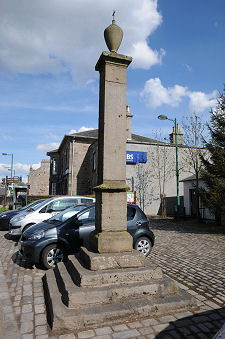
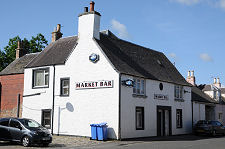
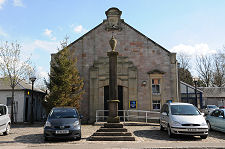
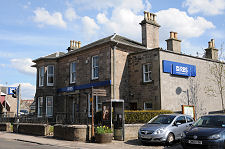
At the centre of Carnwath is Carnwath Cross, the mercat or market cross, set back a little where the Main Street widens to form the Market Square. This was erected by the 5th Lord Somerville in 1516, apparently to celebrate the granting of burgh status to the village in 1514: though other sources suggest that Carnwath became a burgh as early as 1451. The village acquired a mill and a school during the 1600s, though its principal period of growth came late in the 1700s after the main roads were turnpiked. One result was the establishment of a post office in 1786. Other facilities were also developing, including the Wee Bush Inn, which can be dated back to the 1750s. The Market Bar, near the cross, seems to be not much younger, while the Robertson Hotel is dated 1848.
A railway station serving Carnwath opened in 1848 on the main line between Edinburgh and Carstairs Junction. The line remains in use today, but the station closed in the 1960s. Another station opened in 1867 a mile south of Carnwath at Bankhead, on a line that meandered towards Edinburgh along the southern side of the Pentlands. Both the station and the line it stood on are long gone.
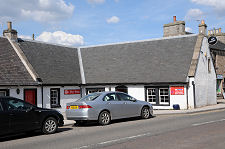
Carnwath is an unusual place with a distinctive and attractive character. The functional and largely undecorated one and two storey buildings lining Main Street combine with a (near) absence of modern shop frontages to give a strong sense of stepping back into another century, and not the one recently departed. It is fascinating to read a description written by a visitor in 1820: "Formerly a curious old-fashioned place, now a double line of neat stone cottages, roofed with slate." In some ways little seems to have changed since then, with the result that Carnwath is once more a curious old-fashioned place: and all the better for it.
 Carnwath Main Street from the West |
|
|
|
Visitor InformationView Location on MapWhat3Words Location: ///daisy.offline.compress |
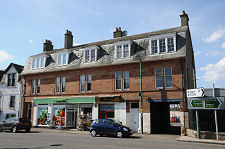 Co Op in Centre of Carnwath |
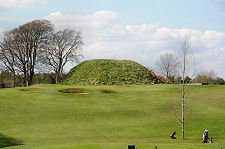 The Motte on the Golf Course |
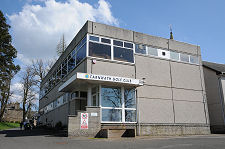 Carnwath Golf Club |
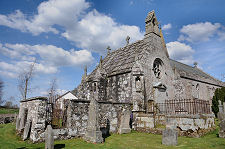 St Mary's Aisle |
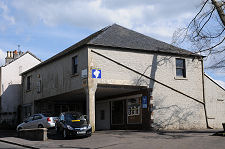 Garage |
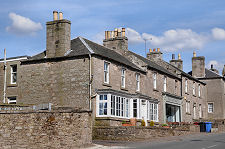 West End of Main Street |