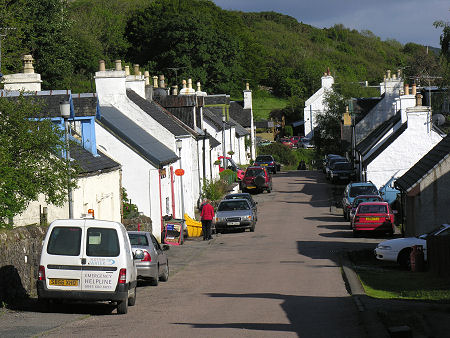
 Dervaig's Main Street, Looking South-East |
Mull is a wildly beautiful place. Accessible by ferry from Oban, Lochaline, or Kilchoan, there is plenty for visitors to see and do. Mull boasts attractive villages and mountains, and there are castles to visit for those wanting a more relaxing time. The island seems larger than it appears on a map, because of the limitations of the mostly single track road network: though many find this part of the attraction. And you will find the people you meet on Mull to be extremely welcoming and friendly. For accommodation on the islands see the links in the "See and Stay" menu above. See the map below for an outline of the area and links to surrounding areas.
The ferry from Oban arrives at Craignure and from here visitors have in the past been able to take the short trip on the Isle of Mull Railway to Torosay Castle and its excellent formal gardens. The castle was sold in 2011, however and may not now open as a visitor attraction: and the railway no longer operates. On the opposite side of Duart Bay from Torosay Castle is the imposing Duart Castle, which most visitors first see from the ferry en route to Mull. In Craignure you also find Torosay Church.
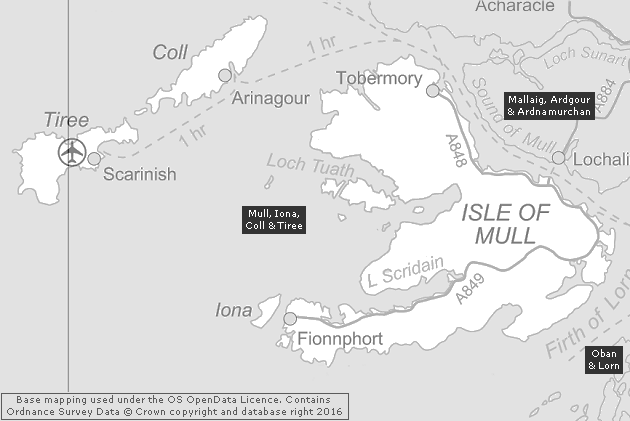 Mull, Iona, Coll & Tiree, Showing Main Settlements & Connecting Areas |
North of Craignure and after passing the remains of the ancient chapel at Pennygown, the twin track road runs out at Salen. A little north of Salen and dominating the shoreline is the imposing ruin of Aros Castle.
The largest settlement on Mull is Tobermory, originally founded as a fishing station. It lies on the east coast towards the northern end of the island. Today it is a favourite tourist halt, its many coloured buildings making for an attractive seaside picture. Attractions within and around the village include Tobermory Distillery, An Tobar Arts Centre, Mull Museum, and the Church of Our Lady, Star of the Sea. Tobermory is also where the ferry from Kilchoan lands. Until 2005 Tobermory was the location for the filming of the BBC children's series Balamory. This continues to bring significant numbers of additional visitors to the island and to Tobermory: making booking ahead of ferries and accommodation particularly important.
West of the main road from Craignure to Tobermory, northern Mull can be wild and remote, and the roads narrow and single track. A twisty drive from Tobermory leads to Dervaig, an attractive planned village that is also home to the very striking Kilmore Church. Further around the coast is the beach at Calgary, widely regarded as the best in Mull. South of here lies the scattered settlement of Kimninian, complete with a fascinating church.
This looks across Loch Tuath to the island of Ulva. Ulva is well worth visiting in its own right, and is home to a fascinating heritage centre and museum at Sheila's Cottage, and to Ulva Church.
Further south, and only two miles across a narrow isthmus from Salen, is the scattered settlement of Gruline. Here you find the Macquarie Mausoleum and St Columba's Church.
Mull's central and southern areas are more wild and mountainous than the north, being home to Ben More, the only Munro (individual mountain over 3,000ft) outwith the Scottish mainland or Skye. Individual settlements worth visiting include Croggan, Lochbuie, Pennyghael, Bunessan, complete with its parish church, and Fionnphort.
The island of Iona sits less than a mile off the south-west tip of Mull. It is reached via the Iona Ferry from Fionnphort. Iona has been a place of Christian worship for more than 1,400 years, since St Columba established a monastery here. Such religious significance makes Iona a place of international pilgrimage and tourism. Today its attractions include the beautifully restored Iona Abbey; the Iona Infirmary Museum with its remarkable collection of carved stones; Relig Odhráin & St Oran's Chapel, the ancient place of burial of Scottish kings; the Michael Chapel; the ruined Iona Nunnery; and Iona Parish Church.
Tiree is an island known for is sandy beaches, which when combined with its excellent record for sunshine make it an attractive spot for those wanting to get away from it all. Its generally low-lying landscape is interrupted only where it rises to a height of nearly five hundred feet at its very western end. Tiree's land area of 30 square miles supported a population of 4,450 at the time of the 1831 census: today the population is nearer 800.
Coll, north-east of Tiree and north-west of Mull has only about a quarter of Tiree's population on an island twelve miles by three. It, too, is known for its extensive beaches, and it also has a range of prehistoric relics including standing stones and a souterrain.
|
|
|
|
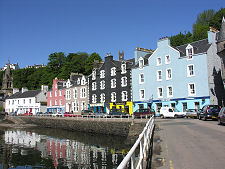 Tobermory |
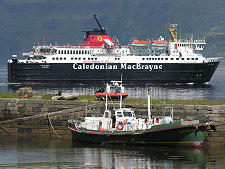 The Mull Ferry at Craignure |
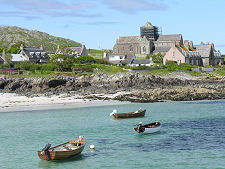 Iona |
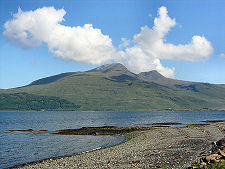 Ben More |
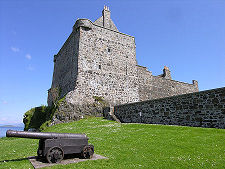 Duart Castle |
