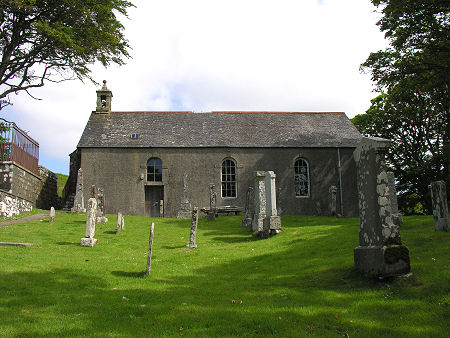
 Kilninian Church |
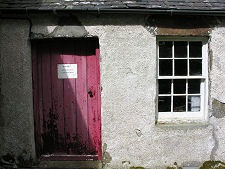
The scattered village of Kilninian stands on the west coast of Mull, looking out over Loch Tuath towards the island of Ulva. Kilninian Church was built in 1755 and at first sight is a simple grey harled box, with external stairs leading to a gallery at its west end.
The important phrase here is "at first sight", because there is rather more to Kilninian Church than initially meets the eye. The first point of interest is in the name. "Kilninian" ought to mean "the church of St Ninian", and the implication is that there might have been a church on this site since St Ninian's time in the early 400s. If so, then the story of the church at Kilninian may deate back even further than the story of the church established by St Columba on Iona.
Speculation about very early origins for a church here find some support in the presence, not far from the church, of Tobar Ninian or "St Ninian's Well". Sacred wells often became centres of early Christian worship and the fact that one exists here and is named after St Ninian adds weight to the theory.
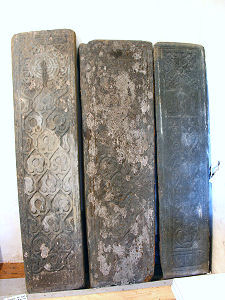
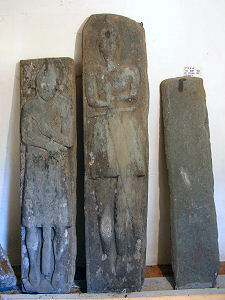
Moving swiftly on, it is certain that there was a church on or near the site occupied by the current church at least as far back as medieval times. The evidence is on show in the vestry at the rear of the church. Here you find six superb carved grave slabs on show, some with geometrically carved patterns, others carrying the effigies of knights.
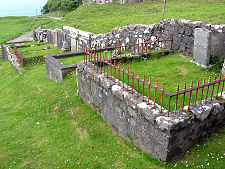
As elsewhere (including on Iona) you can't help wishing that there was a little more information available about precisely where these slabs came from in - presumably - the surrounding graveyard. Nor can you avoid a slight pang of regret that although their presence here preserves these slabs for future generations, the graves they once covered are left unmarked.
The grave slabs on show in the vestry date back to between 1300 and 1500 and come from what is called the Iona school of carving: perhaps not surprising given the proximity of the highly developed stonemasonry skills on Iona at this time.
If the list of suppositions and theories set out above is not enough to raise your interest in this intriguing church, and it should be, there is one more surprise in store for visitors. Internally the church does not carry the usual fixtures, fittings and trappings of a Church of Scotland parish church, which is what you automatically expect it to be. This is because since 2010 the church has belonged to the Romanian Church of Scotland, and it is now known as the Orthodox Monastery of Saints Ninian and Cuthbert. The photographs on this page predate this change of ownership, so may in some respects be out of date.
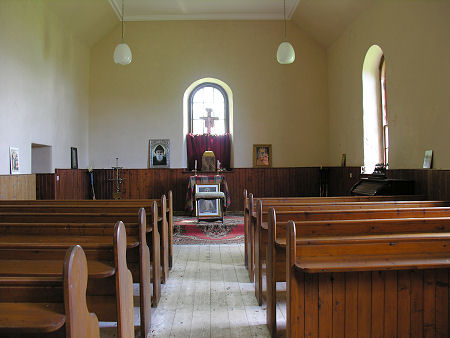 The Interior of Kilninian Church |
|
|
|
Visitor InformationView Location on MapGrid Ref: NM 387 457 What3Words Location: ///outline.strongly.yelled |
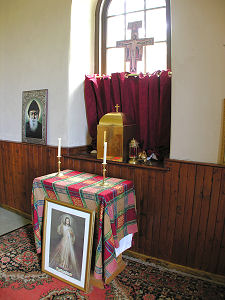 The East End of the Church |
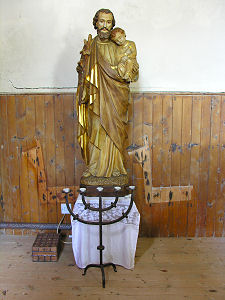 Statue - In Place of Old Pews |