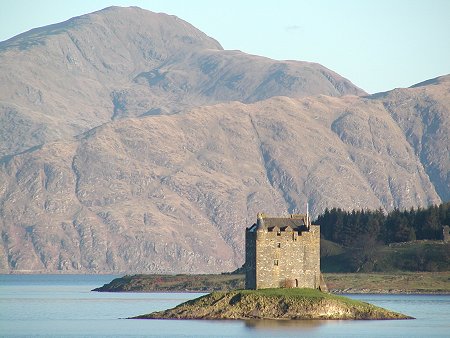
 Castle Stalker with the Mountains of Morvern Beyond |
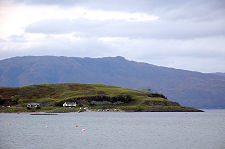
Port Appin lies on the coast of Appin, just north of Loch Creran as it meets the sea. It looks directly across the strip of water called the Lynn of Lorn to the northern tip of the island of Lismore, and across Loch Linnhe to the coast of Morvern beyond.
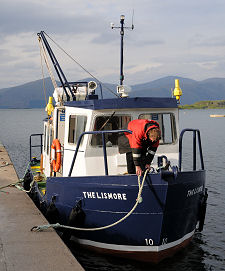
This is one reason why Port Appin can be a busy place at popular times of the year. The shortest and cheapest ferry crossing to Lismore runs from the jetty here. The Lismore is a passenger-only ferry running linking Port Appin with Lismore. There is also a small car ferry linking Lismore to Oban. This allows you more flexibility on the island, and your own transport, but at a higher price and with a lower frequency of service.
The first signs of development in Port Appin were on a 1750 map that showed a substantial house here, and also recorded a ferry route to Lismore. Another ferry ran from nearby North Shian across Loch Creran to South Shian on the Benderloch peninsula.
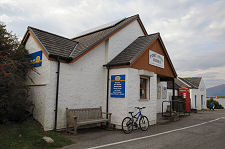
By 1850, Port Appin was being visited by steamers en route from Inverness to Glasgow via the Caledonian and Crinan Canals. More recent years have seen a range of developments. The Pierhouse Hotel and Seafood Restaurant was once the original residence of the pier master who was responsible for overseeing cargo and passengers onto the 19th century steamers: it is renowned for its seafood and its wonderfully comfortable accommodation. Both hotels take full advantage of the breathtaking scenery. In the early 1990s the village shop in Port Appin was taken over by a local co-operative and today the Port Appin Stores is also home to a busy Post Office.
Until not all that long ago Port Appin was also the terminus of a private ferry that ran across Loch Linnhe to Glensanda on the Morvern coast. This allowed local people to work in the Glensanda superquarry on the remote far shore of Loch Linnhe. Glensanda involves the quarrying of an entire granite mountain, Meall na Easaiche, before transporting the pulverised granite along a mile of conveyor belts in tunnels to a jetty, where it is loaded directly into bulk carriers.
Glensanda started operation in 1986 to provide lining material for the English half of the Channel Tunnel. At its height two ships a day sailed from here, and they even laid out a small airstrip on the coast. Today Glensanda continues to provide high quality granite to various destinations in Europe and beyond. The quarry still employs some 160 people, but the mainland terminus for the ferry serving it has been moved along the coast from Port Appin. On balance this seems good news for the village, which no longer has to accommodate quarry workers' cars.
As you turn off the main A828 towards Port Appin your attention is immediately caught by Castle Stalker, set on its own very small islet in Loch Laich. Castle Stalker was built in about 1495 by Duncan Stewart of Appin who was granted lands in the area by James IV for his support in destroying the power of the Lords of the Isles (see our Historical Timeline). The castle was taken by the Campbells in 1620, before being recaptured by the Stewarts after a siege in 1685. It was abandoned in the late 1700s and roofless by 1830. What you see today is the result of restoration since the 1960s.
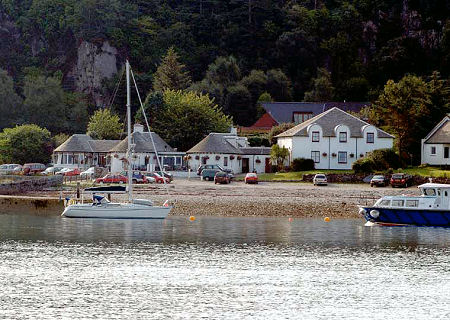 The Pierhouse Hotel from the Sea (Image Courtesy Pierhouse Hotel) |
|
|
|
Visitor InformationView Location on MapWhat3Words Location: ///desiring.tour.glossed |
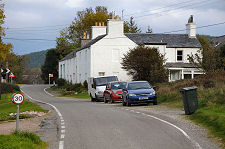 Approaching Port Appin |
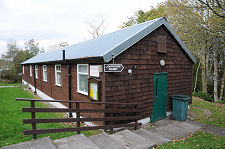 Village Hall |
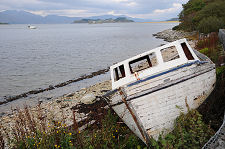 Loch Linnhe |
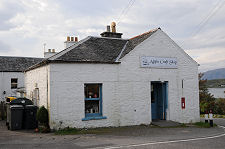 Appin Craft Shop |