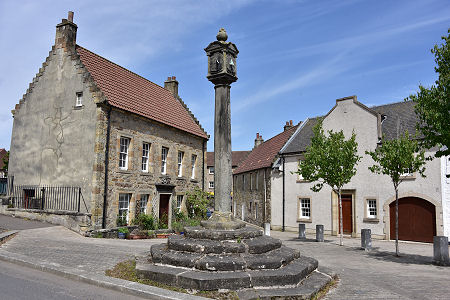
 High Street and the Mercat Cross |
The village of Airth lies on the old road that parallels the south bank of the River Forth from Stirling to Grangemouth. Another way of locating it is to say it is a mile north of the junction with the access roads to the Kincardine and Clackmannanshire Bridges over the river.
The story of the village revolves around its location at the foot of a ridge of high ground: as does its name, which means "level green place". The first settlement in the area was probably more dispersed than the one that developed later, partly on the high ground around Airth Castle, at the south end of today's village; partly on high ground around Airth Tower, over a mile north of today's village; and partly along the now deserted south-west shore of the River Forth, half a mile north-east of today's village.
Airth Tower, also called Elphinstone Castle or Elphinstone Tower, was a four storey tower house built for the Elphinstone family in 1508. The settlement around it, called Elphinstone, was cleared away when stately Dunmore Park was built here in the early 1820s. Both Elphinstone Tower and Dunmore Park are now ruinous, the park being best known for the Pineapple, a garden pavilion with a remarkable pineapple-shaped roof. (Continues below image...)
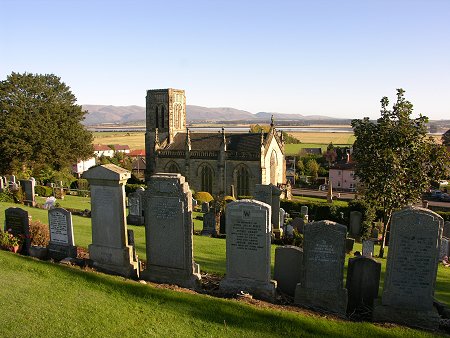 Airth Parish Church & Village with the River Forth in the Background |
Airth Castle started life earlier than Airth Tower. It too, has fallen on hard times. Until March 2023 it operated as the focal point of an upmarket hotel and wedding venue. Then the company running the hotel went into liquidation and the buildings themselves went into decline. A visit in May 2025 found them to be in a very poor state, boarded up with visible windows broken and interiors wrecked. The castle itself has two very distinctive faces. From the south it appears to be a traditional L-plan tower house, while from the north all you see is the castellated manor house built at an angle to fill the arms of the "L" in the early 1800s.
Airth Castle's origins date back to a simple defensive tower built here by Fergus de Erth (Airth) in the years before 1300. This is now called Wallace's tower, commemorating a raid on the castle, then in English hands, by William Wallace, to rescue an uncle of his held prisoner here. By 1488 the castle was a possession of the Bruce family and was attacked by James III because of the Bruces' support for the claim to the throne by James IV. The second wing forming the "L" was added in 1581.
During the 1400s a naval shipyard was established on the shore of the River Forth at Airth, and trading activities followed, especially after the opening of a nearby coal mine in the 1600s. There are also records of wind-powered sawmills processing local timber for export during this period. But the changing flows of the River Forth led to the silting up of the south-west shore here. As a result the village's role as a port waned in the 1700s, though not before a number of residents had made their fortunes from trade.
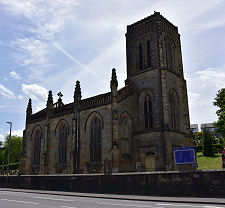
Immediately to the east of Airth Castle are the ruins of the Old Parish Church. Parts of this date back to the 1100s, though most of it was built in the 1650s. It was abandoned in 1820 when Airth's current Parish Church opened its doors.
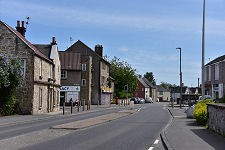
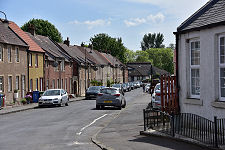
At first glance, Airth seems to owe more to 1900s housing development than to any part of its earlier history. But it retains some remarkably attractive elements if you care to look. This is especially true in the High Street, which lies a little on the uphill side of the later Main Street which now carries through traffic. The highlight is the mercat cross, erected in 1697 to replace an older one still in place near Airth Castle. This is 17ft high, including the stepped octagonal stone base.
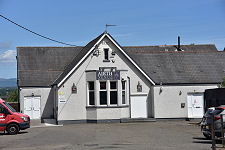
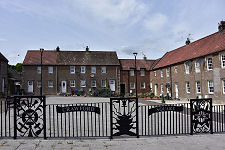
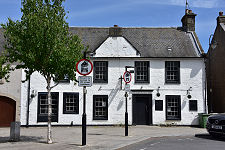
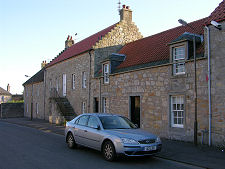
Until 2024 the High Street was home to the Elphinstone Inn, dating back to the 1800s. When we last visited, in May 2025, it was due to be converted into three flats. A number of other buildings in this part of Airth, including "The Captain's House" date back to the early 1700s. Other houses of a similar age can be found on Shore Street, which once led to the harbour.
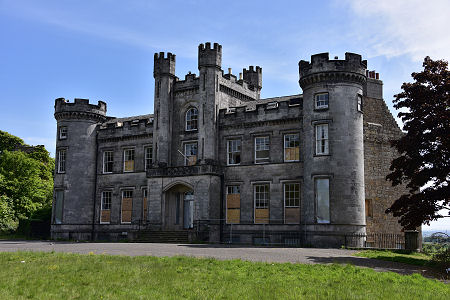 Airth Castle in May 2025 |
|
|
|
Visitor InformationView Location on MapWhat3Words Location: ///guitars.structure.tall |
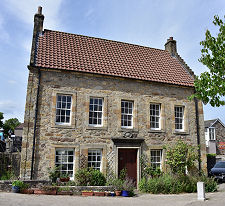 The Captain's House |
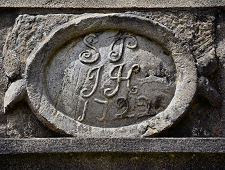 1722 Inscription Above Door |
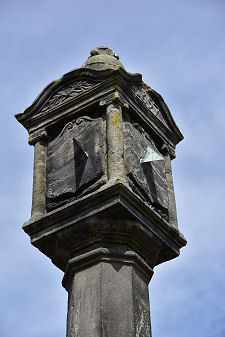 The Head of the Mercat Cross |
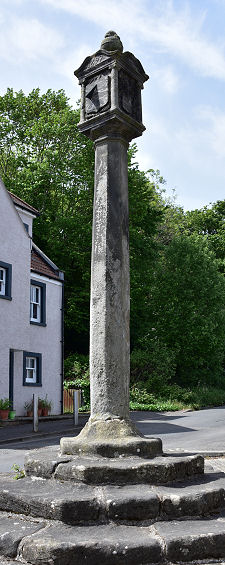 The Mercat Cross |
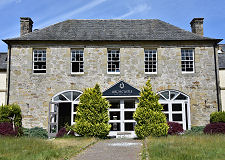 Airth Castle Reception, May 2025 |
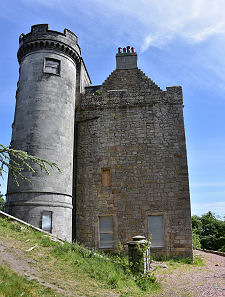 West End of Airth Castle, May 2025 |