 Argyll's Lodging |
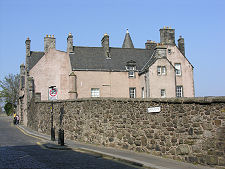
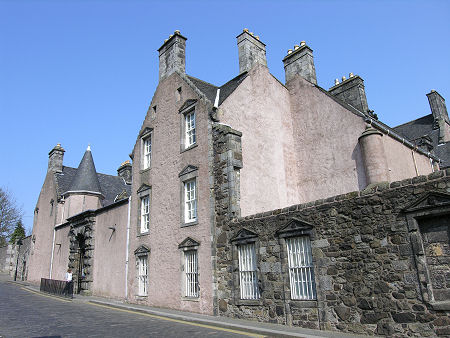
Argyll's Lodging is the most complete surviving example of a seventeenth century town house in Scotland. It can be found in the upper part of Stirling, just below Stirling Castle's Esplanade. The house sits behind a screen wall and comprises a collection of buildings built in two phases and in three ranges around an enclosed courtyard.
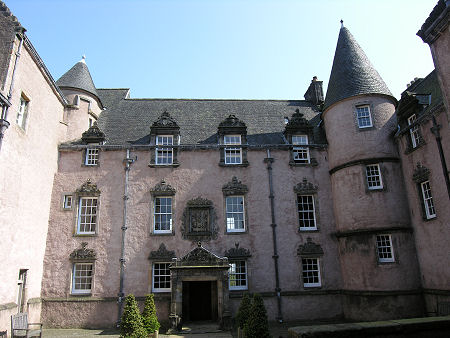
Conversion and extension of an existing sixteenth century tower house began in the 1630s for Sir William Alexander, 1st Earl of Stirling, who had previously resided at Menstrie Castle. Further enlargement was undertaken in the 1670s for the 9th Earl of Argyll. Argyll's Lodging shows considerable French influence. The turrets sited at each corner of the house overlooking the courtyard have conical roofs typical of French provincial townhouses.
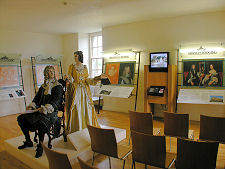
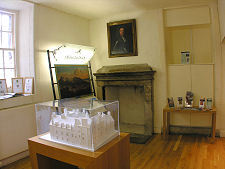
Visitors enter the complex through an archway from the road into the courtyard. This is much as it would have been in the 1670s. A grand doorway marks the entrance to the most important reception room of the house. The entrance today is through the Historic Environment Scotland reception and shop to the right of the front arch. Beyond the reception are static and multimedia displays on the history of the house. On your visit you may also encounter actors helping bring the past to life as they recount the story of the building and its residents.
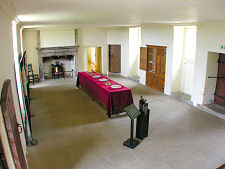
In the 1630s the Laigh Hall, or lower dining room, was one of two main reception rooms used by the Earl of Stirling. By the 1670s, when the Earl of Argyll was in residence, this probably also served as a dining room for his senior attendants. The High Dining Room on the first floor was the most important room in the house. The fireplace and buffet recess date from the early half of the century, and the fine wall decoration was added in the latter half of the Century.
From the early 1800s onwards the house served many uses, first as a military hospital and more recently as a youth hostel. Despite this, part of the painted wall work survived. Removal of a false wall during renovation revealed the original decoration. Painters were commissioned to recreate the pattern around the rest of the room and the result is magnificent.
The State Apartments have been painstakingly recreated and offer a fascinating insight into the lives of the people who lived here. During the occupation of Lord and Lady Argyll in the late 1600s, the apartments comprised three rooms: an outer chamber or drawing room, the couple's bed chamber and Lady Argyll's closet.
In the drawing room there is a grand fireplace dating from the 1630s and with traces of the family arms of the Earl of Stirling still apparent. The walls are hung with fine tapestries and the recreated furnishings are lavish.
The bedchamber, with original 17th Century en-suite, the stool closet, has an intimate feel. A large four-poster bed dominates the largely purple room and there is more fine recreated furniture. The walls are hung with drapes. This opulence was not just for personal pleasure; the Lord and Lady would also entertain in this room.
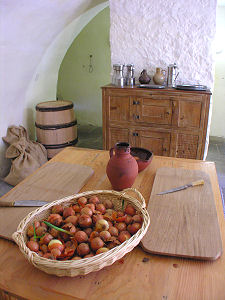
The earliest surviving parts of Argyll's Lodging dates from the 1500s and include a kitchen and two small vaulted rooms at the east end of the range. These were part of the first house on the site, though larger kitchens were later added at the west end as the property was extended. It is possible to explore the later kitchen wing complete with storerooms, food being prepared, and pies being made.
There were once extensive formal gardens behind the property. The 9th Earl of Argyll was a keen gardener and it is likely that they were laid out for his enjoyment. Today it is possible to wander round the reduced area of lawns after exiting the rear door in the Laigh Hall.
 Argyll's Lodging |
|
|
|
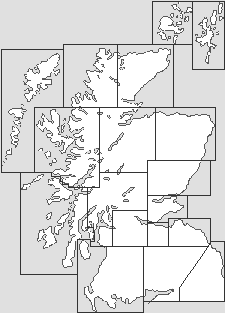
Visitor InformationView Location on Map4 Star Historic House. Tel: 01786 450000. Post Code: FK8 1EG Grid Ref: NS 772 938 www.historicenvironment.scot HES: Lodging Web Page What3Words Location: ///bump.neat.seat |
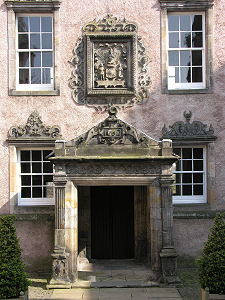 Main Door |
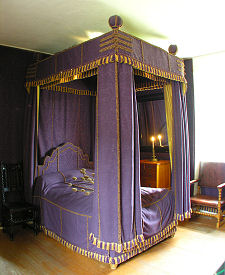 Bed Chamber |
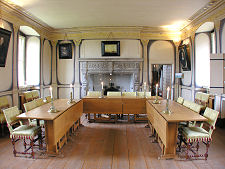 The High Dining Room |
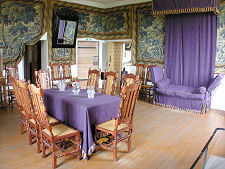 State Drawing Room |